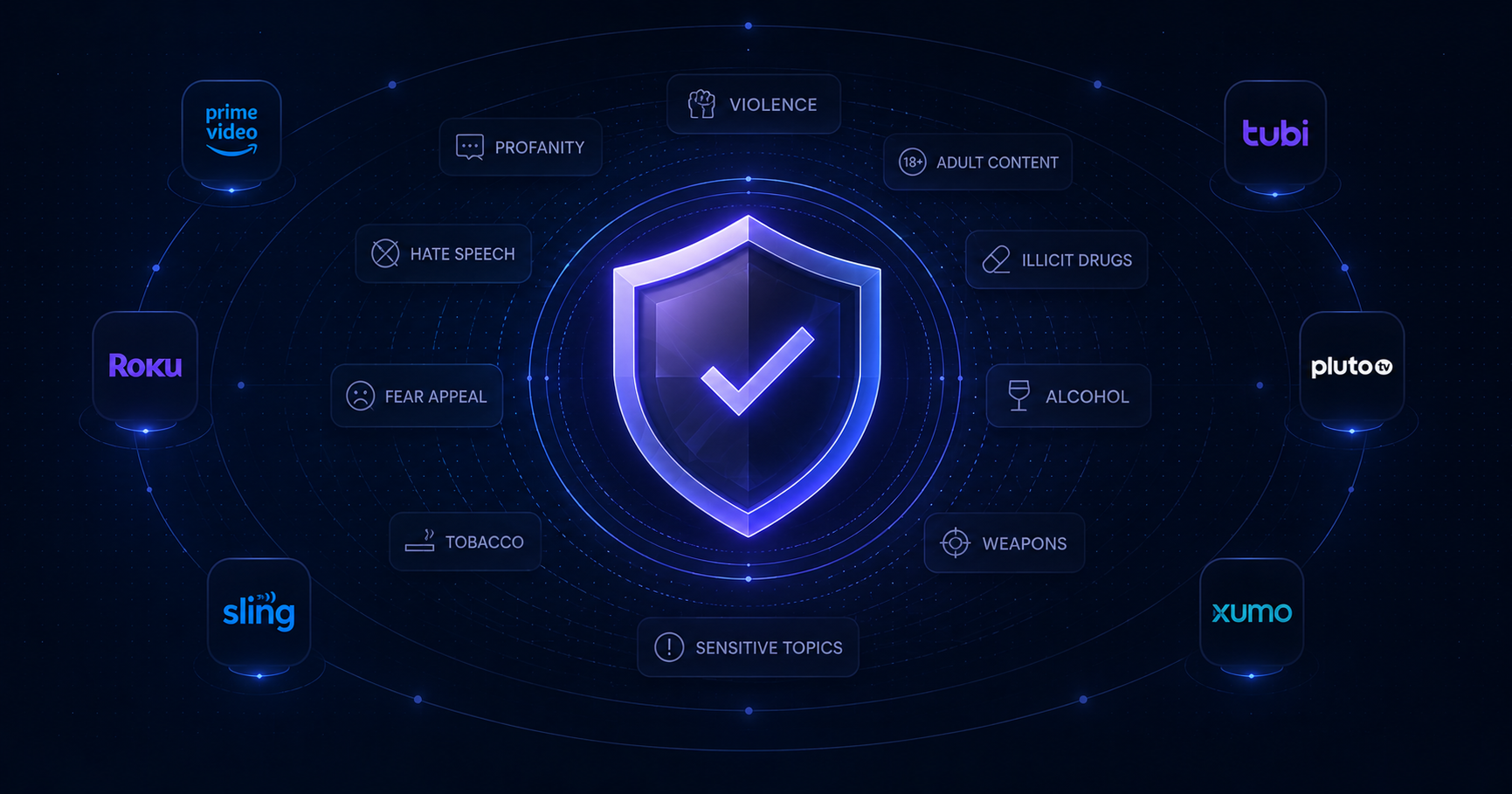
Brand safety in CTV is structurally different from brand safety on the open web. There are no browser cookies to intercept, no JavaScript injections mid-render, and the inventory ecosystem skews toward curated app environments rather than the long tail of web publishers. But CTV has its own brand safety failure modes: misrepresented app bundles, inaccurate content metadata, category mismatch in programmatic bid requests, and ad adjacency violations that damage advertiser perception even when the creative renders correctly. This guide explains how CTV brand safety works mechanically, what controls are available to buyers and sellers, and how the LtvAdx advertiser platform implements them.
Why CTV brand safety differs from web
The web brand safety problem is primarily one of content adjacency at scale: billions of pages, automated ad serving, and adversarial inventory misrepresentation. CTV operates in a smaller, more curated universe: hundreds of app publishers rather than millions of websites, with app distribution controlled by platform gatekeepers like Roku, Amazon, and Apple. This gatekeeping raises the baseline quality floor significantly. A Roku channel must pass platform review before distribution; a website does not.
The residual CTV brand safety risk concentrates in three areas. First, content metadata accuracy: an app bundle self-declaring as a home improvement channel while running news content misleads buyers who are category-targeting. Second, ad pod adjacency: a brand may appear in the same break as a competitor or in a context that conflicts with its brand guidelines even on a reputable publisher. Third, programmatic supply chain transparency: when multiple SSPs and resellers represent the same CTV inventory, buyers cannot always verify the true supply source without sellers.json and ads.txt enforcement.
IAB content category taxonomy in CTV bid requests
The IAB Content Taxonomy — versions 2.x and 3.x — is the primary mechanism buyers use to block content categories in programmatic CTV. Publishers declare content categories in the content.cat field of the OpenRTB bid request. Buyers configure IAB category block lists in their DSP line items. When a bid request carries a blocked category, the DSP does not bid. The system works correctly when publishers declare categories accurately and completely.
The failure mode is under-declaration or inaccurate declaration. A publisher running true crime content that categorizes their app as general entertainment avoids category blocks that advertisers with brand safety concerns would correctly apply. LtvAdx enforces content category accuracy through publisher onboarding review, periodic content audits, and buyer-side reporting that surfaces category-to-impression mismatch signals. Publishers with persistent category mismatch rates above threshold are flagged for review.
Competitive separation and category exclusions
Competitive separation — preventing two competing brands from appearing in the same ad pod — is a contractual requirement in most direct-sold CTV campaigns and a best-practice setting in programmatic. The LtvAdx ad server enforces competitive separation at the pod resolution layer: slot one's winner is known before slot two auctions, and the auction logic blocks advertisers whose domain or IAB category conflicts with the slot one winner from bidding into slot two of the same pod.
Beyond competitive separation, category exclusions let buyers block entire IAB categories from their campaign. A financial services advertiser may exclude political content, gambling adjacent content, and sensationalist news. A children's brand will exclude all non-kids content categories and typically require kids-safe publisher whitelisting rather than relying on category blocking alone. Configure category exclusions at the campaign level in the advertiser portal and audit them quarterly as taxonomy versions update.
Allowlists and blocklists in programmatic CTV
App-level allowlists are the most conservative brand safety control available in CTV programmatic. Rather than blocking categories and relying on publisher metadata accuracy, an allowlist approach restricts buying to a pre-approved set of app bundles. This sacrifices scale — the approved list is always a subset of available inventory — for certainty. Premium brand campaigns with low risk tolerance typically run allowlist strategies during flight and broaden after post-campaign brand safety audits confirm clean adjacency.
Blocklists are the inverse: exclude specific app bundles or publisher IDs from campaign reach. Blocklists are useful for suppressing known problematic apps but provide weaker protection than allowlists because new problematic inventory enters the ecosystem continuously. Best practice is to run both: a robust blocklist as a baseline and an allowlist for high-sensitivity flights. The LtvAdx advertiser campaign manager supports both at the deal, campaign, and line item levels.
Third-party brand safety verification in CTV
Third-party verification vendors — IAS, DoubleVerify, Oracle Moat — have extended their measurement products into CTV with varying degrees of coverage depending on the delivery path. Server-side ad insertion creates a measurement challenge for client-side JavaScript tags: when the ad is stitched into the manifest before it reaches the player, there is no browser environment for a traditional verification pixel to execute. CTV verification relies on VAST tracking events fired by the player or SSAI stitcher rather than JavaScript-based signals.
VAST 4.2 introduced verification node support that enables third-party vendor measurement in a player-executed, server-free model. Publishers running VAST 4.2 through the LtvAdx SSAI engine can include verification nodes in their VAST responses, enabling IAS and DoubleVerify impression-level brand safety signals to reach buyers without JavaScript dependency. Advertisers requiring third-party verification should confirm with their DSP and publisher that VAST 4.2 with verification node support is in use before launching.
Kids content and COPPA compliance
Children's programming on CTV carries COPPA obligations that restrict the behavioral targeting and data collection techniques permissible on other inventory. Ads served on kids apps or in kids content classifications cannot use behavioral targeting, cannot deploy persistent identifiers, and must be contextually relevant to the content rather than audience-targeted. Advertisers appearing in kids content must comply with FTC advertising guidelines for children in addition to general brand safety requirements.
The LtvAdx platform enforces kids mode at the publisher configuration level: apps and channels classified as kids content run in a restricted mode that disables behavioral targeting, suppresses HouseholdID activation, and restricts eligible advertiser categories. Publishers misclassifying adult content as kids content or running mixed-classification apps in kids mode are subject to removal. Buyers should treat kids content classification as a whitelist criterion rather than a category to target programmatically.
Supply chain transparency: ads.txt and sellers.json
Programmatic supply chain fraud in CTV primarily manifests as domain spoofing — misrepresenting which app is serving the impression in the bid request. IAB app-ads.txt (the CTV equivalent of ads.txt) and sellers.json provide the authorized seller declarations that allow buyers to verify they are buying from legitimate inventory sources.
All publishers running on LtvAdx are required to maintain current app-ads.txt files in their app store listings declaring LtvAdx as an authorized seller with the correct seller account ID. LtvAdx's sellers.json lists every publisher it has approved as a programmatic seller. DSPs that enforce app-ads.txt compliance — which all major buyers do — will reject bid requests from publishers whose app-ads.txt does not include the selling SSP. Publishers new to the platform should complete this setup within the first 48 hours of integration using the getting started guide. If you have questions about how LtvAdx implements supply chain controls, contact the publisher success team or book a walkthrough.