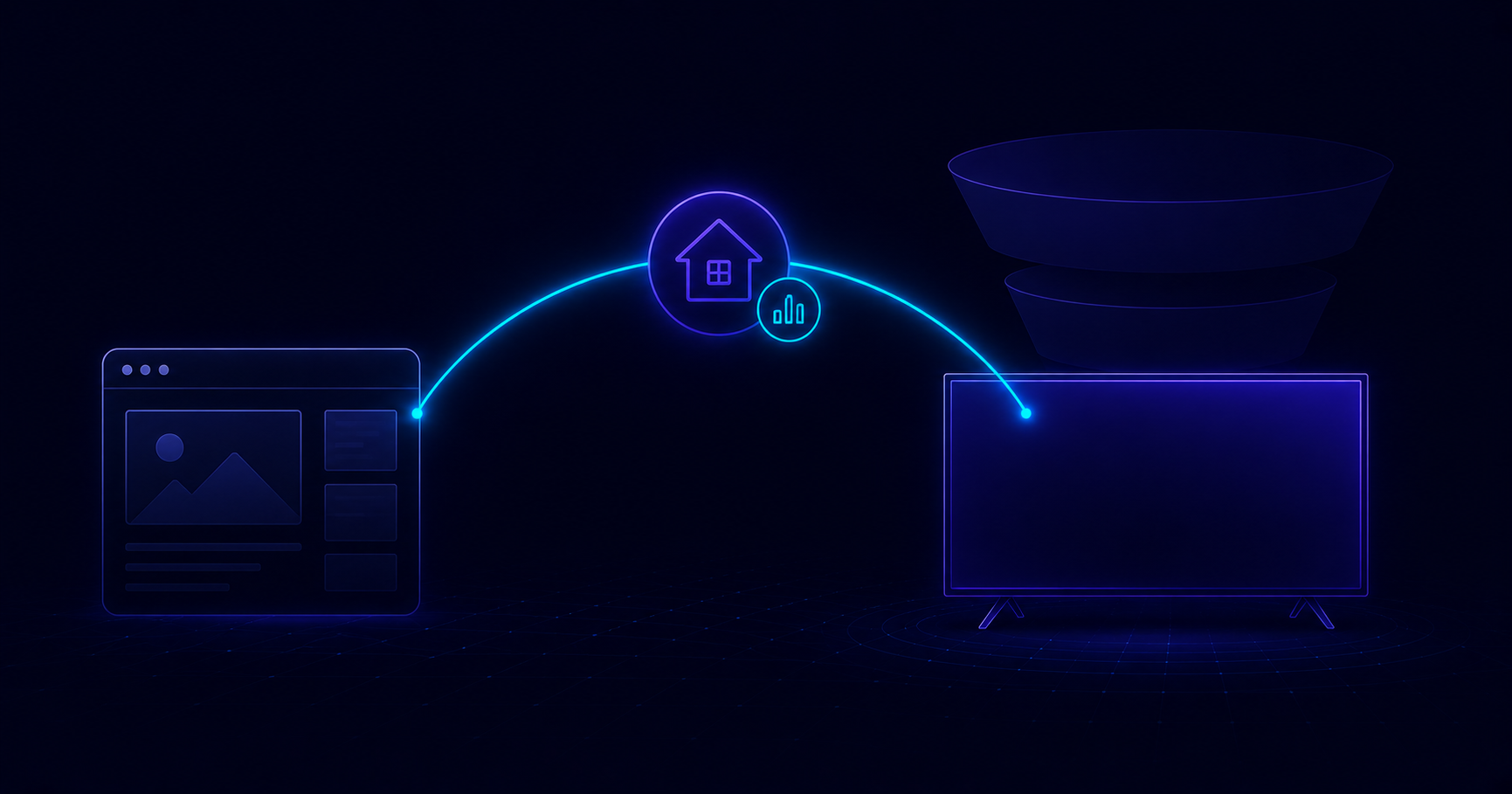
CTV retargeting is the practice of serving streaming TV ads to households that have previously engaged with an advertiser's brand — visited the website, abandoned a shopping cart, watched a product video, or downloaded an app — with creative messaging calibrated to where they are in the purchase funnel. The concept is familiar from digital display and search: someone visits a product page and sees banner ads for that product across the web for the next two weeks. CTV retargeting delivers the same strategic intent — staying present with warm audiences — but on the largest screen in the household, in a non-skippable television environment, with the completion rates and attention quality that no digital retargeting format can match. This guide covers how CTV retargeting is built technically, which retargeting strategies drive the best outcomes, how to configure frequency and creative sequencing for retargeting campaigns, and how to measure whether retargeted households are actually converting at higher rates than cold audiences through the LtvAdx advertiser platform.
How CTV retargeting works technically
CTV retargeting requires a bridge between the web or app behavior that identifies the warm audience and the CTV device in the household where the retargeting ad will be served. Unlike web retargeting — which drops a cookie in the browser that follows the user across websites — CTV retargeting relies on the household IP address as the connection between web behavior and streaming device. When a visitor arrives at an advertiser's website from a residential IP address, the IP is logged with a timestamp and optionally hashed against a customer identifier if the visitor is authenticated. That IP is then matched against CTV bid requests that originate from the same IP, connecting the web behavior to the household's streaming devices.
IP-based household bridge is the most widely deployed CTV retargeting mechanism and works well for the majority of residential fixed broadband connections. Its limitations are the same as for all IP-based identity: mobile broadband connections produce less accurate household matching, dynamic IP assignment means the IP-behavior association can become stale over days or weeks, and shared IP environments (apartment buildings, offices) produce false matches. For retargeting campaigns targeting recent high-intent behavior — cart abandonment within the last 24 hours, a specific product page visit yesterday — use a short IP recency window (24–72 hours) to maximize the signal freshness. For longer-cycle consideration retargeting — a household that researched a product category two weeks ago — extend the lookback window to capture longer purchase cycles while accepting some match rate degradation.
First-party authenticated identity produces higher-quality CTV retargeting match. When a website visitor is logged into an account associated with an email address, the hashed email can be matched against the LtvAdx HouseholdID graph with higher accuracy than IP-only matching. Email-to-household match rates for CTV retargeting typically run 45–65% for consumer brands with large authenticated user bases. This authenticated path is the basis for the highest-performing CTV retargeting campaigns because the household identity is deterministic rather than probabilistic.
Building CTV retargeting audiences
CTV retargeting audience construction mirrors web retargeting segmentation logic with adaptations for the household identity model. Website visitor retargeting captures all IP addresses that visited the advertiser's domain within a defined recency window and matches them to CTV household devices. Product page visitor retargeting narrows this to visitors of specific product or category pages — higher intent than site-level visitors and more relevant for product-specific creative sequencing. Cart abandoner retargeting is the highest-intent segment: households where a session included adding to cart without completing checkout are among the warmest retargeting audiences available and are worth a premium CPM bid in CTV auctions.
Customer suppression — excluding existing customers from retargeting campaigns — is a critical configuration step that reduces waste and prevents the brand perception damage of advertising a new customer offer to someone who just purchased at full price. Upload your customer list as a suppression segment in the advertiser platform before campaign launch. For subscription and SaaS businesses, active subscriber suppression is equally important — retargeting your own paying customers with acquisition messaging is a meaningful cost and potential churn signal.
Cross-platform retargeting extends the audience definition beyond website behavior. App users who have not engaged with the app in 30+ days are a strong retargeting segment for re-engagement campaigns. Email subscribers who have not opened a campaign in 90 days are a reachable CTV segment through email-hash matching. CRM customers in a specific lifecycle stage — post-trial non-converters, churned subscribers, high-value customers approaching renewal — can each be activated as distinct CTV retargeting segments with creative and offers specific to their funnel position.
Creative sequencing in CTV retargeting
The most powerful CTV retargeting approach is creative sequencing: serving different creative variants to the same household at different points in the retargeting window, based on their engagement history and frequency of exposure. A household that visited a product page three days ago and has seen one CTV ad from the campaign should receive a different message than a household that visited six weeks ago, saw four CTV ads, and has not converted. Sequencing treats retargeting as a conversation rather than a repeated broadcast.
A practical sequencing framework for CTV retargeting: impression 1–2 (within the first week of the retargeting window) serves a reminder creative that reconnects the household to the product or brand they showed interest in — "You were looking at [product category]. Here's what makes [brand] different." Impressions 3–4 serve a proof or social validation creative — customer results, awards, ratings — that addresses purchase hesitation with third-party validation. Impressions 5–6 serve a conversion incentive — a specific offer, a trial extension, a deadline-based discount — that creates urgency for households that have been exposed multiple times without converting.
This sequencing requires household-level frequency tracking across creative variants — the system needs to know which specific creative a household has seen and at what frequency point they are in the sequence. The LtvAdx frequency capping system supports creative-level frequency tracking within the household identity framework, enabling the sequencing logic described above without requiring a third-party creative sequencing platform.
Frequency management for retargeting campaigns
Retargeting frequency management in CTV requires tighter controls than prospecting campaigns because warm audiences are smaller and easier to overexpose. A site visitor retargeting pool of 200,000 households with a daily cap of 50,000 impressions has a mathematical overexposure problem if the cap is applied uniformly — the same households will be served the majority of impressions because programmatic demand concentrates on the highest-bid impressions within the audience segment.
Set household-level daily caps of 1–2 impressions and weekly caps of 3–5 impressions for retargeting campaigns. These caps force impression distribution across the audience pool rather than concentrating on the most frequently available households. A 30-day retargeting campaign targeting 200,000 households with a weekly cap of 4 household impressions has a maximum ceiling of 3.2 million impressions over the flight — a reasonable scale that provides multiple exposures per household without overexposure.
The distinction between retargeting frequency caps and prospecting frequency caps is important. Prospecting caps are designed to limit exposure of cold audiences to prevent fatigue before sufficient brand building has occurred. Retargeting caps are designed to maintain consistent presence with warm audiences during their consideration window without burning out the audience on repetitive messaging. The appropriate retargeting cap depends on the consideration cycle length: high-frequency retargeting (daily impressions) makes sense for 3–7 day consideration cycles like event tickets; lower frequency (2–3x per week) is right for 30–90 day cycles like automotive or home improvement.
Incrementality: does CTV retargeting actually work?
CTV retargeting faces the same incrementality challenge as all retargeting advertising: warm audiences have already expressed intent and are more likely to convert regardless of advertising. The question incrementality testing answers is whether the CTV retargeting ads caused the conversion, or whether the household would have converted anyway. Without this test, retargeting campaigns routinely claim credit for conversions that would have occurred organically, overstating ROI and leading to over-investment in retargeting relative to prospecting.
Run a holdout test: take the retargeting audience pool and randomly assign 20% to a holdout group that receives no CTV retargeting ads during the campaign period (or receives a neutral PSA creative). Compare conversion rates between exposed and holdout households within the same audience pool over the same time window. The difference in conversion rate — the incremental lift — is the actual advertising effect. If the exposed group converts at 3.2% and the holdout at 2.8%, the incremental lift is 0.4 percentage points, representing 14% incremental conversions from advertising. Every conversion claim above that baseline is attribution to natural intent rather than advertising effect.
The CTV attribution guide covers holdout group test design in detail. The LtvAdx partner API supports holdout group configuration at the line item level for retargeting campaigns. Incrementality results should be used to calibrate the retargeting budget allocation in the next campaign cycle — if retargeting incrementality is low, reallocate toward prospecting where incremental reach is higher.
CTV retargeting for specific funnel stages
Different retargeting audiences require different CTV campaign configurations. Trial-to-paid conversion retargeting — targeting free trial users who have not converted to a paid subscription — requires email-hash audience matching, a creative that communicates the cost of missing what comes after trial, and a hard deadline (trial expiry) that creates natural urgency. This campaign type typically runs 7–14 days, 3–5 household impressions maximum, with a conversion offer at frequency 3+.
Abandoned cart retargeting on CTV targets high-intent shoppers who got within one click of purchase. CTV serves this better than web retargeting for high-ticket items (furniture, appliances, automotive) where the purchase decision involves the full household and the CTV context reinforces the aspirational framing of a significant purchase. Creative for abandoned cart CTV should be product-specific if possible — using dynamic creative optimization (DCO) to serve an ad featuring the specific product the household added to cart is the highest-performing configuration.
Lapsed customer win-back retargeting uses a longer lookback window (90–180 days since last purchase or engagement) and focuses on what has changed or improved since the customer lapsed. The creative brief centers on product updates, new features, or renewed value proposition rather than a simple reacquisition offer. CTV win-back campaigns for subscription products benefit from the premium television environment communicating brand substance — reinforcing that the product is worth returning to — in ways that a push notification or email retargeting cannot.
For a complete retargeting campaign setup from audience construction through measurement, the programmatic TV buying checklist includes the retargeting-specific configuration steps alongside the standard campaign setup workflow. To discuss retargeting audience activation or creative sequencing configuration for your specific use case, contact the advertiser team or request a platform demonstration.