CTV measurement has matured faster in the past two years than in the preceding five. The combination of VAST event beacons, household identity graphs, and deterministic outcome matching has given advertisers tools for attribution that are genuinely rigorous — not approximations borrowed from digital. Understanding which measurement approaches apply to which campaign objectives, and how to implement them correctly, separates brands getting accountability from CTV spend from those still reporting on completion rate alone. This guide covers the measurement stack for CTV campaigns running through LtvAdx, from delivery verification through outcome attribution.
The CTV measurement stack: four layers
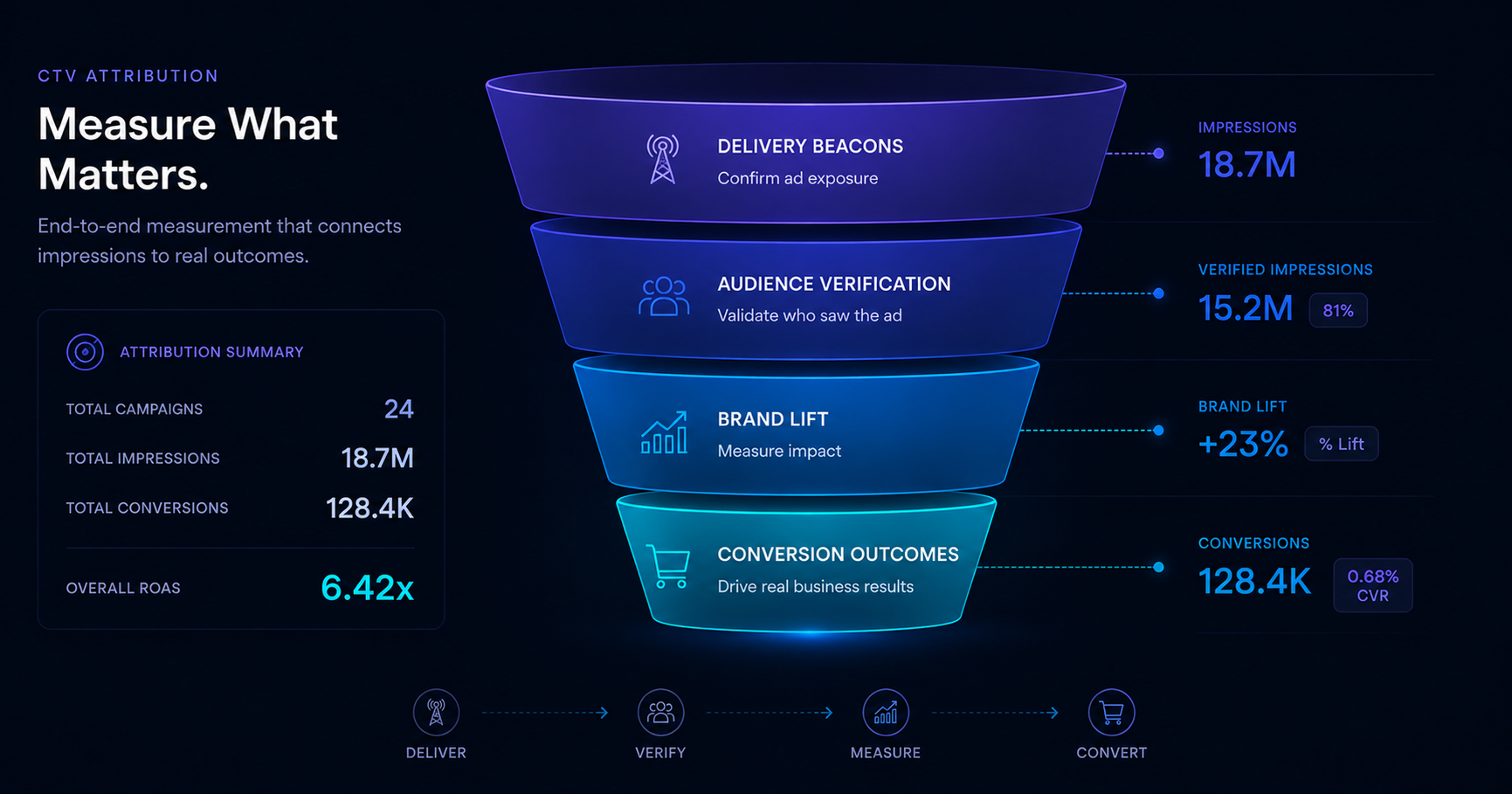
CTV campaign measurement operates across four distinct layers. Delivery measurement confirms that an ad was served to a device. Viewability measurement confirms that the ad was visible on a connected screen (as opposed to served to an app running in background). Audience verification confirms that the served impression reached the intended household segment. Outcome attribution connects served impressions to downstream consumer behavior — site visits, search lift, store visits, or purchases.
Most campaigns measure only the first layer (delivery) and report video completion rate as the primary KPI. This is not measurement — it is delivery reporting. True measurement requires engaging at least layers three and four for any campaign that has a business objective beyond ad serving itself. The infrastructure to do this exists today and does not require a third-party MMP for every measurement question.
Delivery measurement: VAST beacons and impression counting
VAST 4.2 defines a standardized set of tracking events fired by the player or SSAI stitcher during ad playback: impression (first frame rendered), start (player begins playback), firstQuartile, midpoint, thirdQuartile, complete, and additional error and click events. The LtvAdx ad server records all beacon fires and surfaces them in the delivery report.
The critical distinction for CTV is who fires the beacon: the SSAI stitcher or the client player. In a server-side insertion path, the stitcher fires beacons because the player cannot always distinguish ad content from programming content in the manifest. This means beacon data does not confirm that the viewer watched the ad — only that the stitcher reached the relevant manifest offset. For playback verification in environments where viewer presence cannot be assumed (overnight recording playback, background app states), player-side events are more reliable but require client SDK integration.
Audience verification with HouseholdID
Audience verification confirms that impressions reached the household segments specified in the campaign targeting. Without it, an advertiser targeting affluent households in top DMAs has no way to confirm the impressions served actually matched those criteria rather than landing on untargeted households through audience segment mismatch or identity resolution error.
LtvAdx surfaces audience verification through the HouseholdID reporting layer: campaigns with household targeting enabled receive post-campaign audience delivery reports showing the segment composition of served impressions. The report answers: what percentage of delivered impressions hit the target segment? What was the household reach within the target, and at what average frequency? This data validates that the buying against the audience was real — not just modeled or assumed.
Reach and frequency measurement
Household reach and frequency is the CTV equivalent of the GRP metric in linear TV. A reach-and-frequency report shows the unique households exposed to the campaign and the distribution of exposures per household. For brand awareness objectives, reach is the primary goal metric; for consideration objectives, frequency within the reach matters more. Understanding this trade-off before campaign launch shapes how you configure targeting pool size, deal structure, and frequency caps.
Cross-screen reach measurement — combining CTV app impressions with addressable linear — is available when the operator and the publisher share identity under the same HouseholdID graph. A household that has seen the ad twice on their streaming app and once on their linear TV is counted as one household with three exposures, not three separate reach units. This de-duplicated household reach is the number worth citing to brand clients, not the sum of impressions divided by assumed average household size.
Brand lift measurement
Brand lift studies measure the advertising's effect on consumer perception: awareness, consideration, intent, and brand favorability. In CTV, brand lift is typically measured by serving a survey to a sample of exposed households and comparing their responses to a control group of similar, unexposed households. The difference in response rate between exposed and control groups is the lift attributed to the campaign.
LtvAdx integrates with brand lift measurement vendors through the reporting API, which exposes the HouseholdID exposure log needed to define exposed and control groups for survey targeting. Brand lift studies require minimum campaign scale — typically 500,000+ impressions across a defined audience segment — to generate statistically significant results. Campaigns below this threshold should use exposure correlation with site visitation data as a proxy rather than formal brand lift methodology.
Outcome attribution: site lift, search lift, and conversion
CTV outcome attribution connects TV ad exposure to consumer action. Site lift attribution measures whether exposed households visited the advertiser's website at higher rates than unexposed control households in the period following ad exposure. Search lift measures whether exposed households searched for the brand or product at elevated rates. Conversion attribution tracks whether exposed households completed a purchase or lead form submission.
All three attribution models require a household identity bridge between the CTV exposure and the outcome event. For site and search lift, this bridge is typically an IP address match: the household IP from the CTV impression is compared against the IP from the web visit or search event. This works well for residential broadband connections and less well for mobile or shared IP environments. For purchase conversion, deterministic match on CRM identifiers (hashed email, phone) produces higher accuracy than IP matching.
Configure outcome attribution integrations in the LtvAdx advertiser campaign manager by specifying the attribution window (typically 7 or 14 days post-exposure for CTV), the attribution model (last-touch, first-touch, or data-driven), and the outcome event URL or CRM match file. For agencies running multi-client CTV attribution, the Reporting API provides the raw exposure logs needed to run custom attribution models in your own analytics environment.
Incrementality measurement
The most rigorous form of CTV attribution is incrementality testing: a randomized controlled experiment that assigns similar households to exposed and holdout groups, runs the campaign against the exposed group only, and measures the outcome difference attributable to the advertising rather than to organic consumer behavior. Incrementality testing eliminates the correlation-causation problem in all other attribution models — the control group ensures you are measuring advertising effect, not selection bias.
Running incrementality tests in CTV requires the ability to suppress ad delivery to the holdout group at the household level while maintaining identical audience targeting. LtvAdx supports holdout group configuration at the line item level through the partner API. Results from incrementality tests should be used to calibrate attribution models for future campaigns — the lift coefficient from a clean experiment is a more accurate basis for ROI calculation than any modeled attribution approach.
To get started with CTV measurement beyond delivery reporting, review the LtvAdx reporting documentation and the programmatic TV buying checklist which covers measurement setup as part of the pre-launch process. For custom measurement requirements, contact the measurement team or request a demo.