Direct-to-consumer brands built their customer acquisition engines on Facebook and Instagram performance advertising. The playbook was repeatable: test creative at small budgets, find winning combinations, scale the winners, measure ROAS against last-click attribution. Then iOS 14.5 arrived in 2021, shredding the signal quality that made that playbook work. CPMs on Meta climbed 30–50% while targeting precision collapsed. The brands that scaled fastest on social were simultaneously the most exposed when the signal degraded. The response — diversifying into search, TikTok, affiliate, email — addressed symptom rather than cause. The underlying problem is dependence on any single measurement-driven channel whose signal quality is controlled by a third-party platform. CTV offers DTC brands something fundamentally different: television-scale reach, household-level measurement that does not depend on app tracking permissions, and the brand-building impact that a $30 Meta video ad can never replicate. This guide explains how DTC brands build and measure CTV campaigns through the LtvAdx advertiser platform — not as a brand awareness luxury but as a performance channel with accountable outcomes.
Why DTC brands have been slow to adopt CTV
The resistance to CTV among DTC brands is rooted in two legitimate concerns and one misconception. The first legitimate concern is measurement: DTC brand culture treats unattributable impressions as waste, and CTV's attribution model — household IP matching, 14-day lookback windows, probabilistic conversion paths — felt too soft relative to the click-to-conversion attribution that social performance teams were trained on. The second is creative cost: a television-quality 30-second commercial costs more to produce than a carousel ad or a UGC video, and brands accustomed to testing hundreds of creative variants at low cost resist the commitment of a proper broadcast production.
The misconception is that CTV is only for brand building, not performance. This is wrong in a way that has been demonstrated repeatedly by DTC brands in automotive accessories, home goods, subscription boxes, and financial products who have run CTV campaigns with direct attribution to trial sign-ups, purchase conversions, and subscription starts at competitive cost-per-acquisition. The methodology is covered in depth in the CTV for performance advertisers guide. The summary: household post-exposure site lift and search lift attribution — measuring whether CTV-exposed households visit your site or search for your brand at higher rates than unexposed households — produces accountable performance metrics that DTC attribution teams can evaluate on the same ROI framework as other channels.
The DTC customer acquisition model on CTV
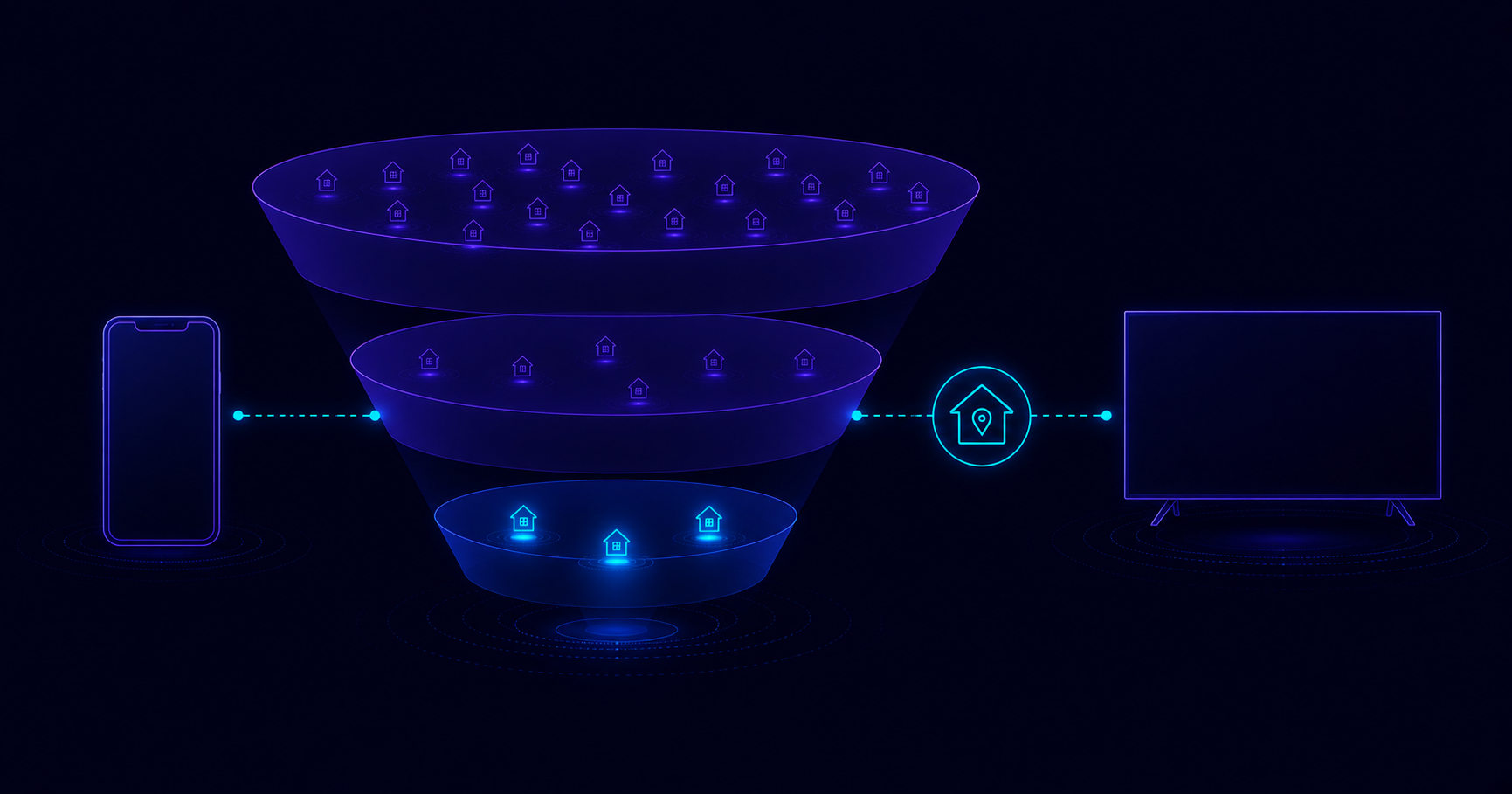
The customer acquisition model for DTC brands on CTV operates at three funnel stages with distinct campaign configurations for each. At the top of the funnel, CTV's television reach introduces the brand to cord-cutter households who have never encountered the brand through social or search. These households represent the "cold reach" that DTC brands struggle to find efficiently after exhausting their social look-alike pools. CTV cold reach campaigns are configured as broad audience awareness buys — genre and demographic targeting rather than behavioral segments — with creative designed to land brand awareness and a single compelling product claim in 30 seconds.
At the mid-funnel, CTV retargeting reaches households that have already visited the brand's website or engaged with digital advertising without converting. The household IP bridge connects web visit behavior to CTV device delivery — a household that visited the DTC brand's site last week and abandoned without purchasing receives a CTV ad this week reinforcing the brand value and extending a specific offer. The CTV retargeting guide covers the full technical setup and creative sequencing approach. For DTC brands, CTV retargeting is frequently the highest-ROI application of streaming advertising because warm audiences convert at 3–5x the rate of cold impressions.
At the bottom of the funnel, CTV converts consideration-stage households with specific offers, limited-time promotions, and direct response creative that provides a memorable URL, discount code, or QR code-adjacent visual prompt. The post-exposure conversion path — CTV ad on TV, search or direct visit on phone or laptop — requires CTV creative that makes the bridge easy: a short memorable URL spoken clearly and displayed on screen, a discount code that signals exclusivity, or a product name specific enough that post-exposure search is unambiguous.
Audience strategy for DTC CTV campaigns
DTC brands have a natural first-party data advantage in CTV audience building. Email lists from customers, trial users, and email subscribers can be hashed and matched against the LtvAdx HouseholdID graph to create CTV-targetable audience segments directly from existing customer data. Match rates of 45–65% for consumer DTC brands mean that a 500,000-subscriber email list produces 225,000–325,000 CTV-reachable households — a meaningful audience for retargeting, lookalike modeling, and suppression.
Lookalike expansion from first-party seed audiences is the primary DTC prospecting strategy in CTV. The HouseholdID system builds a statistical profile of the seed audience (converter characteristics, demographic composition, behavioral attributes) and identifies CTV households with similar profiles. DTC brands that upload a high-value customer segment — subscribers who have purchased three or more times, for example — produce lookalike models that outperform broad demographic targeting for acquisition campaigns because the seed is defined by actual customer behavior rather than demographic approximation.
Category interest targeting provides an alternative prospecting path for DTC brands in verticals where behavioral intent signals are observable. A DTC athletic nutrition brand can reach households with fitness and health content viewership on FAST channels through genre targeting. A DTC home décor brand can reach households with home improvement content affinity. These contextual signals do not require CRM data to activate and provide a viable prospecting path for new DTC brands without large existing customer databases.
Creative production for DTC CTV: managing cost and velocity
The creative production cost objection to CTV from DTC brands is legitimate but often overstated. A television-quality 30-second commercial does require more investment than a social ad — but the benchmarks have changed significantly. DTC brands that have built strong creative teams for social video production have found that adapting those assets for CTV delivery (upgrading resolution, improving audio mastering to broadcast standards, reframing from 9:16 to 16:9) produces CTV-viable creative at a fraction of traditional broadcast production costs.
The key technical adaptations for DTC social creative repurposed for CTV: resolution upgrade to 1920×1080 minimum (4K preferred for premium inventory); audio mastering to -24 LKFS integrated loudness from the mobile compression mix that most social video uses; text overlay legibility at television viewing distance (text that is readable on a phone screen at 12 inches often fails at 10 feet on a 65-inch display); and branding moved earlier in the edit — social ads often delay brand reveal to capture attention first, but CTV's non-skippable environment means the brand can and should appear in the first three seconds. Review the full specification requirements in the CTV creative best practices guide.
For DTC brands launching CTV with limited production budget, three creative variants provide enough for meaningful A/B testing: a product demonstration variant (shows the product working and delivering the core benefit), a social proof variant (customer results, reviews, community scale), and an offer-direct variant (specific discount, trial, or bundle with clear call-to-action URL). These three creative approaches test different conversion drivers and generate enough performance data within 4–6 weeks to identify which messaging dimension drives the highest post-exposure site lift.
Measurement framework for DTC CTV
DTC brands should configure CTV measurement before campaign launch, not after delivery. The measurement infrastructure requires: a pixel or server-side event integration that captures site visits with IP address logging (most DTC brands already have this through Google Analytics 4 or their e-commerce platform), a campaign-level attribution window configured to match the DTC product's consideration cycle length (7 days for impulse-adjacent products, 14–30 days for higher-consideration purchases), and a baseline measurement of the site visit rate from the target geographic audience before the campaign launches (the pre-campaign baseline is what you compare exposed household visit rates against).
The primary performance metrics for DTC CTV are: household site visit lift (do exposed households visit the site at a higher rate than the geographic baseline?), cost per incremental site visit (total campaign spend divided by incremental visits above baseline), and incremental purchase rate (conversion rate of CTV-exposed households minus baseline conversion rate). These metrics map directly to the DTC acquisition math that finance teams understand: if the cost per incremental purchase is below the allowable CPA for the customer LTV model, the channel is working.
Incrementality testing — configuring a holdout group within the retargeting or lookalike audience that receives no CTV ads during the campaign period — is the gold standard for DTC CTV measurement. The holdout methodology is the same regardless of channel: it answers whether the advertising caused the outcome or whether the audience would have converted anyway. DTC brands with rigorous performance culture should insist on holdout-tested incrementality results rather than view-through attribution as the primary CTV success metric. The attribution guide covers holdout configuration in technical detail.
Budget allocation and channel integration
For DTC brands adding CTV to an existing performance media mix, the recommended starting allocation is 10–15% of video budget in a 60-day test period. This is sufficient to generate statistically meaningful site lift measurement across a reasonably sized geographic target while limiting the downside if the test does not meet performance thresholds. Brands that see positive site lift and acceptable cost-per-visit results in the test period typically scale CTV to 20–30% of video budget in the following quarter.
CTV and paid social are more complementary than competitive for DTC brands. Social excels at granular individual-level targeting, fast creative iteration, and lower-funnel conversion capture through in-platform purchase flows. CTV excels at reaching the cord-cutter audience that social misses, building brand familiarity that makes social retargeting more effective, and providing television-format creative impact at the household level. Brands that use CTV for household-level awareness and retargeting while running social for individual-level conversion capture find that social retargeting performance improves for CTV-exposed audiences — the television exposure creates familiarity that accelerates the social conversion.
To get started with DTC CTV campaigns on LtvAdx, review the programmatic TV buying checklist for the end-to-end campaign setup workflow. For first-party audience activation and measurement setup, start with the integration documentation or request a platform walkthrough with the LtvAdx advertiser team.