The assumption that CTV is a brand awareness channel — suitable for impression volume and recall metrics but unsuitable for performance outcomes — has aged poorly. The combination of household identity resolution, deterministic post-exposure attribution, and the scale of cord-cutter audiences that are unreachable through other channels has made CTV a viable direct response medium for a growing set of advertiser categories. This does not mean CTV performs identically to search or social for every performance objective. It means that performance advertisers who understand the format's specific attribution mechanics, creative requirements, and audience activation capabilities can drive measurable outcomes from CTV spend — not just brand equity. This guide is for performance marketers evaluating or scaling CTV as a response channel through the LtvAdx advertiser platform.
Rethinking the performance attribution model for CTV
The core tension between CTV and performance marketing is the attribution window and conversion path. Search and social can attribute a conversion to an ad click in the same session — the viewer sees the ad, clicks it, and converts in one continuous journey. CTV has no click. A viewer watching a streaming app on their television cannot open a browser, navigate to a website, and complete a purchase without switching devices. The CTV-to-conversion path is necessarily multi-device and extends over time.
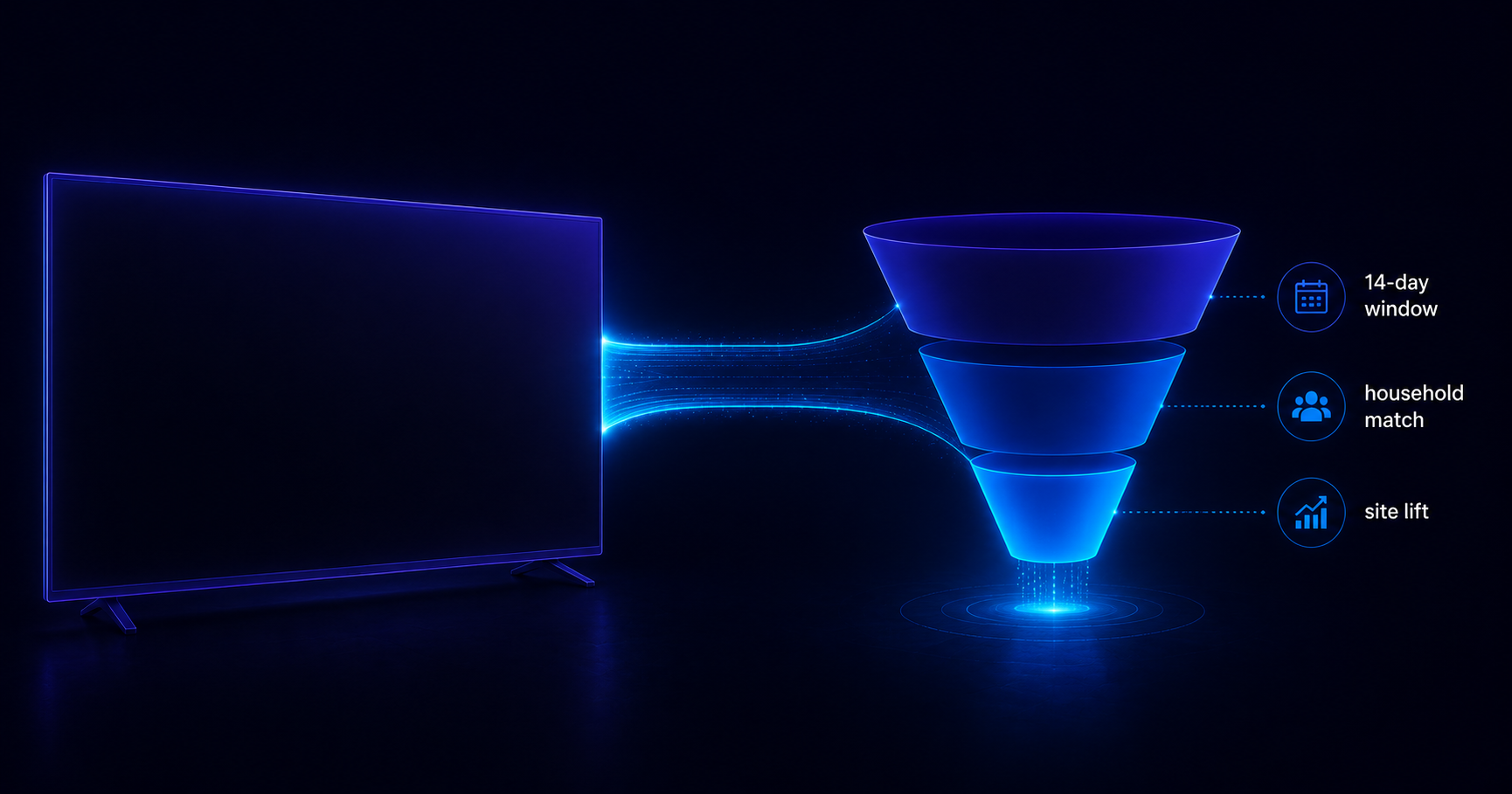
The appropriate performance attribution model for CTV is household post-exposure window attribution: after a CTV ad is served to a household, monitor whether that household visits the advertiser's website, searches for the brand, or completes a conversion within a defined window (typically 7–14 days) across any device in the household. The household identity layer — specifically the IP address bridge between the CTV impression and the downstream web activity — is what makes this attribution possible. This is covered in depth in the CTV attribution and measurement guide; the specific mechanics of household IP matching, its accuracy limitations, and the incrementality testing framework that validates attribution models are all relevant for performance advertisers new to the channel.
The implication for campaign reporting is that CTV performance metrics require a different dashboard than search or social. The relevant KPIs are: household visit rate (percentage of exposed households that visited the site within the attribution window), cost per household site visit, search query lift (measured as the difference in brand search rate between exposed and unexposed households), and for direct response with CRM matching, cost per acquisition among exposed households. None of these appear in standard DSP delivery reports — they require the post-exposure analysis infrastructure described in the LtvAdx reporting framework.
Which performance categories work in CTV
Not every performance category benefits equally from CTV. The format performs best for advertisers with considered-purchase products where the consumer journey involves research after initial awareness. Auto, home improvement, financial services, insurance, travel, and healthcare are the top-performing categories in CTV direct response because the audience researches those categories on the web after seeing a TV advertisement. A CTV ad that introduces a brand, product, or offer to a household produces a web search or site visit within a day or two — not within minutes, as a search ad would, but within a research cycle that CTV initiates.
App install and mobile performance advertising has emerged as a strong CTV use case specifically for streaming service cross-promotion. A gaming app that advertises on CTV reaches its target audience in a context where they are already in entertainment mode; post-exposure search and install rates from CTV ad exposure are meaningfully above control group rates. The attribution requires ACR or IP-based household matching to mobile install events — a data collaboration setup that the LtvAdx identity infrastructure supports.
Direct response categories that depend on impulse purchases or very short conversion windows — fast food, convenience goods, flash sales — are weaker fits for CTV. The multi-device, multi-day attribution window doesn't align with a conversion that requires same-session action. This does not mean CTV has no role in these categories; brand salience building that pays off over months is different from direct response in a short window. But performance-mode measurement expecting same-session attribution will consistently undervalue CTV in these categories.
Audience targeting for performance campaigns
Performance CTV campaigns require more precise audience targeting than brand campaigns because the goal is not broad reach — it is reaching households with high purchase propensity. The targeting capabilities available in CTV programmatic have expanded significantly: household income and wealth tiers, purchase intent segments from retail data partnerships, in-market indicators for specific product categories, life event signals (new movers, new parents, recent car shoppers), and geographic precision down to zip code or DMA.
The best-performing performance CTV audiences combine two or three targeting dimensions rather than applying every available signal simultaneously. A financial services advertiser targeting in-market mortgage customers in the top 20 DMAs performs better with those three dimensions precisely applied than with ten demographic and behavioral overlays that shrink the audience to a tiny pool of exactly-right households at the expense of scale. The tension between precision and scale is a universal performance marketing dynamic, and CTV is no exception — start broader than feels comfortable, measure the performance distribution across segments, and tighten iteratively based on data rather than intuition.
Household ID targeting for performance campaigns can incorporate first-party CRM data: upload a hashed customer list to create lookalike audiences based on existing converter household profiles. Households that share demographic, geographic, and behavioral characteristics with your best customers represent the highest-probability performance segment in the available CTV inventory. Configure CRM match audiences in the LtvAdx advertiser platform and measure their performance against contextual and third-party segment audiences using holdout testing to confirm the lift is real rather than selection bias.
Creative strategy for performance CTV
Performance CTV creative carries a different strategic brief than brand creative. The goal is not simply to build awareness or recall — it is to create enough intent that the viewer initiates a research or purchase journey after the ad ends. This requires the creative to include a specific, memorable offer or call to action that the viewer can recall and act on later: a URL they can type (or speak to a voice assistant), a vanity URL that is short and distinct, an offer code that signals a meaningful incentive, or a specific product or service claim that prompts search.
Audio branding is more important in performance CTV than in brand advertising. A viewer who is engaged enough to act after the ad ends will often do so because the audio message was memorable — the URL or offer was stated clearly and repeated — rather than because they read an on-screen text overlay they may not have noticed. "Visit [domain].com" spoken clearly at both the beginning and end of a 30-second spot, alongside a clean on-screen display of the same URL, produces meaningfully better post-exposure site visit rates than URL-buried-in-text creative that assumes the viewer is scrutinizing the screen. Review the CTV creative best practices guide for the technical specifications and audio standards that apply to all CTV creative.
Creative sequencing — serving different messages to households at different stages of post-exposure behavior — is an advanced performance CTV tactic. Households that have visited your website after a first exposure can receive a second creative with a more specific offer or product recommendation targeted to their browsing behavior. This requires a household identity bridge between the CTV frequency layer and the advertiser's first-party web analytics — a setup that connects HouseholdID to your website cookie pool via IP matching and enables retargeting within the CTV environment.
Incrementality testing for CTV performance
The highest-confidence performance measurement framework for CTV is incrementality testing: a randomized controlled experiment that assigns similar households to exposed and holdout groups and measures whether the exposed group converts at a higher rate than the control. Incrementality testing eliminates the confounding of organic behavior that plagues view-through attribution — it answers the question "did our CTV ads actually cause these conversions?" rather than "were our CTV ads observable near the time of conversion?"
Running a clean incrementality test requires: a household identity layer that can assign and maintain holdout group membership consistently, a conversion measurement mechanism that identifies converting households through IP or CRM matching rather than click tracking, sufficient statistical power (typically 100,000+ households in both exposed and holdout groups), and a test window long enough to capture the full post-exposure conversion cycle for your category (14–30 days for considered purchases, 7 days for shorter-cycle categories).
The conversion lift from a clean CTV incrementality test provides the most defensible ROI number available for CTV performance campaigns. It also calibrates future budget allocation: if the test shows CTV driving 15% incremental conversion lift among exposed households at $25 CPM, you have the data needed to model CTV's marginal return relative to search and social and allocate budget accordingly. Configure holdout group tests through the LtvAdx partner API or contact the agency team for assistance with incrementality test design.
Connecting CTV to your performance marketing stack
Performance CTV is most effective when it is integrated into the same measurement and optimization infrastructure as your other performance channels. This means: CTV impression logs flowing into the same data warehouse as search, social, and display data; household IP matching integrated with your web analytics platform for consistent attribution; CRM data available for audience matching and post-campaign conversion analysis; and a cross-channel measurement framework that applies consistent attribution methodology across channels rather than channel-specific last-touch models that will always disadvantage CTV.
The LtvAdx reporting API exports impression-level logs with household IP, device type, timestamp, creative ID, and campaign metadata — everything needed for downstream attribution analysis in your data warehouse. Publishers and advertisers accessing this data should implement the reporting integration as part of initial campaign setup rather than retrofitting measurement after launch. For performance advertisers evaluating CTV for the first time, the programmatic TV buying checklist covers the measurement setup steps alongside the campaign configuration steps. To discuss performance use cases for your specific category and budget, request a demo with the LtvAdx advertiser team.