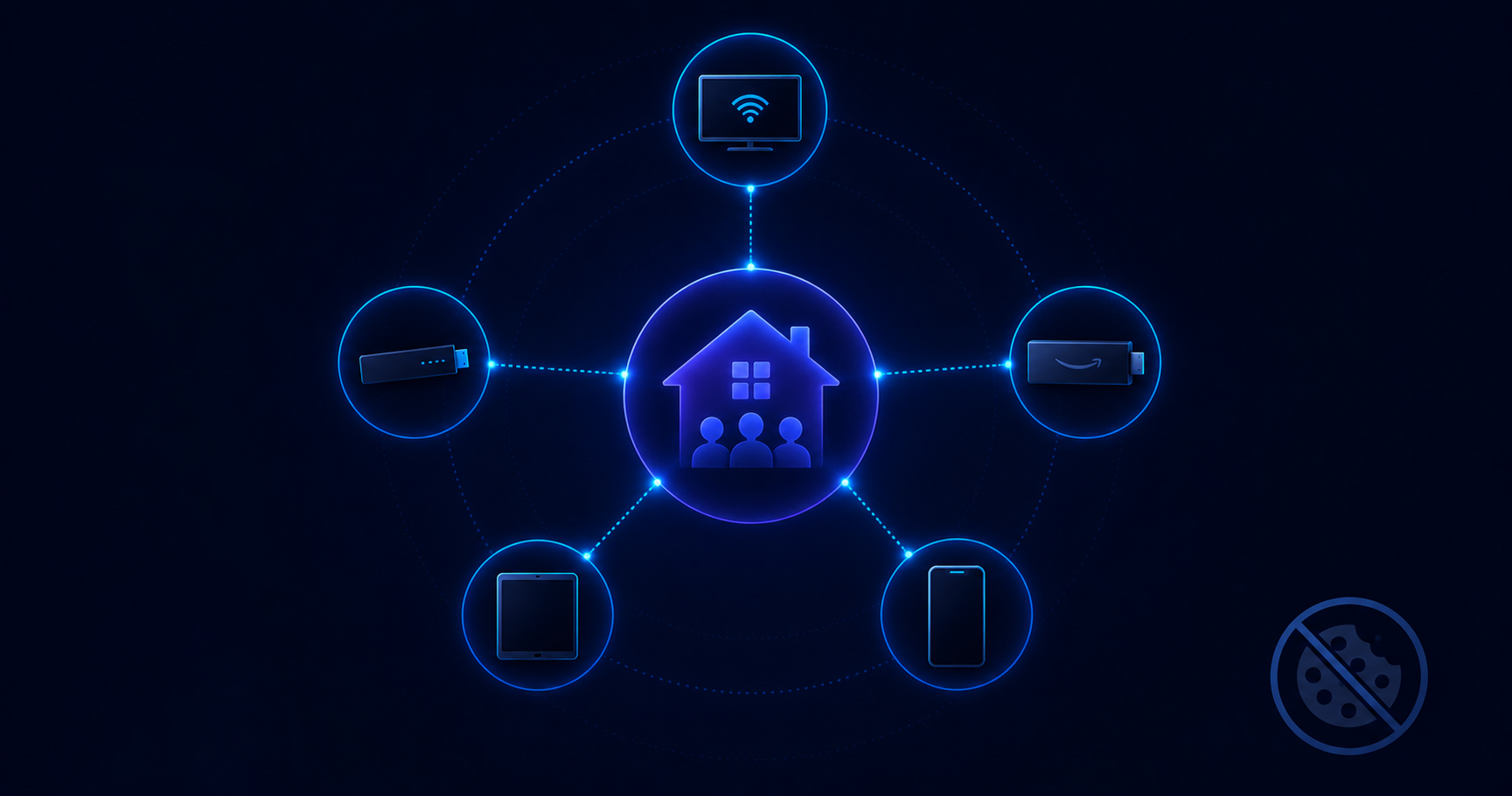
HouseholdID is the identity layer that makes frequency capping, reach measurement, and cross-device targeting work in a medium that never had browser cookies to begin with. CTV identity is a genuinely different problem from web identity — there's no persistent cookie to write and read, every device in a home carries its own advertising identifier, and the industry has spent the last several years converging on household-level resolution as the practical answer. This guide covers how that resolution actually works, what it changes about targeting and measurement, and the privacy constraints that shape how it's built.
From device IDs to households
CTV players expose device-level identifiers: a Roku advertising ID (RIDA), an Amazon Fire Advertising ID (AFAI), a Samsung TIFA, an Apple IDFA where available, plus the connection's IP address. None of these persist across devices — a household with a living-room Roku, a bedroom Fire TV, and a phone has three distinct identifiers for what is, from an advertiser's perspective, one audience. An identity graph resolves these device-level signals — RIDA, AFAI, IP, deterministic matches where available — to a single household key, so frequency counters, reach reporting, and cross-device sequencing all operate on the same underlying entity the advertiser actually cares about.
The resolution itself relies primarily on shared network signals — devices connecting from the same residential IP over a meaningful window — supplemented by deterministic matches when a platform or MVPD exposes authenticated login data. IP-based resolution alone has known limitations (carrier-grade NAT can group unrelated households behind one IP; VPNs and mobile hotspots introduce noise), which is why a production-grade household graph layers confidence scoring and multiple signal types rather than treating shared IP as a deterministic match on its own.
What household resolution actually changes
The most immediate effect is on frequency capping: without household resolution, the same viewer can receive an advertiser's full frequency cap on each of their devices independently, multiplying actual exposure well past what the campaign intended. With it, a "3 impressions per household per week" cap means exactly that, counted once across every device the household uses. The second effect is on reach reporting — deduplicated household reach is a materially different (and more honest) number than summed device-level reach, and buyers increasingly require the household number for planning rather than accepting device counts as a proxy.
The third effect, less discussed but arguably more consequential, is on cross-screen sequencing: ad journeys that need to show a different creative on the second exposure than the first only work if the system can tell that a Fire TV impression and a Roku impression an hour later belong to the same household. Without household resolution, sequential storytelling across CTV devices is effectively impossible — every device starts the sequence over from the beginning.
Privacy and consent on the big screen
CTV identity operates under real regulatory and platform constraints, and building a household graph doesn't exempt a publisher or advertiser from them. Regulations and platform policies increasingly require explicit notice or opt-in for personalized advertising on CTV surfaces, particularly in jurisdictions covered by GDPR and equivalent frameworks, and the IAB TCF consent signal needs to propagate through the identity resolution layer the same way it does through the bid stream. Publishers should document what signals feed their household graph, honor opt-outs at the household level (not just per device), and prefer privacy-safe identifiers — hashed emails, UID2, or authenticated MVPD login IDs where a household has actually logged in — over IP-and-device fingerprinting alone whenever a stronger signal is available.
This isn't only a compliance obligation. Household graphs built on weak, unconsented signals produce worse identity resolution — more false matches, more churn as IP assignments change — which degrades the frequency capping and reach reporting the whole system exists to improve. The privacy-conscious approach and the accurate approach point in the same direction more often than the tradeoff framing suggests.
Why household graphs matter beyond targeting
Lifetime value modeling for subscription and commerce brands depends on tying ad exposure to downstream outcomes — a trial signup, a purchase, a renewal — at the household level, not the device that happened to stream the episode where the ad ran. Attribution and incrementality testing both require knowing that the household exposed to an ad is the same household that later converted, which is impossible without a stable household key connecting exposure events across devices and, where linear TV is also in the plan, across addressable linear delivery as well. Co-viewing — multiple people in a household watching together, common for CTV in ways it isn't for mobile — also makes device-level reach systematically undercount actual audience reached, another reason household-level measurement is closer to the number buyers actually need.