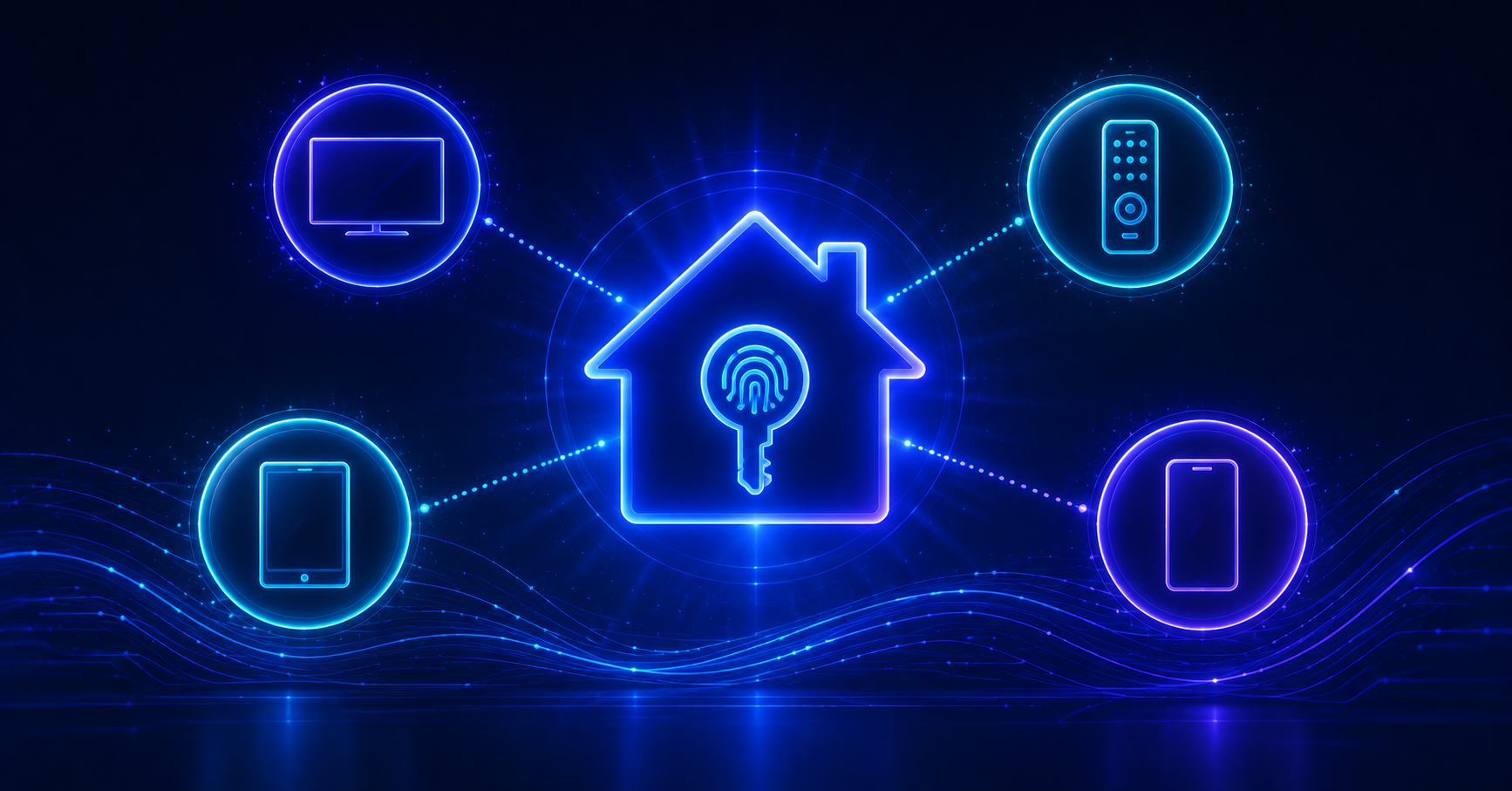
The deprecation of third-party cookies in Chrome — delayed repeatedly but now arriving in earnest — has generated enormous anxiety in digital advertising. The irony for CTV practitioners is that CTV never had cookies. Television-connected devices have no browser cookie jar, no persistent cross-site tracking, and no identity infrastructure inherited from 1990s web standards. CTV's identity problem and its solution are fundamentally different from the web's, and the industry has had years to develop approaches that do not depend on cookies at all. Understanding how identity works in CTV — what signals are available, how they are resolved into targetable household units, and how privacy regulations constrain their use — is essential knowledge for every advanced TV practitioner. The LtvAdx HouseholdID system is built on these principles, and this guide explains the technical and strategic foundations beneath it.
The signals available in CTV identity
CTV devices emit several identity signals that ad serving infrastructure can access at bid request time. The primary signal is the platform advertising ID: Roku's RIDA (Roku ID for Advertising), Amazon Fire TV's AFAI (Amazon Fire Advertising ID), Apple's IDFA (Identifier for Advertisers) as used on Apple TV, Samsung's TIFA (Tizen ID for Advertising), LG's LGUDID, and Vizio's IFA. These are device-level identifiers issued by the platform manufacturer and reset-able by the user. They are the closest CTV equivalent to a cookie, but they are not persistent across devices, not shared across platforms, and not observable outside the app environment in which they are collected.
The second signal is the IP address of the household's internet connection. Most residential broadband connections use a single IP address shared across all household devices. IP address-based household matching — comparing the IP in a CTV bid request against IPs observed in other contexts — is the most widely used method for connecting CTV ad exposure to downstream behavior like web visits and purchases. IP matching has known limitations: dynamic IP assignment means the same IP may map to different households over time; shared IP environments (apartment buildings with shared Wi-Fi, university networks) produce false matches; and IP-based matching produces probabilistic rather than deterministic household identification.
First-party authenticated signals — hashed email addresses or phone numbers from streaming service logins — are the highest-quality CTV identity input. When a viewer signs into a FAST channel or AVOD service with their email address, that email can be hashed and matched against publisher and advertiser CRM databases at bid time. Authenticated identity match rates vary by service (free registration services typically see 40–65% match rates against major identity graphs), but authenticated impressions command significantly higher CPMs because the audience segment verification is deterministic rather than modeled.
How household ID graphs work
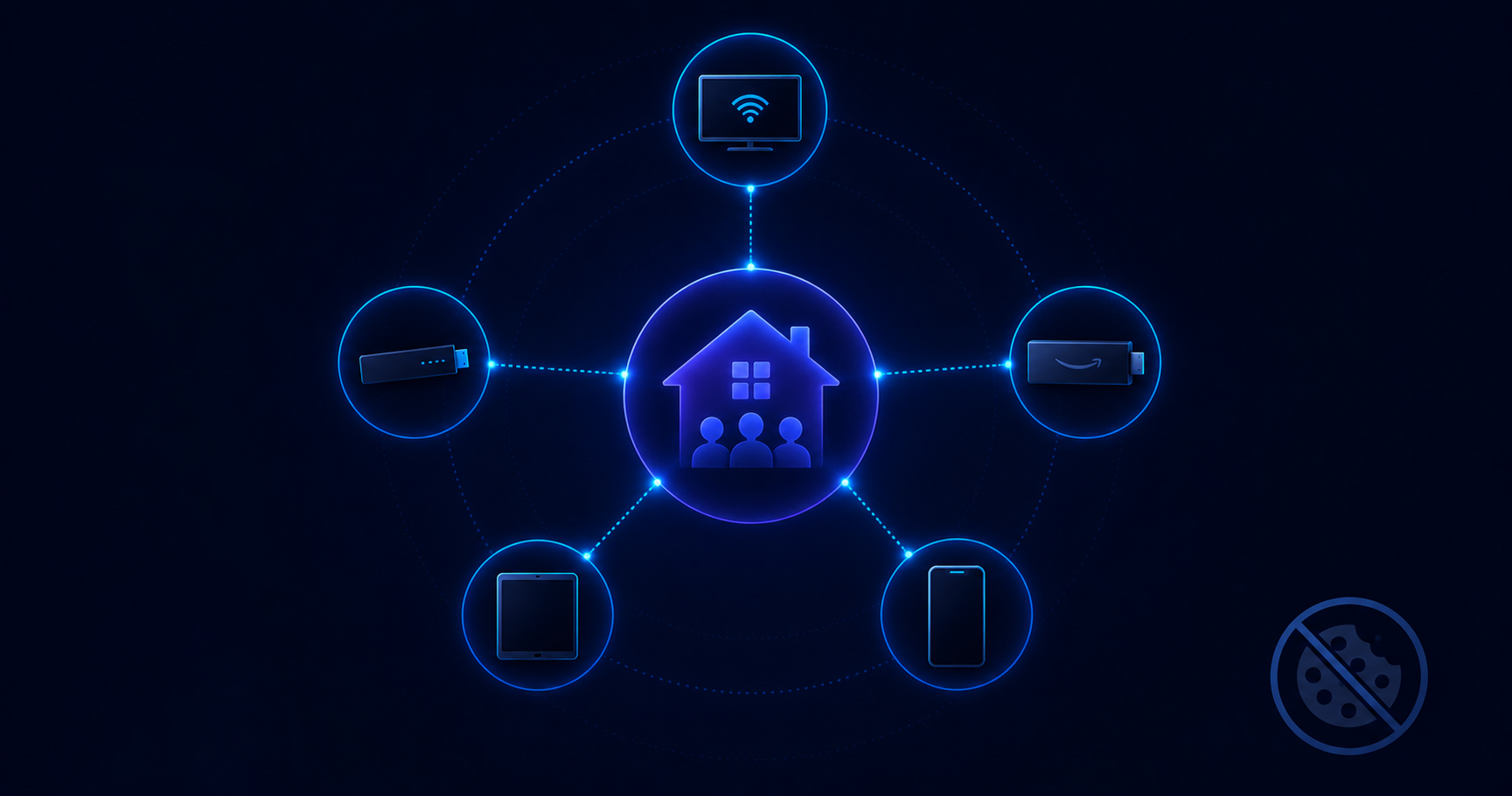
A household ID graph is a data structure that resolves multiple device-level signals — platform advertising IDs, IP addresses, authenticated first-party identifiers — to a single household-level key. The resolution process uses probabilistic and deterministic matching: devices observed consistently at the same IP address are provisionally linked; devices with matching authenticated identifiers (same hashed email on a streaming app and a retail app) are deterministically linked; and device graph data from telecom and data providers adds additional resolution coverage for households with limited first-party signal.
The LtvAdx HouseholdID graph maintains persistent household keys that survive device replacements, platform advertising ID resets, and IP changes. When a Roku device resets its RIDA, the household key remains stable because the graph resolves the new RIDA to the same household based on other co-occurring signals at the same IP and authenticated sessions from other apps in the household. This persistence is what enables reliable household-level frequency capping across a flight: the frequency counter is attached to the household key, not the device advertising ID, so a reset RIDA does not create a new frequency counter and allow re-exposure to a household that has already been capped.
Household graphs are not perfect. Rural households with cellular home internet (CGNAT addresses shared among many subscribers) have low IP-match accuracy. Households with sophisticated privacy tools (VPNs, ad blockers on streaming devices) produce degraded signal. College students using campus Wi-Fi are misattributed. These edge cases are known and accounted for in match rate estimates — a 60% household match rate on CTV inventory means 40% of impressions are served without household-level targeting, falling back to genre and daypart contextual signals rather than audience segment data.
ACR data and content-based identity enrichment
Automatic Content Recognition (ACR) data is a distinct identity enrichment layer available through smart TV manufacturers. ACR embeds in the TV's operating system and recognizes what is being displayed on the screen by fingerprinting frames against a reference database. This creates a viewing history for the household — not just what they watch on OTT apps but what they watch on linear cable, broadcast antenna, and gaming console. ACR-enriched households carry content affinity and linear TV exposure data that pure OTT signal cannot provide.
For CTV advertisers, ACR-based audience segments are particularly valuable for two use cases. First, competitive conquesting: identifying households that have recently been exposed to a competitor's linear TV campaign and targeting them with CTV advertising through streaming apps on the same smart TV. Second, linear TV reach extension: identifying households that have high linear TV viewership but limited streaming app usage and reaching them through linear addressable inventory from MVPD operator partners. The HouseholdID system incorporates ACR-derived content affinity data where available, enriching the household profile beyond programmatic OTT signals alone.
Privacy regulations and CTV identity: COPPA, CCPA, and GDPR
CTV identity is subject to three primary regulatory frameworks in major markets. COPPA (Children's Online Privacy Protection Act) prohibits behavioral targeting and persistent identifiers on services directed to children under 13. Any CTV app classified as children's content must disable platform advertising ID collection, suppress household ID activation, and serve contextual or contextually appropriate advertising only. Publishers operating kids apps on LtvAdx are placed in a kids-mode configuration that enforces these restrictions at the ad server level.
CCPA (California Consumer Privacy Act) grants California residents the right to opt out of the sale of their personal information, including advertising identifiers. CTV apps distributed to California users must honor opt-out signals — typically implemented through the platform's advertising ID opt-out mechanism (Roku "Limit Ad Tracking," Amazon's equivalent setting) and transmitted as a limit ad tracking (LAT) flag in the bid request. LtvAdx respects LAT flags by suppressing behavioral targeting and household ID activation for opted-out devices while still serving advertising based on contextual signals.
GDPR applies to CTV services with European Union users and requires a legal basis for processing personal data including advertising identifiers. For most CTV advertising, the appropriate legal basis is consent obtained through an IAB Transparency and Consent Framework (TCF) v2.2 compatible consent management platform (CMP). CTV apps serving EU users should integrate a TCF-compatible CMP that collects and signals consent status for advertising purposes. The LtvAdx platform reads TCF consent strings from bid requests and applies appropriate data processing restrictions based on declared purposes.
First-party data strategies for CTV publishers
The publishers with the strongest CTV identity positions are those with large authenticated first-party audiences. A FAST channel or streaming service that requires free registration before viewing has email or phone data for every viewer — a first-party identity asset that other publishers must purchase from third-party data providers. Building that registration wall requires careful UX design: friction that prevents sign-up destroys the audience size that makes the identity asset valuable. Best practice is a lightweight, one-click registration using Google or Apple single sign-on that collects an email address without requiring password creation.
Publishers with first-party registration data should implement data clean room integration with major advertisers to enable CRM matching without sharing raw email addresses. An advertiser uploads a hashed customer list; the clean room matches it against the publisher's hashed registration database and returns a match audience segment. Neither party sees the other's raw data, but both parties can activate the matched audience for campaign targeting and measurement. LtvAdx supports clean room audience activation through the partner API for publishers operating data collaboration programs.
Universal IDs and cross-platform identity in CTV
Universal ID initiatives — LiveRamp's RampID, The Trade Desk's UID2, Index Exchange's IX-ID — are attempting to create a post-cookie identity standard for digital advertising broadly, including CTV. These systems work by hashing authenticated email addresses into a standardized identifier that can be recognized across participating publishers and DSPs without sharing the underlying email. For CTV, UID2 is the most widely adopted: streaming services that collect authenticated logins can generate UID2 tokens from hashed emails and pass them in bid requests, giving buyers a cross-publisher audience signal that does not depend on platform advertising IDs.
The practical advantage of UID2 adoption for CTV publishers is demand premium: DSPs that have activated UID2 can apply audience targeting to UID2-enabled impressions that they cannot apply to anonymous or device-ID-only impressions. Publishers with high UID2 coverage in their bid requests see higher CPMs in the segments that benefit most from authenticated audience targeting. The LtvAdx bid request infrastructure supports UID2 token passing through the standard OpenRTB user.eids extension; publishers interested in implementing UID2 should review the integration documentation for the specific field mapping required.
Identity for cross-screen measurement
One of the most valuable applications of CTV identity is enabling cross-screen measurement — connecting television ad exposure to outcomes that occur on other devices in the household. A household that sees a CTV ad on their Roku device and subsequently searches for the brand on their smartphone and visits the website on their laptop has completed a multi-device attribution journey that requires a household identity layer to reconstruct.
The HouseholdID approach connects the CTV impression to the household key, and the same household key identifies the IP address of the household's web traffic. When the website visit and the search query originate from the same IP address that was present in the CTV bid request, the attribution chain is complete. This is the basis for the site lift and search lift measurement methodologies described in the CTV attribution guide. The limitation — CGNAT and VPN environments — is the same one that affects household ID matching, and the solution is the same: combine IP matching with authenticated signals where available for higher-confidence attribution on the impressions that have them.
For publishers and advertisers building their CTV identity strategy, the starting point is accurate platform advertising ID collection in your streaming app, followed by first-party registration data if your product supports it, followed by clean room or UID2 integration for advertiser CRM matching. The LtvAdx identity documentation covers each integration step. For a complete walkthrough of how HouseholdID fits into your specific inventory or campaign setup, request a platform demonstration.