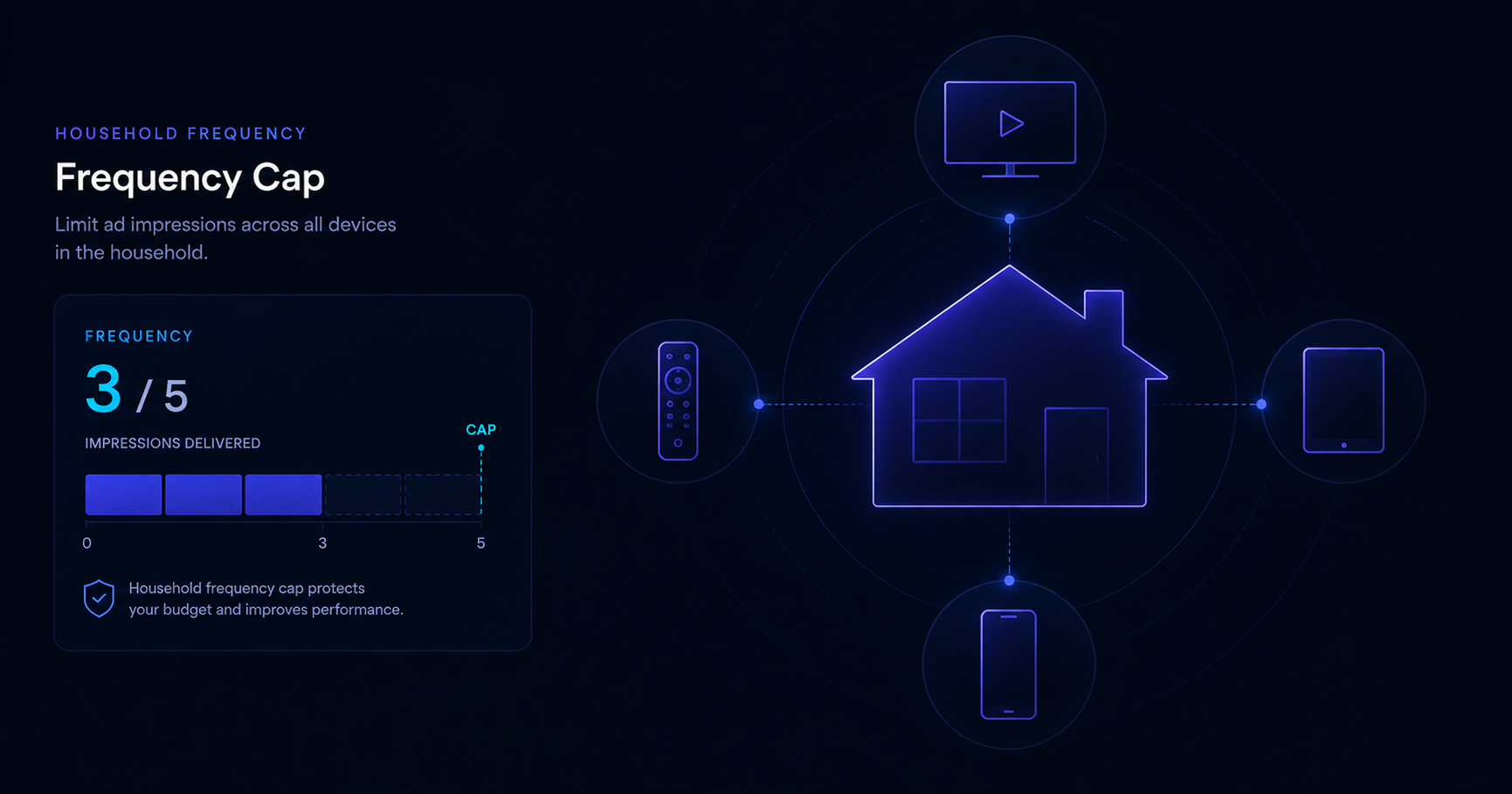
Frequency capping is one of the most consequential settings in a CTV campaign, and one of the most commonly misconfigured. Too low a cap and your reach story falls apart — the same household sees your ad once and the message does not land. Too high a cap and you are burning budget on overexposed households while untouched ones exist in the same audience segment. Getting frequency right in CTV requires understanding how household identity works, what controls the ad server exposes, and how to measure whether your cap is actually enforcing correctly across devices. The LtvAdx HouseholdID system is built specifically to address the cross-device frequency problem that has made CTV capping unreliable at scale.
Why frequency capping is harder in CTV than in digital
Web frequency capping relies on a persistent browser cookie: serve the ad, write a counter, read it on the next impression. CTV has no browser cookies. Each device — smart TV, streaming stick, gaming console — carries its own identifier: a Roku advertising ID, an Amazon Fire advertising ID, a Samsung TIFA, an Apple IFA. When a household has three streaming devices and two smart TVs, the same person can receive the same ad five times in a single evening as five separate identifiers, each with its own frequency counter, none aware of the others.
This device fragmentation is the root cause of the CTV ad fatigue complaints that brand research consistently surfaces. Viewers report seeing the same ad "dozens of times" in a single viewing session; what is actually happening is that each device in their household sees the ad up to the per-device cap, and the household-level frequency is the sum of all per-device impressions. Device-level caps do not solve the problem; household-level caps do.
Household-level frequency capping with HouseholdID
The HouseholdID identity graph resolves multiple device identifiers to a single household key. When LtvAdx sees a bid request from a Roku device associated with HouseholdID hhid-abc123, it increments the frequency counter against that household key — not just the device. When the same household's Fire TV sends a bid request for the same campaign, the existing counter is checked: if the household cap has been reached, the impression is not served regardless of whether the Fire TV device-level cap is still open.
This household-level enforcement is what makes frequency management in CTV match the advertiser's intent. A "3 impressions per household per day" cap means exactly that — not "3 per device per day per household." Configure household caps at the line item level in the LtvAdx advertiser platform. The platform surfaces household reach and frequency in the reporting dashboard so you can validate enforcement after launch.
Cross-screen frequency management
For campaigns running across both CTV and linear addressable TV, frequency management must span delivery modes. A household that has seen your ad twice on their OTT app and once on their cable provider's addressable feed has three exposures — but without a unified identity layer, each system counts independently. The combined exposure is invisible to either system.
LtvAdx unifies CTV app impressions and addressable linear impressions under the same HouseholdID when the linear operator has enabled subscriber identity sharing. The combined frequency counter reflects total household exposure across screens. For campaigns with cross-screen reach objectives, this unified counting prevents both under-capping (overexposure) and over-capping (hitting the limit before the linear component has delivered) simultaneously.
Setting the right frequency thresholds
There is no universal correct frequency cap — it varies by campaign objective, creative quality, content context, and flight length. But research-based benchmarks provide a starting framework. Brand awareness campaigns typically see diminishing returns beyond 3–4 exposures per household per week. Direct response campaigns with strong calls to action may sustain higher frequencies — up to 6–8 per week — before negative sentiment sets in. Retargeting campaigns targeting already-aware households should cap more tightly: 2–3 impressions per week is often sufficient to drive action without fatigue.
Flight length matters: a 4-week campaign capped at 3 per week produces 12 total household exposures, which is well within tolerance for most brands. A 1-week burst at 12 per week produces the same total exposures but in a compressed window that accelerates fatigue. Spread impressions across the flight using day-level caps rather than relying solely on weekly or campaign-total caps when your campaign requires sustained recall over time.
Frequency cap configuration in the LtvAdx platform
LtvAdx supports frequency caps at three levels: campaign, line item, and creative. Campaign-level caps set the maximum total household exposures across all line items in the campaign. Line-item caps enforce limits within a specific targeting segment or deal. Creative-level caps prevent a specific creative from overexposing a household even if the line item cap has not been reached — useful for creative rotation strategies where you want equal distribution across variants.
Cap windows available are: hourly, daily, weekly, and campaign lifetime. Combining windows is the most effective configuration: a daily cap of 2 and a weekly cap of 6 prevents both intra-day saturation and weekly overexposure, while the lifetime cap of 20 sets an absolute ceiling for campaigns with longer flights. Configure these in the advertiser portal under line item settings, or via the partner API for programmatic buyers managing campaigns at scale.
Measuring frequency distribution
The right measure of frequency cap effectiveness is the household frequency distribution report: how many households received 1 impression, how many received 2, 3, and so on up to the cap ceiling. A well-functioning cap produces a distribution where the vast majority of reached households fall at or below the target frequency with minimal households at the cap ceiling. A distribution skewed heavily toward the ceiling indicates the cap is not throttling effectively or that the audience pool is too small to absorb the impression volume without overexposing.
The LtvAdx reporting API exports household-level frequency distribution data for campaigns running on HouseholdID-resolved inventory. Review this report weekly during active campaigns and adjust caps if the distribution shows significant ceiling bunching. Frequency distribution analysis pairs with reach analysis: if household reach is below target, the cap may be too tight and excluding repeated impressions that would have driven incremental reach in a wider audience pool.
For an end-to-end walkthrough of frequency cap configuration and the identity resolution that powers it, review the LtvAdx Identity documentation or request a demo with the advertiser success team. For publishers implementing household-level caps on their inventory, publisher portal configuration covers the supply-side settings required to expose household identity data in bid requests.