"VCR" and "completion rate" get used interchangeably in most CTV conversations, and in a lot of contracts they do mean the same thing — but not always, and the gap between definitions is exactly where billing disputes and misread performance reports come from. This piece separates what the terms actually measure, why CTV completion numbers run so much higher than other video formats almost automatically, and how to optimize a campaign without chasing a metric that was never a real quality signal to begin with.
Video completion rate (VCR), precisely
VCR is completed views divided by started views, measured via the VAST complete quartile beacon — the tracking event a player fires when playback reaches 100%. In CTV, VCR runs high: 85–95% is typical for non-skippable 15- and 30-second in-stream spots, well above what skippable digital video or social feed video ever achieves. The reason is structural, not a quality achievement: CTV viewers are lean-back, watching on a shared living-room screen with no skip button on most inventory, so the ad plays to completion by default rather than because the creative earned the attention.
That structural-not-earned distinction matters for how VCR should be read. A high VCR on non-skippable CTV inventory tells you the ad wasn't interrupted — it doesn't tell you the viewer was engaged, remembered the brand, or would have kept watching if a skip option existed. Treating CTV VCR the same way a buyer treats skippable YouTube view-through rate — as an engagement signal — overstates what the number actually demonstrates.
Where "completion rate" diverges from VCR
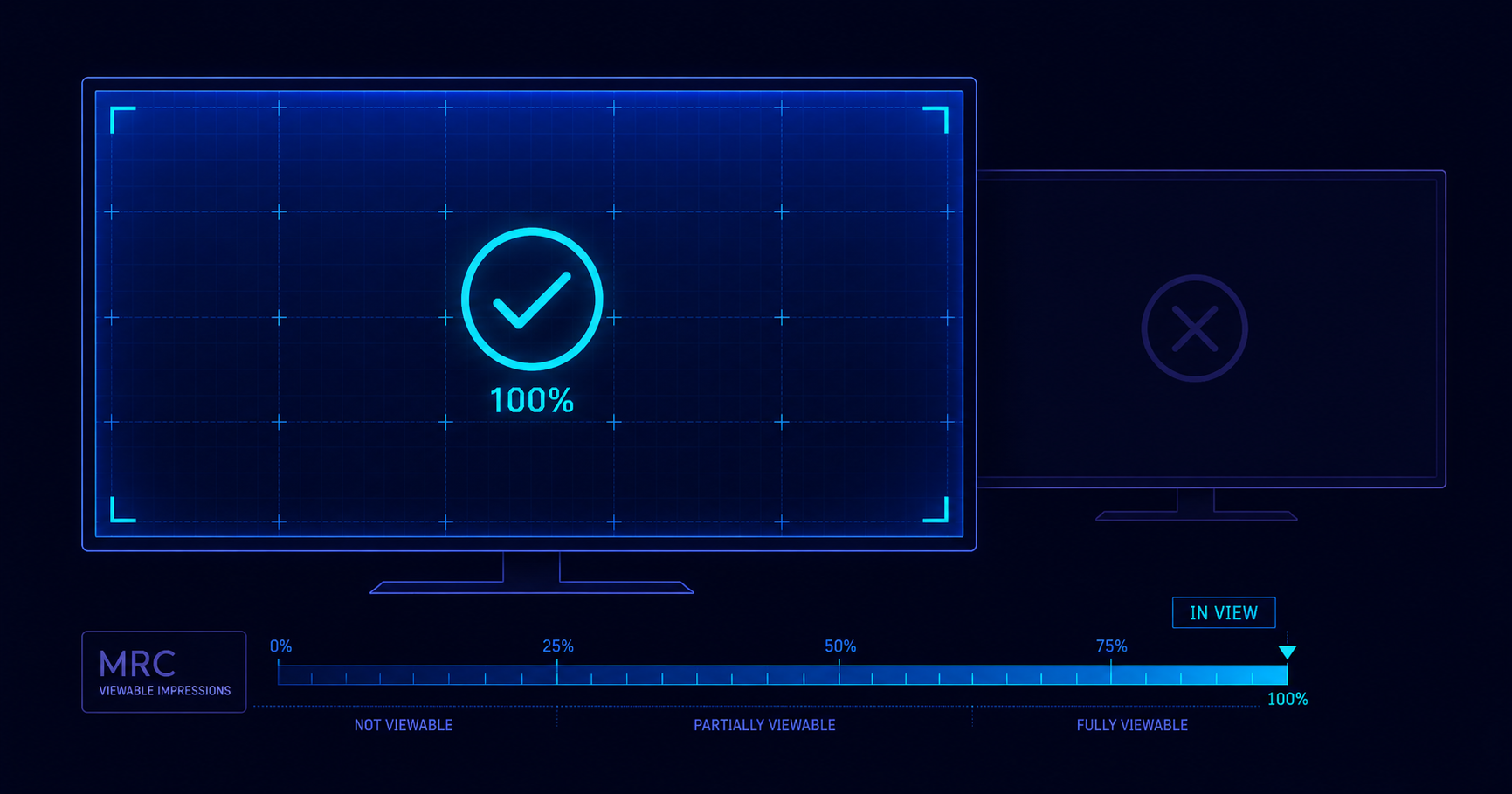
In most insertion orders, "completion rate" and VCR are contractually the same metric. But the term sometimes refers to something stricter: viewable completions, where a viewability standard is applied on top of the raw completion event — the ad has to complete and be confirmed as foreground, audible-eligible, and actually rendered, not just fire the completion beacon while the app was backgrounded or the device was asleep. This distinction is exactly why buyer and seller need to align definitions explicitly in the IO rather than assume shared vocabulary: which quartile events count as authoritative, whether SSAI-side beacons or client player beacons are the source of truth when they diverge, and how invalid traffic is filtered before the rate is calculated.
SSAI and client-side beacon sources can disagree in specific, diagnosable ways — an SSAI stitcher confirms the segment was delivered in the manifest, while a client beacon confirms the player actually rendered it, and a gap between the two often points to a device that received the stream but wasn't actually playing (backgrounded app, screensaver triggered mid-break). Reconciling which source governs the reported rate before the campaign launches avoids a dispute after the fact where both sides are technically reporting correctly from their own vantage point.
Optimizing completion without gaming the metric
Because non-skippable CTV completion is close to automatic, the real optimization lever isn't squeezing a few more points out of an already-high VCR — it's making sure the high completion rate is actually attached to a viewer who was paying attention. Shorter creatives with a clear value proposition in the first five seconds perform better on recall and outcome metrics even when VCR itself barely moves, since the metric was never capturing attention in the first place. Pod placement matters too: ads placed immediately after a natural content break hold attention better than ads buried mid-pod after several other spots have already run.
Ad load is the lever that most directly threatens completion in a way that does reflect genuine viewer behavior: stacking too many ads into a single pod — especially common on FAST channels running heavier ad loads to maximize yield — drives early exits and app-switching even in a lean-back, non-skippable environment. A publisher optimizing purely for pod fill without watching downstream completion and re-engagement metrics can win the immediate auction and lose the audience.
What to actually report and negotiate on
For buyers evaluating CTV performance, VCR is a useful delivery-health check — confirm it's in the expected 85–95% non-skippable range, and investigate if it isn't — but it shouldn't be the primary success metric an IO is negotiated against. Brand lift, incrementality, and outcome attribution (covered in the attribution and measurement guide) measure what completion rate structurally can't: whether the ad actually did something. Define VCR and completion rate identically and explicitly in every IO, use it to catch delivery problems, and put the real performance conversation on metrics built to answer it.