Ad pod strategy is one of the highest-leverage decisions a CTV publisher makes. The number of slots per break, the ordering of those slots, competitive separation rules, and the floor CPMs assigned to each position determine fill rate, viewer experience, and effective CPM simultaneously. Publishers who get this right earn significantly more per hour of viewing than those running default three-slot pods with no structural differentiation. This guide covers how to architect ad pods for CTV and FAST channel inventory, how SSAI mechanics constrain and enable your choices, and how to measure whether changes are working.
What is a CTV ad pod?
An ad pod is a sequential group of video ads served during a single commercial break in a streaming video stream. Unlike a single mid-roll placement, a pod contains multiple impressions — typically two to five — delivered back-to-back before the content resumes. Pod structure maps directly to how linear television organizes commercial time, which is why broadcasters transitioning to FAST find the concept familiar. What is different in streaming is the per-impression addressability: every slot in a pod can carry a distinct creative targeted to distinct household segments, priced individually, and measured with quartile-level beacons.
Pods are defined at the VMAP or SSAI manifest level. A VMAP document instructs the player where breaks fall in a VOD asset or live stream and how many ad slots each break contains. The LtvAdx ad server receives a pod request, runs sequential auctions for each slot, stitches the winning creatives into the manifest via SSAI, and returns tracking events per slot. Understanding this flow is the prerequisite for any pod optimization work.
Pod length: balancing fill rate and viewer retention
The dominant instinct among publishers is to maximize pod length — more slots means more impressions per break. This logic holds until viewer drop-off and advertiser CPM penalties erode the incremental revenue. Research across FAST channel operators consistently shows that pods beyond four minutes of ad time in a thirty-minute program produce diminishing returns: completion rates on late-pod slots collapse, and sophisticated DSPs deprioritize inventory with poor historical video completion rates (VCR).
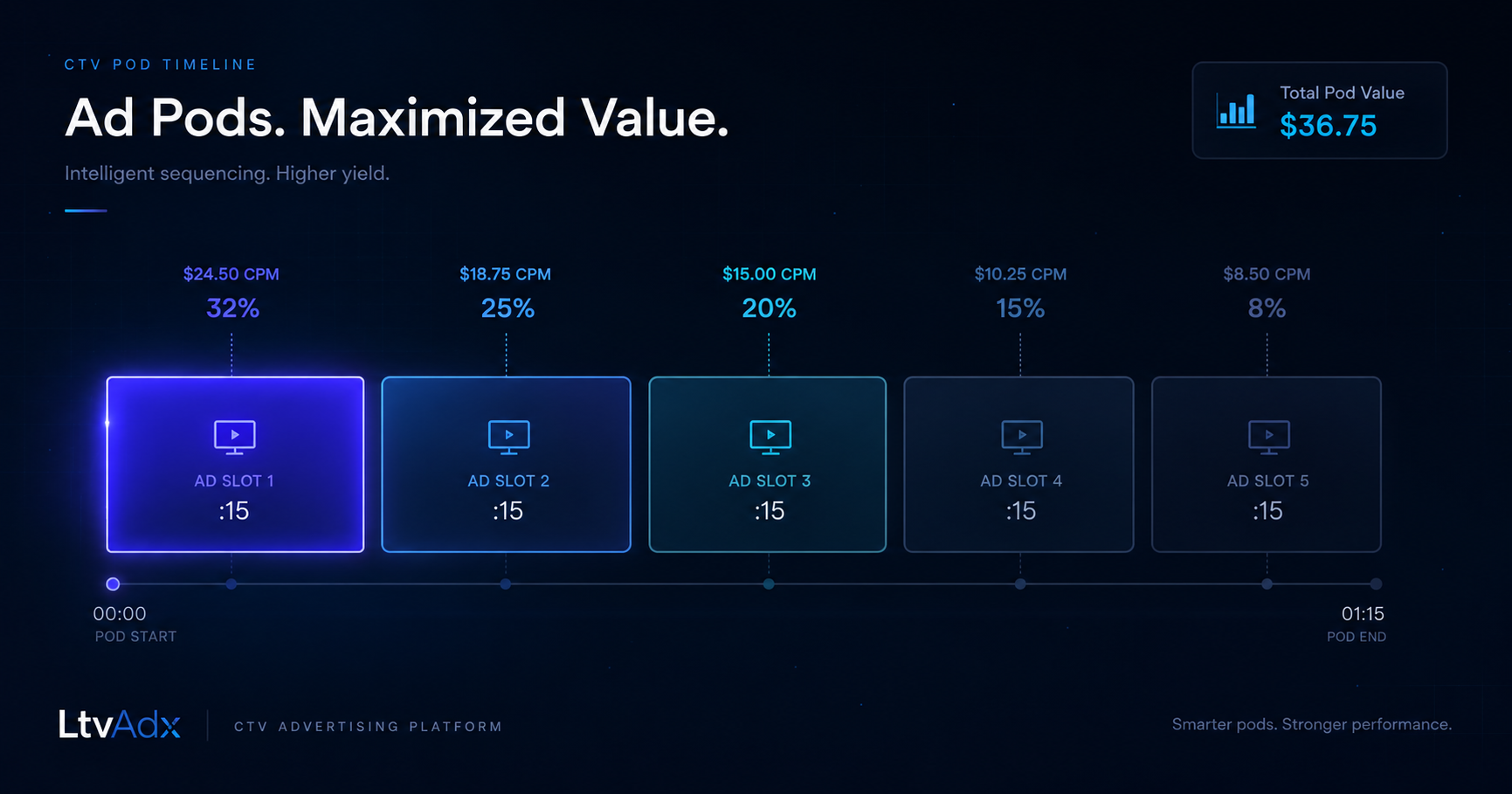
A structural framework that works well for most content types is the four-slot pod with graduated floors. Slot one carries a premium floor — often 30–50% above the average CPM — because buyers pay a significant premium for first position. Slots two and three run at standard floors. Slot four runs at a reduced floor to maintain fill without sacrificing the earlier positions. This graduated approach ensures the highest-value spots clear first and the marginal slots do not cannibalize overall eCPM.
Live programming — sports, news, awards — tolerates slightly longer pods because viewer intent to return to content is high. Two-minute pods in live streams typically show lower abandonment than two-minute pods in on-demand drama. Tune your pod length per content genre rather than applying a single global policy across your entire library.
Slot position pricing and deal structure
Position-based pricing is the most underused revenue lever available to CTV publishers. Buyers operating through OpenRTB routinely express position preference — first pod, first slot — in their targeting parameters. Publishers who expose position metadata in bid requests attract significantly more competitive bids for premium positions. Configure your ad server to pass video.pos and pod sequence fields in outbound bid requests so buyers can act on them.
For direct-sold campaigns, position guarantees are a strong upsell. An advertiser buying a sponsorship of a nightly news program may pay a 40–60% CPM premium for guaranteed first pod, first slot across a defined flight. This deal structure is easy to implement in a campaign trafficking system that understands pod ordering and can block competing creatives from adjacent slots.
Competitive separation rules
Competitive separation prevents two ads from the same advertiser or the same product category from appearing in the same pod. Most major advertisers require it contractually, and violating it creates liability, make-good requests, and loss of future spend. In a programmatic environment where auction winners are determined milliseconds before stitching, enforcing separation requires the ad server to perform sequential slot resolution with awareness of preceding slot winners.
The LtvAdx ad server resolves pod slots sequentially: slot one auctions first, slot two auctions with awareness of slot one's winner, and so on. Advertiser domain blocking, IAB category exclusions, and custom category mappings are evaluated at each slot against all preceding winners in the same pod. Publishers managing direct-sold and programmatic in the same pod can define hard separation rules for the direct creative and let programmatic fill remaining slots within the separation constraints.
Slate and fallback management
Unfilled pod slots are a viewer experience and revenue problem. A blank screen between a filled slot and a content return is disorienting. A house promo slate or a partner-guaranteed fill should cover every slot that does not clear the floor price. Configure fallback creative at the pod level, not just the placement level, so the SSAI stitcher always has something to insert. House ads are the common fallback, but cross-network promos, PSAs, and branded content fillers are all viable depending on your partner agreements.
Monitor unfilled slot rate per pod position and per content genre via the LtvAdx reporting dashboard. A spike in unfilled late-position slots during primetime usually signals that your floor prices are too high for the available demand at that daypart, not that demand has disappeared. Segment the analysis before cutting floors globally.
SSAI manifest design for pod delivery
The SSAI manifest layer is where pod configuration meets delivery reality. A correctly structured VMAP document defines break offsets, maximum pod duration, minimum slot duration, and the ad call endpoint per break. The LtvAdx SSAI engine supports both HLS and DASH manifests and handles SCTE-35 cue tone insertion for live streams. For VOD, break positions are set at asset ingest time using the VMAP document or API-level break configuration.
One common mistake is mismatch between the pod slot count declared in the VMAP and the number of creatives the ad server returns. If the SSAI stitcher requests three slots and receives two filled creatives, it must either fill with slate, compact the pod, or leave dead time. Define your slate behavior explicitly in the stitcher configuration rather than relying on defaults. Testing with a three-device QA matrix — Roku, Fire TV, and a browser player — before each pod configuration change catches the rendering edge cases that device-specific players surface.
Measuring pod performance
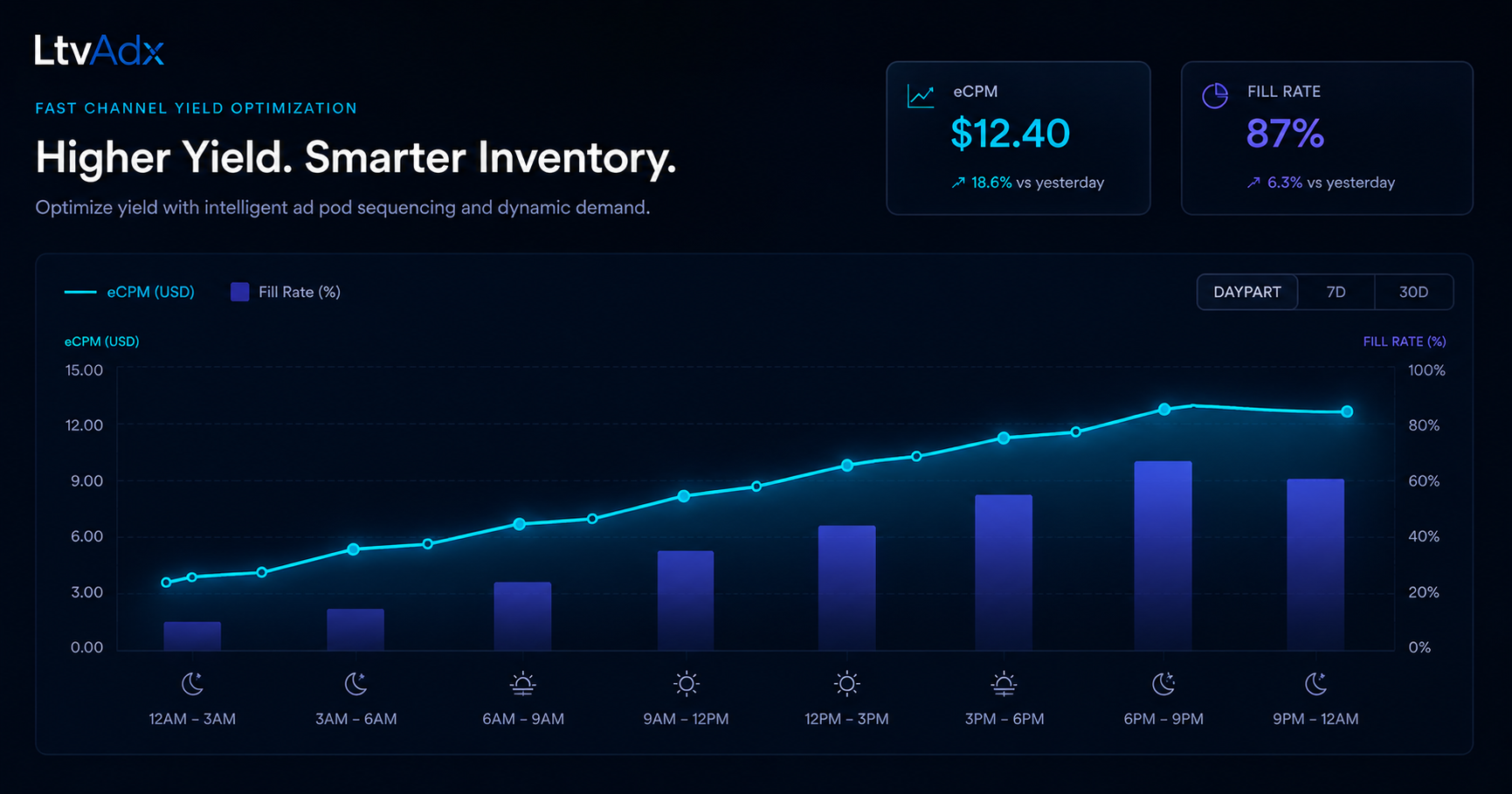
The right measurement framework for pod optimization tracks four metrics per slot position: fill rate, average CPM, VCR, and abandonment rate at pod exit. Fill rate and CPM tell you about revenue efficiency; VCR and abandonment tell you about viewer experience. A pod producing high fill and CPM but elevated abandonment is destroying long-term inventory value by training viewers to skip or exit. Balance all four before declaring a configuration optimal.
The LtvAdx reporting API surfaces pod-level and slot-level breakdowns in its event stream. Export slot position data into your data warehouse or BI tool and build a weekly pod performance dashboard segmented by content genre, daypart, and device type. Optimization cycles shorter than two weeks rarely produce statistically significant signal given the variance in streaming viewership patterns.
Pod strategy for FAST channels
FAST channels present a specific pod challenge: linear-style programming with fixed break schedules and no on-demand catch-up. Pod lengths are determined at the channel packaging stage and are difficult to change mid-schedule. The best FAST operators define pod templates per programming block — news pod templates, entertainment pod templates, kids pod templates — and apply them at channel creation rather than retrofitting after launch.
Demand for FAST inventory continues to grow as advertisers seek the scale of streaming with the simplicity of linear buying. If you operate FAST channels, read the FAST channel monetization playbook for the full demand sourcing and yield management picture alongside the pod structuring guidance here. Connecting your FAST supply to LtvAdx FAST channel solutions gives you access to PMP deals and programmatic demand optimized for linear-style inventory.
Common pod configuration mistakes
Publishers entering CTV programmatic for the first time routinely make a handful of structural errors. Running pods without position metadata in bid requests leaves money on the table because position-premium bidders cannot identify the inventory. Setting uniform floors across all positions prices premium slots too low and marginal slots too high simultaneously. Neglecting competitive separation configuration creates contractual exposure with direct advertisers. Forgetting to configure slate results in dead air on partially filled pods. And failing to segment reporting by pod position makes it impossible to identify which slot is the optimization target.
Each of these is correctable through proper configuration in a platform that exposes the right controls. The LtvAdx publisher portal surfaces pod templates, position floor pricing, separation rules, and slate assignment in a single trafficking interface so operations teams do not need engineering involvement for routine pod adjustments. For a complete implementation walkthrough, start with the getting started guide or book a demo with our publisher success team.