FAST channel monetization is the revenue discipline that determines whether a free ad-supported streaming TV channel is a viable business or a loss-making distribution experiment. The content is free to viewers; every dollar of revenue comes from advertising. The gap between a FAST channel generating $6 eCPM on 60% fill and one generating $14 eCPM on 82% fill — on identical content — is entirely a function of how the monetization infrastructure is configured. This guide covers the demand mix, yield architecture, identity setup, and operational practices that separate top-performing FAST operators from those running on default settings.
What makes FAST channel inventory distinctive
FAST channels are linear streaming television. Viewers tune in to a scheduled programming feed — crime documentaries at 8pm, classic sitcoms on a loop, 24-hour news — rather than selecting specific titles on demand. Commercial breaks occur at fixed points in the schedule, defined by SCTE-35 cue tones embedded by the playout system. The viewer expects breaks; the ad load mirrors traditional TV conventions of 12–18 ad minutes per hour.
This linear structure gives FAST inventory characteristics that differ from AVOD. Audience attention per break is higher because viewers are engaged with the programming flow and waiting for content to resume. Completion rates on FAST breaks average 90–95% when ad load is kept within viewer tolerance thresholds. The pod structure — number of slots, slot duration, break cadence — is fixed at channel packaging time rather than varying by content title, which makes yield optimization more systematic than in VOD environments. For the full mechanics of pod configuration, see the CTV ad pod strategy guide.
The demand mix: direct, PG, PMP, and open auction
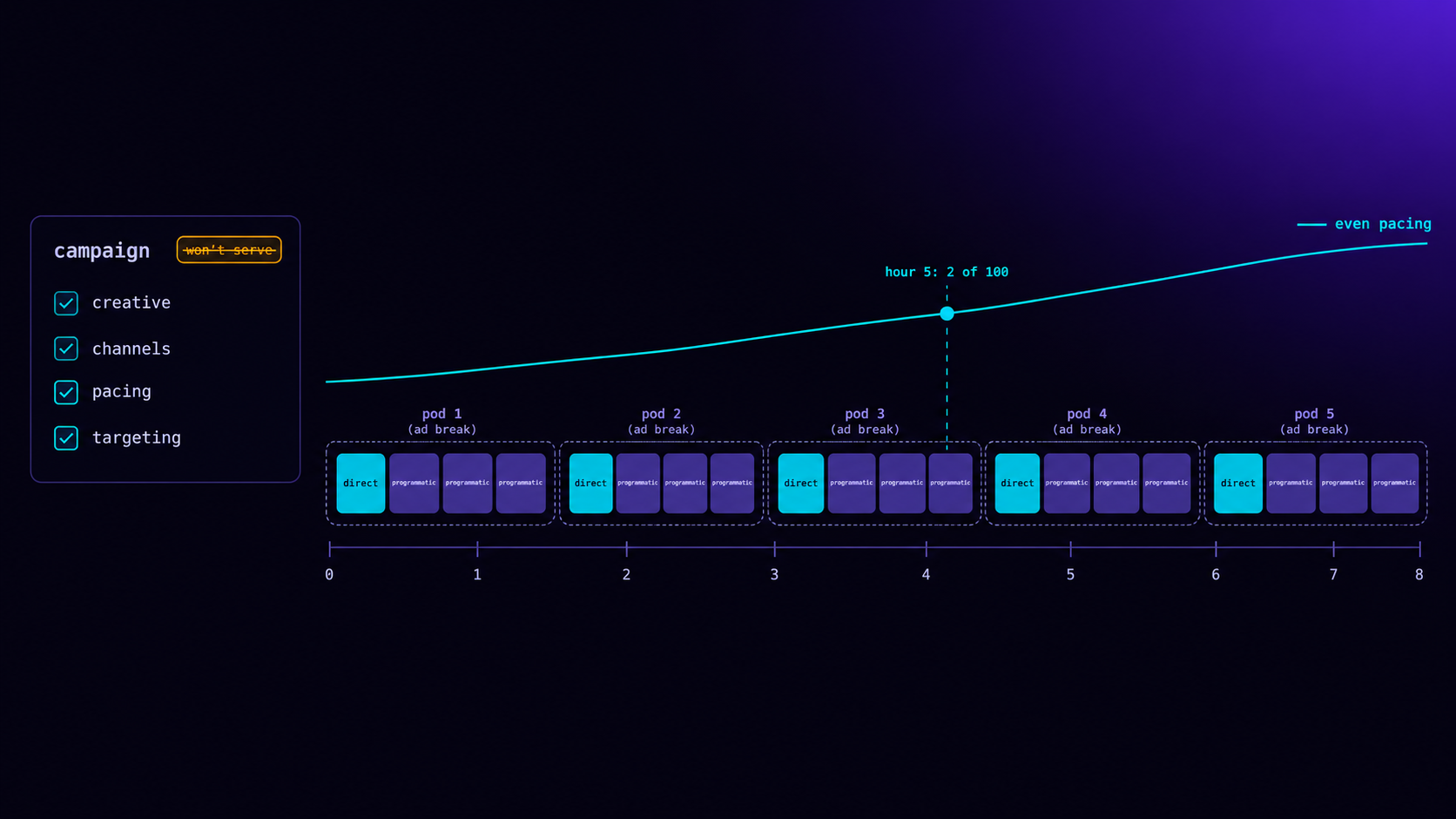
FAST channel revenue comes from four demand tiers. Direct-sold IO campaigns — negotiated by your sales team, trafficked against specific programming blocks — carry the highest CPMs and should be sold for your premium dayparts and marquee content. Genre sponsorships, live event adjacencies, and share-of-voice packages are direct-sold products that programmatic cannot replicate.
Programmatic guaranteed (PG) deals provide upfront volume and CPM commitments executed through deal IDs — the automation equivalent of a direct IO without manual trafficking. The programmatic guaranteed guide covers deal setup and delivery mechanics. Private marketplace (PMP) deals give preferred DSP buyers first-look at your inventory at negotiated floor CPMs without volume commitment. Open auction programmatic fills remaining inventory at market-clearing rates. Configure the LtvAdx ad server waterfall to enforce this tier sequence — direct and PG first, PMP second, open auction last, house slate as final fallback.
Floor pricing by daypart and genre
A single channel-wide floor price is the most common yield mistake in FAST monetization. Prime-time entertainment inventory on Thursday evenings commands a different market price than overnight infomercial-adjacent programming on the same channel. Buyers know this and bid accordingly — setting a uniform floor either leaves money on premium inventory or creates fill rate problems on lower-demand windows.
Configure floor schedules in the LtvAdx publisher portal using daypart templates: prime entertainment (6–11pm), daytime (9am–6pm), overnight (11pm–9am), and live event overrides for special programming. Genre-based floors matter when a single channel runs mixed content — a horror documentary channel airing true crime at prime time and older reality programming overnight needs different floors for each programming block. The FAST channel yield optimization guide covers the full floor pricing and waterfall strategy with eCPM benchmarks.
Identity enrichment and audience packaging
Anonymous FAST inventory — ad breaks served to devices with no household identity context — clears at the lowest programmatic CPMs. Enriched inventory — breaks where the HouseholdID graph has resolved the device to a household with demographic and behavioral signals — clears 30–60% higher in head-to-head comparison. The identity enrichment mechanism for FAST channels is passing the device advertising ID (Roku RIDA, Fire TV AFAI, Samsung TIFA) from the streaming app through the SSAI bid request so the HouseholdID graph can resolve it before the auction runs.
FAST channels with viewer authentication — even free registration requiring an email address — have access to a more powerful identity signal: hashed email matching against advertiser CRM databases. Implementing a lightweight sign-in with Google or Apple single sign-on captures an email-based identity signal for every registered viewer without requiring password creation. Match rates against major identity graphs run 40–65% for authenticated FAST audiences. The CTV identity without cookies guide covers the full identity stack from device IDs through authenticated signals.
SSAI configuration for FAST linear streams
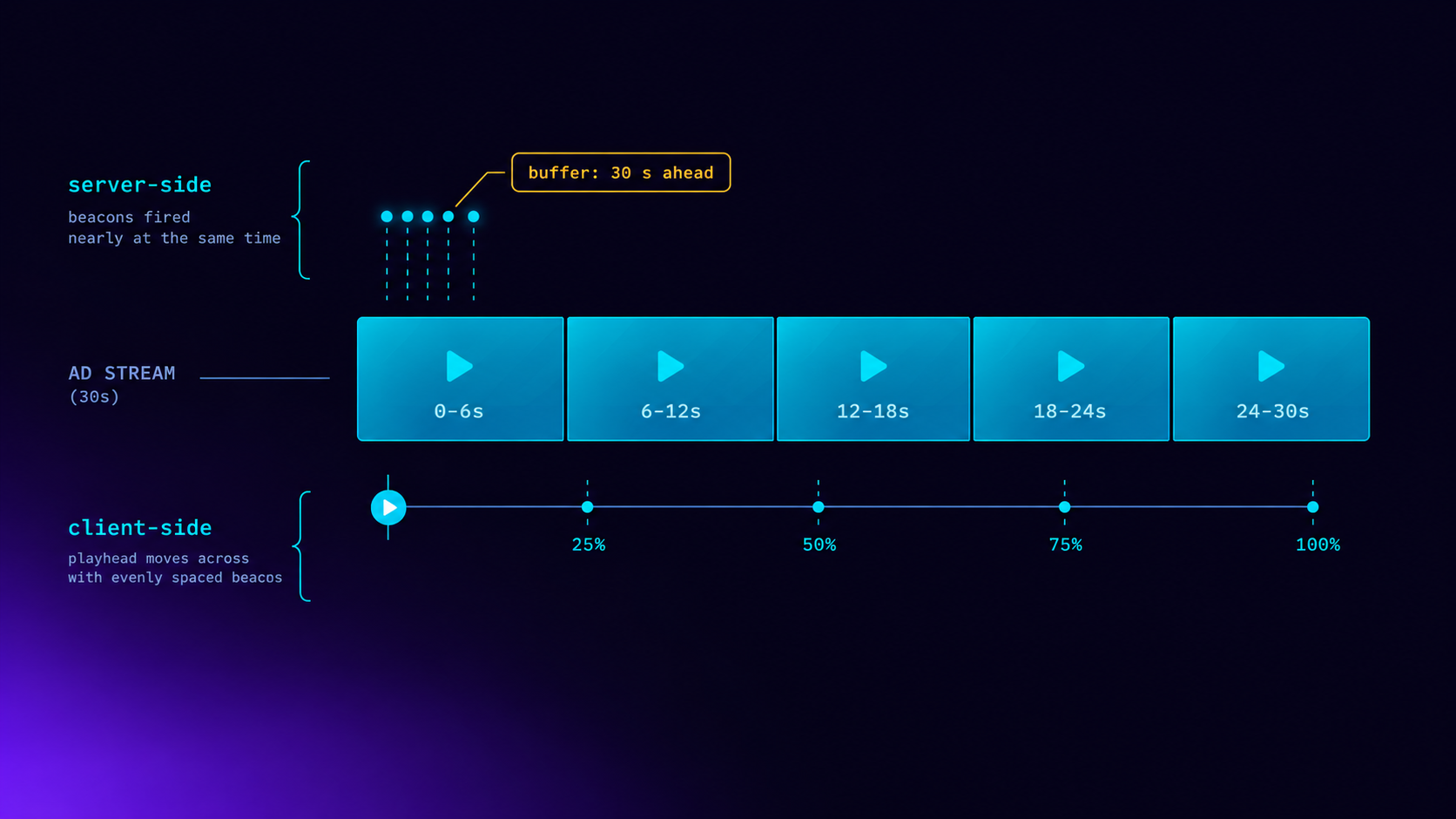
FAST channels require SSAI tuned for continuous linear delivery — not VOD-style per-asset insertion. The LtvAdx SSAI engine monitors the live HLS manifest for SCTE-35 markers from the playout system, interprets break duration, calls the ad server for pod fill, and stitches winning creatives into the manifest. For channels running on platforms like Roku and Samsung TV Plus, the SSAI path is the standard integration because these platforms require seamless manifest delivery and do not support client-side VAST for linear content.
Configure slate behavior explicitly — every unfilled slot needs a fallback creative to prevent dead air. Set house promo slate at the pod level and configure it as a guaranteed fallback in the stitcher rather than relying on player-side error handling. Monitor unfilled slot rate by break position and daypart weekly; a sustained spike in first-slot unfill is a floor price signal, not a demand shortage signal. For VMAP and break configuration specifics, the VMAP guide for CTV publishers covers the technical setup.
Metrics that determine FAST channel viability
The single most important operational metric is revenue per viewing hour — total advertising revenue divided by total viewing hours delivered. This metric captures the combined effect of eCPM, fill rate, and ad load in one number that maps directly to content licensing cost coverage. A channel with $8 revenue per viewing hour and $6 content cost per viewing hour is viable. The same channel at $4 revenue per viewing hour is not, regardless of how good its eCPM looks in isolation.
Track fill rate, eCPM, and VCR segmented by daypart, genre, and device platform using the LtvAdx reporting dashboard. Surface these in a weekly digest to channel operations leadership — yield decisions made without this data default to guesswork. For a complete analytics framework, the CTV reporting and analytics guide covers the four-layer measurement stack from delivery reports through auction analytics.
To launch or migrate a FAST channel on LtvAdx, start with the integration documentation or request a demonstration with the FAST channel team.
Frequently asked questions about FAST channel monetization
What is a FAST channel?
A FAST channel (Free Ad-Supported Streaming TV) is a linear-style streaming channel that airs scheduled programming and is free to viewers, monetized entirely through advertising. FAST channels are distributed on platforms like Pluto TV, Samsung TV Plus, Roku Channel, Amazon Freevee, and LG Channels.
How do FAST channels make money?
FAST channels generate revenue through advertising CPMs on ad slots delivered during scheduled commercial breaks. Revenue depends on fill rate, eCPM, and total viewing hours. Operators mix direct-sold sponsorships, programmatic guaranteed deals, private marketplace deals, and open auction programmatic fill.
What eCPM can FAST channels expect?
FAST channel eCPMs typically range from $6 to $18 depending on content genre, audience demographics, daypart, deal mix, and identity enrichment. Premium primetime entertainment and live sports inventory commands the upper end; overnight and long-tail genre inventory is at the lower end. Well-optimized FAST channels earn 40-70% more than default-configured ones on the same inventory.
What is the best SSAI setup for FAST channels?
FAST channels require SSAI configured for continuous linear HLS or DASH streams with SCTE-35 break detection. The SSAI stitcher monitors the live manifest for cue tone markers, calls the ad server with available break duration, stitches winning creatives into the manifest, and inserts slate for unfilled slots. Pod templates defining slot count, duration, and competitive separation rules are set at the channel level.
How do FAST channels get programmatic demand?
FAST channels connect to programmatic demand by integrating with an SSP or exchange through SSAI ad tags or OpenRTB supply paths. The exchange runs real-time auctions against DSP demand for each break. Publishers should configure floor prices, content category metadata, and audience identity signals to attract relevant buyers at competitive CPMs.
What is the difference between FAST and AVOD?
FAST channels are linear — they have scheduled programming the viewer tunes into, like a traditional TV channel. AVOD (ad-supported video on demand) is on-demand — the viewer picks a specific title to watch. Both are free and ad-supported, but their ad pod structure, viewer behavior, and monetization configuration differ significantly.