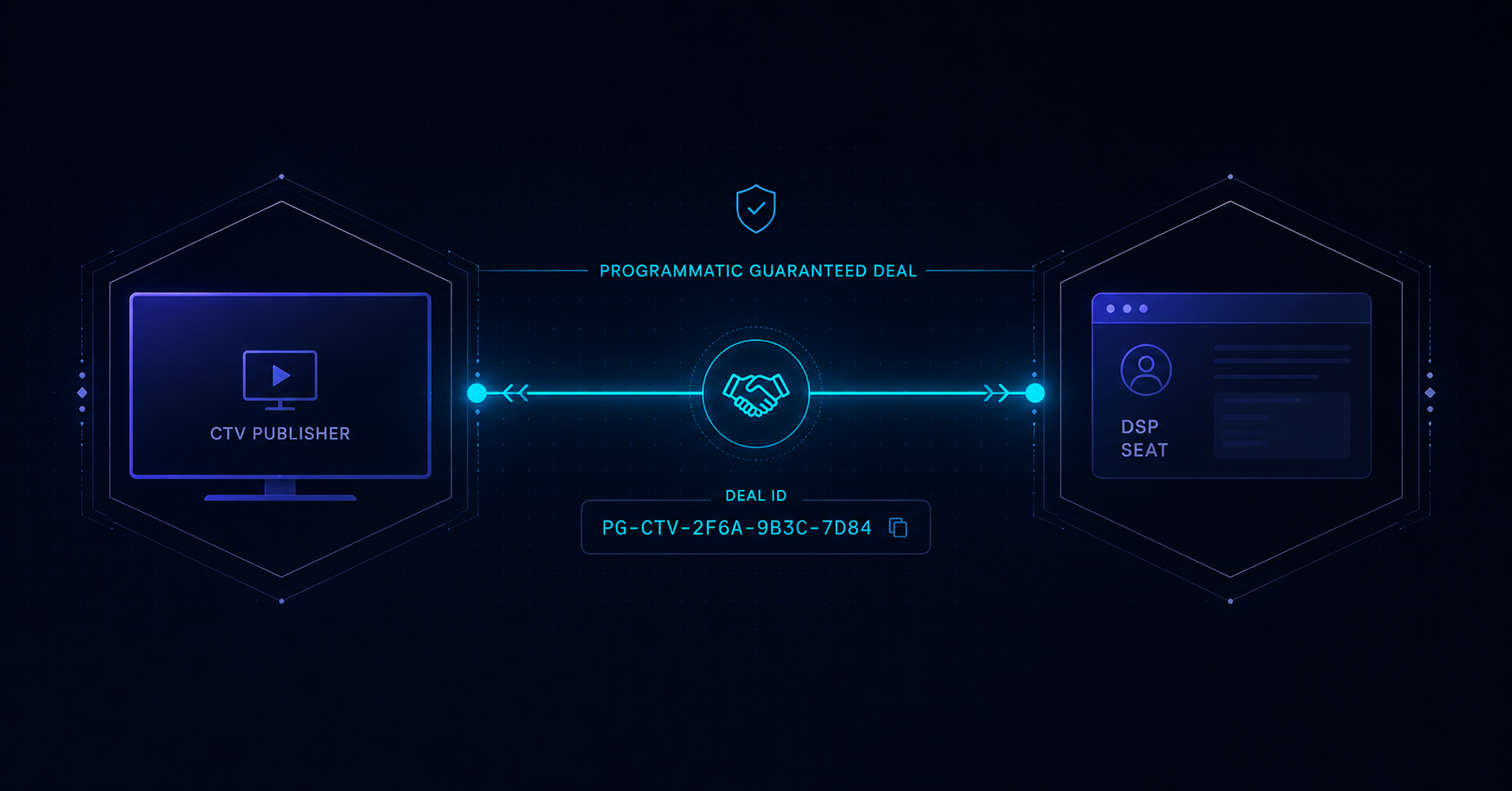
Programmatic guaranteed (PG) is the buying model that resolves the central tension in advanced TV advertising: publishers want the revenue certainty of direct IO deals; buyers want the workflow automation of programmatic. PG delivers both — a fixed price, fixed volume commitment executed through automated delivery rather than manual trafficking. Understanding when to use PG versus open auction or private marketplace deals, and how to configure it correctly, is increasingly important for any media buyer allocating significant CTV budget. This guide covers the PG mechanics in CTV advertising, how to set up deals, and how the LtvAdx ad server enforces guarantees.
What programmatic guaranteed means in practice
In a programmatic guaranteed deal, a buyer and seller agree on a fixed CPM, a minimum impression volume, and a flight window before any impressions are delivered. Unlike a private marketplace (PMP) deal where the buyer has a first-look at inventory but no obligation to buy, a PG deal creates mutual commitment: the publisher reserves inventory, and the buyer agrees to take it. The automation layer handles delivery pacing, creative rotation, and reporting — replacing the manual insertion order workflow with a deal ID and system-to-system execution.
For CTV, PG is particularly valuable for premium programming slots, sports tentpoles, and genre-specific campaigns where guaranteed adjacency justifies a CPM premium. A buyer wanting guaranteed first-pod placement across a specific FAST channel's primetime window cannot achieve that through open auction, where winning any specific slot is probabilistic. PG eliminates that uncertainty at an agreed price.
PG vs PMP vs open auction: choosing the right model
The choice between PG, PMP, and open auction depends on three variables: campaign objective, required certainty of delivery, and price sensitivity. Awareness campaigns with reach and frequency objectives and defined target audiences often use PG for the delivery guarantee and frequency management it enables. Performance campaigns with flexible targeting and budget may prefer open auction for price efficiency. Mid-funnel retargeting campaigns often use PMP as a middle ground — priority access to premium inventory at negotiated rates without the volume commitment.
For addressable linear TV, PG is the dominant buying model because linear inventory is structured around upfront commitments. The mechanics mirror the traditional TV upfront but execute programmatically: annual or quarterly commitments at negotiated CPMs, delivered through the ad server's guaranteed delivery engine against the agreed household segments.
Deal ID structure and setup
A programmatic guaranteed deal in LtvAdx is created through the publisher portal or the partner API. The publisher defines: deal CPM, minimum impression volume, daily/weekly pacing cap, eligible inventory (by app, genre, daypart, or content tier), eligible creative formats (duration, aspect ratio), and any competitive separation or category exclusion constraints. The resulting deal ID is shared with the buyer's DSP.
On the buyer side, the DSP activates the deal ID in the campaign targeting, associates creative assets, and sets pacing instructions. When the LtvAdx SSP encounters a bid request that matches the deal's eligible inventory criteria, it notifies the buyer's DSP via the OpenRTB deal object. The DSP responds with the agreed CPM, the deal ID in the bid response, and the creative to serve. The ad server validates the response, confirms the creative passes format requirements, and delivers.
Pacing is handled jointly: the publisher's ad server manages delivery rate to prevent over-delivering early in the flight, and the buyer's DSP manages spend rate. Discrepancies between publisher-counted and buyer-counted impressions are a common operational friction point — configure both sides to count on the same event (VAST impression fire versus ad server decision) before launch and document the methodology in the deal agreement. The LtvAdx reporting dashboard surfaces impression-level logs that facilitate discrepancy resolution.
Audience targeting in programmatic guaranteed
PG deals in CTV can carry audience targeting constraints that open auction cannot reliably enforce. A buyer wanting to guarantee delivery against households in the top income quartile across specific DMAs can specify this in the deal configuration. The publisher's identity system matches available impressions to the deal's audience requirement; only qualifying impressions are offered against the deal. This targeted PG approach typically prices at a premium above untargeted PG but delivers higher relevance and reduces wasted impressions.
HouseholdID-based targeting in PG deals uses the same identity graph that powers open auction and PMP targeting. The difference is delivery guarantee: the ad server tracks household delivery against the deal objective and surfaces under-delivery alerts when matching inventory is not reaching the required pace. Publishers with low match rates against a buyer's specific audience requirement should communicate this before deal execution to set accurate volume expectations.
Creative management and approval workflow
PG deals require creative pre-approval before delivery begins. The publisher or their ad operations team reviews the buyer's VAST creative for: correct duration, bitrate and codec compliance, tracking pixel validity, competitive category conflicts, and content appropriateness for the inventory context. This review step is absent in open auction — where policy filtering replaces manual review — and represents one of the operational advantages of PG: publishers know exactly what will air before a single impression delivers.
Creative rotation within a PG deal — multiple creatives cycling across the guaranteed impression volume — requires each creative to pass the approval process individually. Build approval time into deal setup timelines, particularly for campaigns with multiple creative variants or late-stage creative changes. A standard five-business-day creative review window before flight start is a reasonable minimum.
Makegood and underdelivery remediation
When a PG deal underdelivers against its guaranteed volume — due to inventory supply shortfalls, audience match rate gaps, or technical issues — the publisher owes the buyer makegoods. The makegood process is simpler when both parties have impression-level logs to reconcile. Document the guaranteed delivery methodology, the counting event, and the tolerance threshold for underdelivery before flight start. LtvAdx surfaces delivery tracking in real time so underdelivery can be caught mid-flight and addressed before it becomes a billing dispute at campaign close.
For media buyers new to PG in CTV, the programmatic TV buying checklist covers the pre-launch and in-flight steps that prevent most underdelivery situations. Publishers looking to package their inventory for PG deals should start with the publisher portal documentation. To discuss deal structure for your specific campaign requirements, contact the LtvAdx sales team or request a demo.