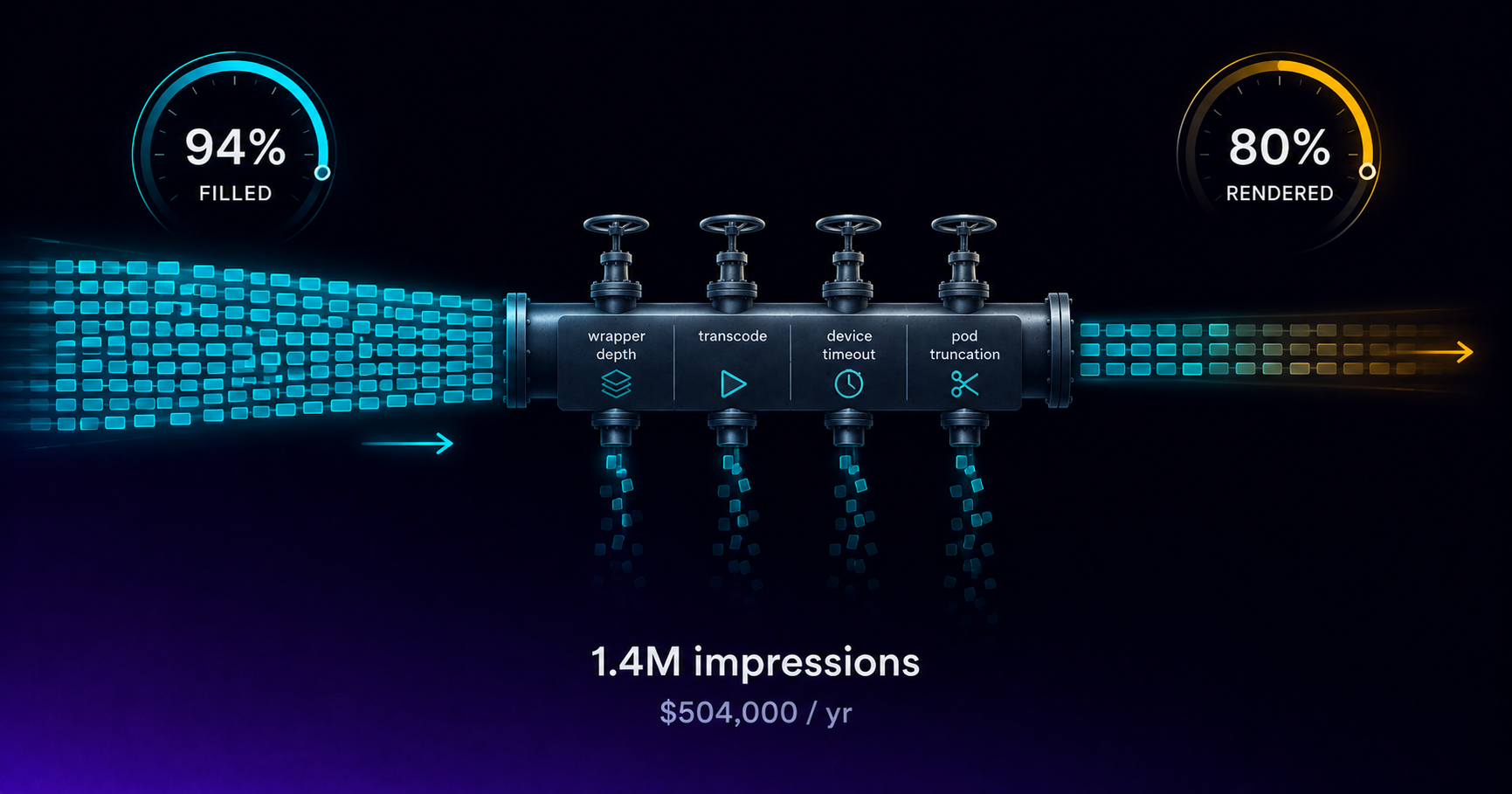
Header bidding transformed web display advertising by replacing sequential waterfall auctions with simultaneous competition among multiple demand sources, producing higher publisher yields and more accurate price discovery. The same pressure to maximize yield from every available impression has driven CTV publishers to explore parallel demand competition — but the technical constraints of streaming video delivery make "header bidding" in CTV work fundamentally differently from its web counterpart. Understanding what parallel demand competition in CTV actually means, how server-side header bidding adapters work in SSAI environments, where the latency risks concentrate, and what yield gains are achievable in practice is essential for any publisher or operator evaluating whether to adopt this approach. This guide covers CTV header bidding from the architecture decision through the practical yield impact, using the LtvAdx ad server as the operational reference for publishers evaluating parallel demand configurations.
Why web header bidding does not translate directly to CTV
Web header bidding works because the browser is a JavaScript execution environment. A header bidding wrapper — Prebid.js being the most widely deployed — runs in the browser before the page loads, sends simultaneous bid requests to multiple SSPs and exchanges, collects bids within a timeout window, identifies the highest bid, and passes it into the ad server auction. The browser handles the parallelization; the page load sequence creates a natural window for the auction; and the display ad unit loads asynchronously after the winning creative is selected. No manifest stitching is involved; no streaming buffer is at risk; the user experience degradation is measured in milliseconds of page load time.
CTV changes every one of these conditions. CTV apps do not have a browser JavaScript environment where a Prebid wrapper can execute independently. The video player in a Roku or Fire TV app runs in a managed streaming context where the app developer controls the ad call, not an injectable wrapper. The timing constraint is much tighter: in an SSAI environment, the ad decision and creative stitching must complete before the player reaches the break point in the manifest — typically within 150–300ms of the SCTE-35 signal for live content, with no flexibility for a 500ms+ header bidding timeout that web display routinely accepts. And the consequence of latency failure is not a banner that loads slowly — it is dead air in a video stream or a missed break window that cannot be recovered.
Server-side header bidding in CTV: the correct architecture
The CTV equivalent of header bidding is server-side parallel demand competition: an ad server or header bidding server that fans out simultaneous bid requests to multiple DSPs and demand sources in parallel, collects responses within a tight timeout window, runs a unified auction across all responses, and returns the winning creative to the SSAI stitcher before the break window expires. This all happens server-to-server without any client-side JavaScript, which is why it is sometimes called "server-side header bidding" or "server-side parallel bidding" to distinguish it from the client-side Prebid model.
In this architecture, the LtvAdx ad server acts as the unified auction layer. When the SSAI stitcher requests an ad decision for an available break, the LtvAdx system fans out OpenRTB bid requests simultaneously to all connected DSPs and demand sources, collects responses within the configured timeout window, runs a unified price comparison across direct IO campaigns, programmatic guaranteed deals, PMP deals, and open auction bids, and returns the highest-value valid creative to the stitcher. This is what happens in every LtvAdx auction — the question for publishers evaluating "header bidding" is specifically whether they want to add additional SSP layers alongside the LtvAdx primary auction.
The Prebid Server for OTT (Prebid for video) is the open-source implementation of this pattern that has gained adoption among sophisticated CTV publishers. Prebid Server runs on the publisher's infrastructure, receives an ad request from the SSAI stitcher, fans out to multiple SSP adapters simultaneously, runs a unified auction, and returns a single VAST response to the stitcher. The key difference from web header bidding is the strict latency budget: Prebid Server for OTT must complete its entire auction cycle — fan-out, collection, comparison, and response — within the SSAI stitcher's timeout window, typically 200–400ms total.
Latency budget management in CTV parallel bidding
Latency is the core operational challenge of CTV header bidding. The total timeout budget from break detection to creative available for stitching is determined by the live stream advance notice (typically 2–5 seconds from SCTE-35 signal) minus the SSAI stitching time (typically 50–100ms for media file packaging). This leaves 1.9–4.9 seconds for the entire ad decision process, including the header bidding auction.
Within that window, every millisecond spent on parallel bidding reduces the window available for VAST redirect resolution and creative packaging. A header bidding server with a 300ms timeout for demand responses, followed by a 200ms VAST redirect chain and 150ms creative packaging, consumes 650ms total — leaving ample margin in a 2-second window but risky in a 1-second window during peak live sports break detection scenarios. Publishers running parallel bidding for live sports content should configure conservative timeout windows and monitor timeout rates in the LtvAdx reporting dashboard to identify demand sources with consistently slow response times that should be deprioritized or excluded from live inventory.
For VOD content, the latency constraint is less severe because the break timing is known at session start rather than signaled in real time. The SSAI stitcher can initiate the ad decision process seconds before the player reaches the break point, giving the header bidding server a larger effective timeout window and reducing the risk of creative gaps from slow demand response.
Yield impact: what parallel demand competition actually delivers
The yield improvement from adding parallel demand competition depends on the publisher's baseline demand configuration. Publishers with a single SSP connection and limited demand source diversity see the largest gains from adding parallel bidding — introducing 3–5 new demand sources into simultaneous competition raises bid density, increases the probability of competitive clearing CPMs, and reduces the fill rate impact of any single demand source having a bad inventory day.
Publishers already running on a diverse multi-SSP waterfall see smaller marginal gains because their demand density is already elevated. The incremental yield from adding a parallel bidding layer to an already well-optimized 5-SSP waterfall is typically 5–15% rather than the 20–40% gains that initial demand diversification provides. The marginal gain must be weighed against the operational complexity and latency risk introduced by the additional parallel bidding layer.
The clearest yield signal for evaluating parallel demand competition is bid density analysis: how many bids does the publisher receive per impression on current inventory? If average bid density is below 3 bids per impression, demand source diversification — whether through parallel bidding or adding additional SSP connections in the LtvAdx demand waterfall — will produce material yield improvement. If bid density is already above 6–8 bids per impression, additional demand sources produce diminishing returns relative to floor price optimization and deal mix improvement, which are covered in the yield optimization guide.
LtvAdx demand configuration as an alternative to external header bidding
Publishers evaluating CTV header bidding are often attempting to solve a demand diversity problem that LtvAdx's native demand configuration can address without the latency risk of an external parallel bidding server. The LtvAdx ad server already fans out simultaneously to all connected demand sources in each auction — adding more DSP connections, activating PMP deals with additional buyers, and opening inventory to the open auction are all ways to increase bid density within the single-server architecture.
Configure additional demand sources in the LtvAdx publisher portal under demand partnerships. Each added DSP connection increases bid fan-out without adding an external server in the latency chain. For publishers who specifically need access to demand sources not currently connected to LtvAdx, the partner API supports custom demand adapter configuration. This approach — expanding demand within the LtvAdx exchange rather than adding an external header bidding server — preserves the sub-10ms ad decision speed and single-point competitive separation enforcement that SSAI delivery requires.
Publishers for whom external Prebid Server adoption is the right decision — typically large streaming publishers with dedicated ad technology teams and existing Prebid infrastructure — should plan the latency budget carefully before deployment, run the integration in a non-live VOD environment first, and instrument timeout and fill rate monitoring before extending to live content. The LtvAdx system supports Prebid Server as an upstream demand source through standard OpenRTB integration when this configuration is required.
Supply path transparency in multi-SSP CTV environments
Adding multiple SSP layers through parallel bidding creates supply path complexity that buyers will audit through SPO programs. Each SSP in the parallel chain must be declared in app-ads.txt as an authorized reseller; sellers.json entries must accurately reflect each platform's role; and schain objects must carry the full parallel chain when bids transit through multiple SSP layers before reaching the DSP. Publishers who add parallel bidding without updating their supply chain declaration documents will see buyer-side SPO filters deprioritize their inventory regardless of the bid price. Complete supply chain transparency maintenance is a prerequisite for any parallel demand architecture, not an optional follow-on step. To discuss demand configuration and supply chain setup, contact the publisher team or request a technical walkthrough.