Viewability in digital advertising was invented to solve a web display problem: banner ads served to positions below the fold that no user ever scrolled to, or in hidden iframes, counted as impressions and drained advertiser budgets without delivering any actual exposure. The MRC (Media Rating Council) defined the web display viewability standard — 50% of pixels in view for one continuous second — and the industry accepted it as the minimum quality threshold for a billable impression. CTV advertising has no equivalent problem in the classical sense. There is no below-the-fold position on a television screen; there is no hidden iframe in a Roku app; a CTV ad either occupies the full screen or it does not exist. Yet viewability in CTV has become a topic of genuine operational importance — not because the same display-era problem exists, but because the question of whether a human viewer was actually present and watching during an ad impression is a harder measurement problem than it appears. This guide covers how viewability is defined, measured, and applied in CTV, what standards exist, and how VCR and completion rate relate to (but differ from) viewability in connected TV advertising.
Why web viewability standards do not apply to CTV
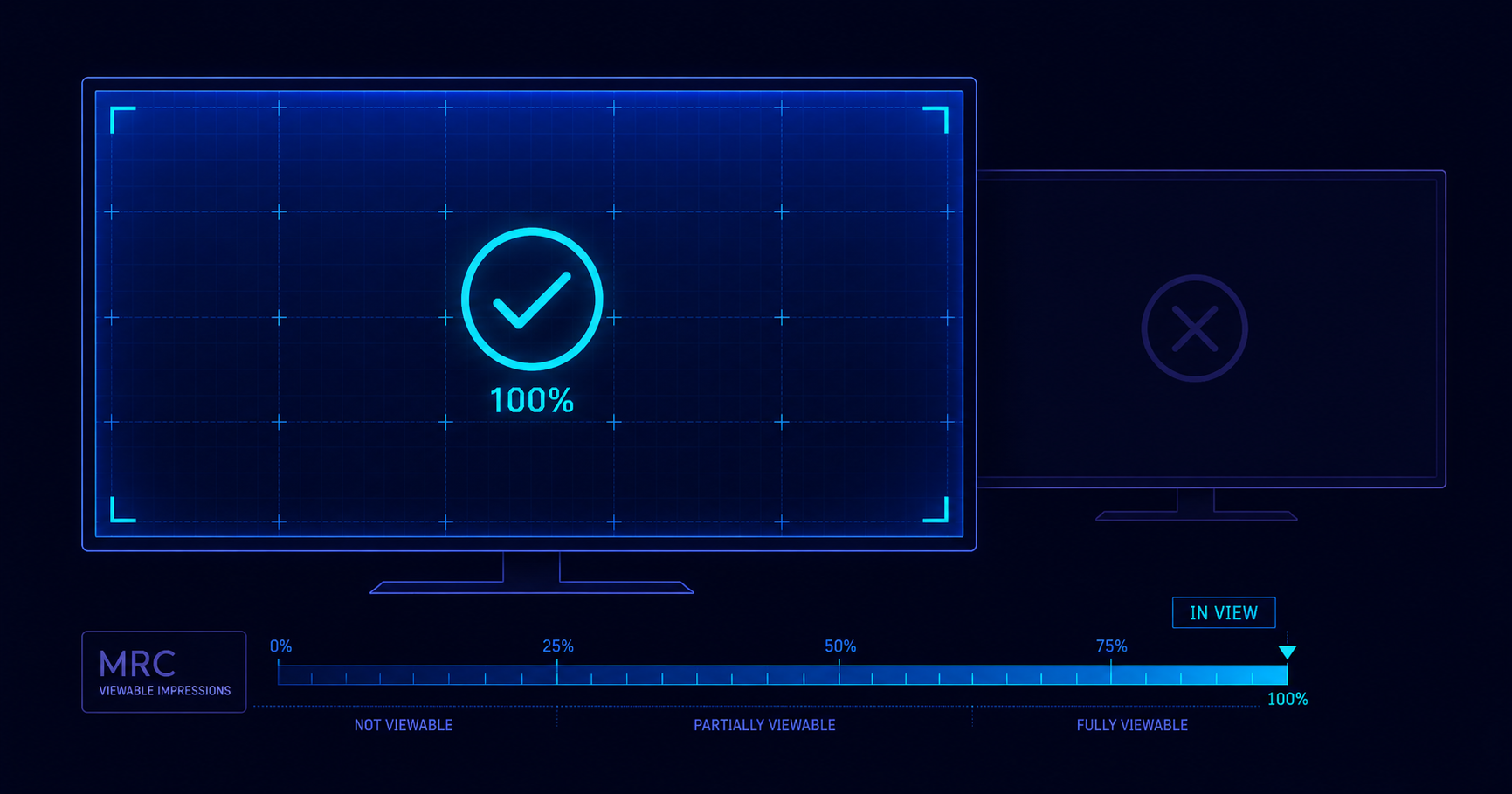
The MRC viewability standard — 50% pixels in view for one continuous second for display; 50% pixels in view for two continuous seconds with audio for video — was designed for web browser environments where ads can be rendered in non-visible portions of a page. In a CTV streaming app, the ad always occupies 100% of the screen at full resolution when the app is in the foreground. There is no partial pixel scenario. The minimum threshold of "50% of pixels visible" is trivially met by every CTV ad that serves at all.
The MRC recognized this structural difference and issued guidance that CTV video advertising meets viewability requirements by definition when the impression is delivered to an active CTV app session in the foreground. What remains unresolved — and what practitioners are actually debating when they discuss CTV viewability — is not pixel position but viewer presence. An ad that occupies 100% of a 65-inch screen is technically viewable, but whether a human being was in the room, oriented toward the screen, and cognitively engaged with the content during the 30-second spot is a different measurement question entirely.
This viewer presence question is legitimate and commercially significant. CTV's premium CPMs are justified in part by the assumed lean-back, engaged viewing context. If a meaningful share of CTV impressions is served while viewers have left the room, fallen asleep, or switched their attention to a phone, the actual quality of the exposure is materially lower than the premise of CTV premium pricing. Measurement infrastructure for viewer presence in CTV is developing but not yet standardized, and honest discussion of what is known requires separating technical viewability from viewer attention.
What MRC and the industry have established for CTV
The MRC's CTV measurement guidelines, most recently updated in its Cross-Media Audience Measurement Standards, establish that CTV video ads are treated as in-view when delivered to an app in active foreground use on a connected television device. The standards require that impression counting distinguish between foreground app state (app visible and active) and background app state (app running but not displayed), with only foreground impressions counting as valid.
Operationally, this foreground/background distinction is the meaningful viewability control available in CTV. An app running in the background — a music app playing audio while another app is displayed, or a streaming app whose session was not explicitly closed before another was opened — can fire SSAI impression beacons for content that is not displayed on screen. Proper CTV app implementation closes the media session and stops ad calls when the app enters the background. Apps that continue ad serving in background states produce what are effectively non-viewable impressions despite technical compliance with the ad serving protocol.
Publishers on the LtvAdx SSAI platform should implement app lifecycle handling that halts ad requests when the streaming app enters the background state. The SSAI session should be terminated or paused on background transitions and resumed on foreground return. This is both a technical quality requirement and a commercial trust requirement — advertisers and DSPs are beginning to audit CTV publisher quality for background impression signals, and publishers who generate background impressions risk demand source deprioritization in supply path optimization programs.
VAST 4.2 verification and third-party viewability measurement
VAST 4.2 introduced the verification node — a <Verification> element in the VAST XML that carries instructions for third-party measurement vendors to execute their measurement code independently of the ad serving infrastructure. This was specifically designed to solve the SSAI viewability problem: when ads are stitched into the manifest server-side, there is no browser JavaScript environment for IAS, DoubleVerify, or Oracle Moat to execute their traditional measurement scripts. The verification node enables these vendors to fire measurement events through the player SDK rather than through JavaScript injection.
In practice, third-party CTV viewability measurement through VAST 4.2 verification nodes is still in deployment across the ecosystem. The largest DSPs and verification vendors support it; many CTV apps have integrated the player SDK changes required to execute verification node instructions. Publishers running LtvAdx who want to enable third-party viewability verification should confirm their streaming app SDK supports VAST 4.2 verification node execution and that their VAST responses include properly configured verification node content. The configuration details are in the LtvAdx integration documentation.
IAS and DoubleVerify both offer CTV measurement products based on VAST 4.2 verification nodes. These products confirm impression-level signals including foreground app state, session validity, and in some implementations screen-on detection. Advertisers requiring third-party viewability certification for CTV campaigns should specify VAST 4.2 verification node support as a deal requirement when negotiating with publishers or configuring programmatic campaigns on the LtvAdx advertiser platform.
Screen-on detection and viewer presence measurement
The most advanced CTV viewability question — is a human present and watching — is addressed through two emerging signal types. Screen-on detection uses smart TV operating system signals or HDMI handshake data to confirm whether the television display is powered on during ad delivery. A streaming session on a Roku device connected to a TV that is powered off still generates app-level ad requests; screen-on detection would filter these as non-viewable. Some smart TV manufacturers expose screen state signals that publishers can incorporate into their ad session logic, but this capability is not universally available across the device universe.
Attention measurement in CTV is a frontier research area rather than an operational standard. Eye-tracking research conducted in household environments suggests that CTV viewer attention during ad breaks is meaningfully higher than in linear TV viewing contexts — partly because streaming service ad loads are lower, creating less fatigue, and partly because streaming viewers who have opted into an ad-supported service have explicitly accepted advertising as part of the value exchange. These panel-based findings are directionally useful but do not produce impression-level attention scores that can be applied operationally to campaign measurement.
Viewability in the context of CTV pricing
The commercial significance of CTV viewability standards is their relationship to CPM premiums. Premium CTV CPMs of $25–$45 are justified by the combination of full-screen non-skippable delivery, lean-back co-viewing context, and high completion rates. If viewability measurement were to reveal that a material share of CTV impressions are served to screens that are off, apps that are backgrounded, or rooms that are empty, CPM pressure from buyers would follow.
The industry's current position is that CTV's viewability profile — properly measured with foreground-app confirmation and screen-on detection where available — is meaningfully better than web display and comparable to or better than linear TV viewing context. Linear TV impression quality has never been measured to the individual-impression level; it is estimated from panel data that cannot confirm whether a specific viewer was present for a specific commercial. CTV's ability to produce foreground-confirmed impression data represents a quality transparency improvement over linear, even before viewer presence measurement is fully standardized.
Publisher best practices for CTV viewability
Publishers who want to demonstrate high viewability quality to buyers — and command the CPMs that premium viewability justifies — should implement four practices. First, proper app lifecycle management: halt ad sessions when the app backgrounds; resume on foreground return; never serve ad requests from background app states. Second, VAST 4.2 verification node support: enable third-party measurement vendors to confirm impression quality independently. Third, screen-on detection where available: suppress ad requests when screen state signals indicate the television display is off. Fourth, transparent reporting: surface app foreground rate and session quality metrics in publisher reporting alongside standard delivery metrics so buyers can audit impression quality.
The LtvAdx reporting system surfaces session quality signals including foreground impression rate and app lifecycle event data for publishers who have implemented proper session management in their CTV app SDKs. For publishers configuring viewability controls in new CTV app integrations, the integration documentation covers the session lifecycle API calls required for proper foreground/background handling. Advertisers who want to configure viewability requirements in programmatic campaigns should review the verification node setup in the advertiser platform documentation or contact the LtvAdx team for guidance on verification vendor integration. To see viewability reporting capabilities in the platform, request a demonstration.