Deal IDs are the operational infrastructure of premium CTV programmatic buying. Every private marketplace deal, every programmatic guaranteed arrangement, and every preferred access agreement between a CTV publisher and a programmatic buyer is executed through a deal ID — a unique identifier that tells the supply-side system which buyer should receive priority access to specific inventory and on what terms. Despite being the mechanism behind the majority of high-value CTV transactions, deal IDs are frequently misconfigured, poorly understood, and responsible for a disproportionate share of campaign delivery failures that ad operations teams spend hours debugging. This guide explains how deal IDs work in CTV programmatic from first principles — the data structure, the auction mechanics, the configuration requirements on both publisher and buyer sides, and the common failure modes — using the LtvAdx ad server and publisher platform as the operational reference.
What a deal ID is and what it contains
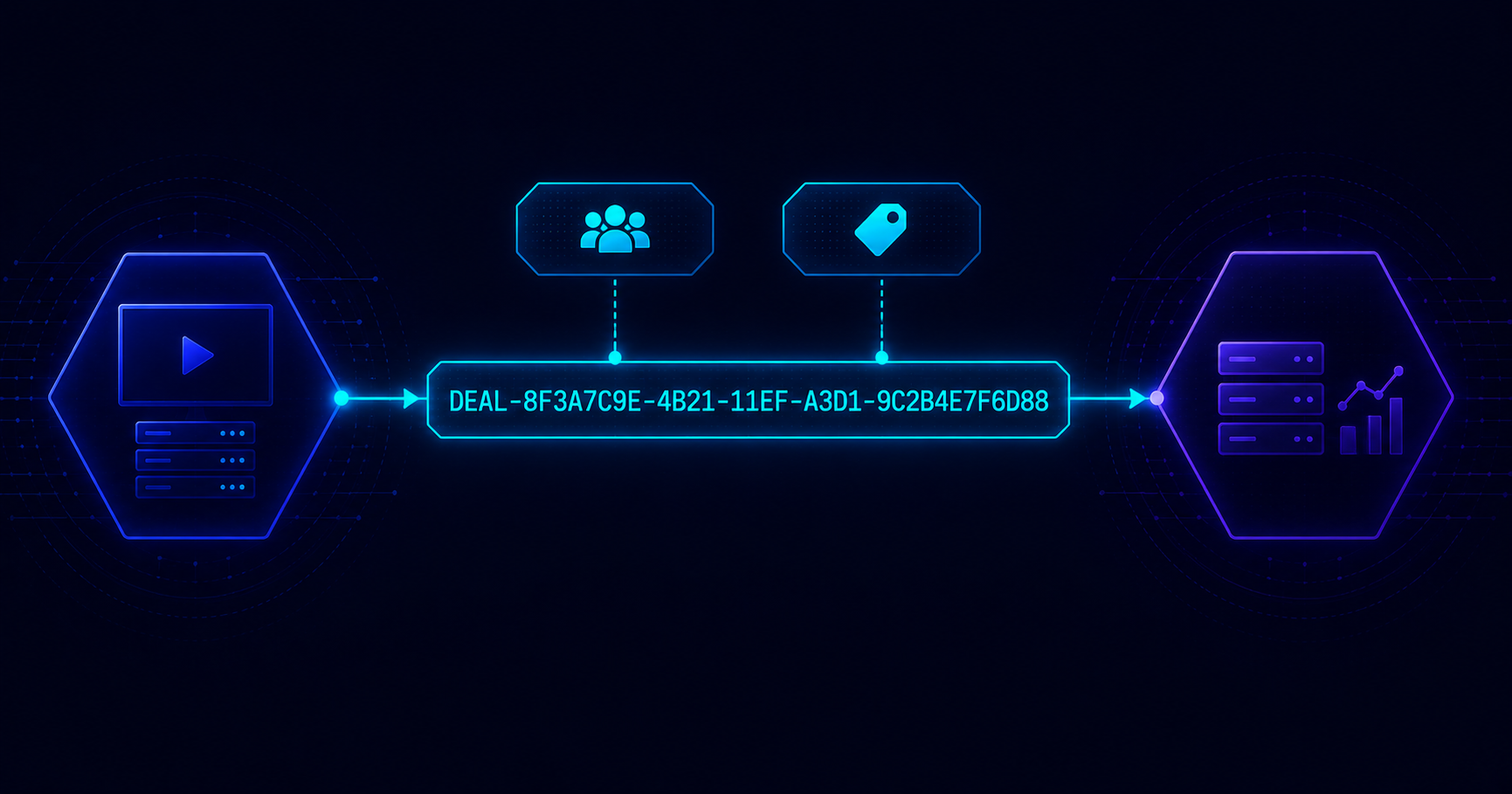
A deal ID is a string identifier — typically alphanumeric, 10–40 characters — that represents a negotiated agreement between a specific publisher (or SSP) and a specific buyer (or DSP seat). The deal ID is created by the supply-side platform and shared with the buyer, who activates it in their DSP as a targeting criterion. The deal ID carries metadata: the floor price for the deal, the eligible inventory (which publisher, which content types, which ad formats), the eligible buyer (which DSP seat ID), and the deal type (PMP, PG, or preferred). This metadata is stored in the SSP and not transmitted in the bid request itself — only the deal ID string appears in the bid request, and both parties' systems look up the associated deal terms from their stored records.
In an OpenRTB bid request, deal IDs appear in the imp[].pmp.deals array. Each deal object contains: the deal ID string (id), the floor price for this deal (bidfloor), the floor currency (bidfloorcur), the deal type indicator (at— 1 for first-price, 2 for second-price, 3 for fixed-price), and optional extensions for deal-specific targeting constraints. The buyer's DSP reads this array, identifies deal IDs that match active campaigns, and if a match is found, responds with a bid that includes the deal ID in the seatbid[].bid[].dealid field of the bid response. The SSP reads the bid response, confirms the deal ID is valid and the bid meets the deal floor, and awards the impression to the deal-linked bid with the priority level the deal specifies.
PMP deals: priority access without commitment
Private marketplace deals give a buyer priority access to specific publisher inventory at a negotiated floor price. The buyer is invited to bid — ahead of open auction competition — but is not obligated to buy. When a bid request arrives that matches the PMP deal's eligible inventory, the SSP includes the deal ID in the pmp.deals array and waits for the buyer's response. If the buyer bids at or above the floor, their deal-linked bid wins over open auction bids of higher value. If the buyer does not bid on a particular impression (due to audience targeting mismatches, creative format restrictions, or frequency caps), the impression falls through to the open auction.
PMP deal configuration in the LtvAdx publisher portal requires: deal name, eligible buyer DSP seat ID (or multiple seats for multi-buyer PMP packages), eligible inventory definition (all publisher inventory, specific content categories, specific dayparts, or specific apps), floor price, creative format requirements (duration constraints, VAST version requirements), and the deal activation start and end dates. Publishers should configure PMP deals with specific inventory definitions rather than "all inventory" umbrella deals to ensure the premium pricing of the deal reflects the specific inventory segment the buyer is paying for.
Common PMP deal failure modes: the buyer's DSP activates the deal ID in the wrong campaign, meaning the deal ID appears in bid responses from campaigns that have targeting constraints incompatible with the deal's inventory (a mobile-only campaign responding to CTV deal bid requests); the buyer bids below the deal floor because the DSP's automated bidding algorithm does not recognize deal floors as hard minimums; the deal is configured with an incorrect buyer seat ID, causing the SSP to not recognize the buyer's bid response as deal-linked; or the deal expiry date passes without renewal, leaving the buyer bidding on what they believe is PMP inventory through open auction.
Programmatic guaranteed deals: committed volume and fixed CPM
Programmatic guaranteed deals add two elements to the PMP structure: a committed impression volume and a fixed CPM. The buyer commits to purchasing a minimum number of impressions from the deal; the publisher reserves that inventory and is obligated to deliver it. The PG deal type indicator in the OpenRTB deal object (at: 4 in some SSP implementations) signals that this is a fixed-price transaction rather than an auction. The deal floor price is the clearing price — not a minimum that a higher bid can exceed, but the exact price for every impression.
PG deals require additional operational setup beyond PMP deals. The publisher must configure delivery pacing on the deal to prevent over-delivery early in the flight; the buyer must confirm that their DSP will respond with a bid on every eligible impression (not just when the audience matches additional targeting layers beyond the deal). Creative pre-approval is required before the deal goes live — the publisher reviews the buyer's VAST creative for format compliance, content appropriateness, and competitive separation before impressions begin delivering.
Deal-level reporting for PG transactions should track: impressions delivered versus committed (pacing against the guaranteed volume), clearing CPM (should be exactly the committed CPM for a fixed-price deal — deviation indicates a deal configuration error), creative rotation delivery if multiple creatives are in flight, and any discrepancy between publisher-counted and buyer-counted impressions. Configure pacing alerts at 75% of expected mid-flight delivery in the LtvAdx reporting dashboard to catch underdelivery before it creates a billing dispute.
Deal ID auction mechanics and priority stacking
The auction mechanics for deal-linked bids operate through a priority stack that determines the order in which demand tiers compete for each impression. In LtvAdx, the priority order is: programmatic guaranteed deals first (delivering at committed CPM against reserved inventory), then PMP deals (prioritized over open auction at or above the deal floor), then open auction (unrestricted competition among all eligible bidders), then house ads or slate (final fallback).
Within the PMP tier, multiple competing deal bids on the same impression are ranked by bid price — the highest deal-linked bid above the deal floor wins. This means publishers can have multiple PMP deals for the same inventory segment with different buyers: the buyer who bids highest above their respective deal floor wins, and the clearing price is typically second-price above the higher of the two deal floors. Publishers should be cautious about PMP floor consistency when multiple deals overlap on the same inventory — conflicting floor prices across overlapping deals can produce unexpected winner outcomes.
The interaction between deal IDs and pod-level competitive separation is important for publishers operating multi-slot pods with deal-linked buyers. If slot one is won by a deal-linked automotive advertiser, the competitive separation rules must evaluate subsequent slots' deal bids against the slot one winner — even if the slot two deal is from a different buyer for different inventory. The LtvAdx ad server applies competitive separation across deal and open auction impressions within the same pod, ensuring deal mechanics do not inadvertently create competitive adjacency that violates advertiser separation requirements.
Troubleshooting deal delivery failures
Deal delivery failures are among the most common operational problems in CTV programmatic ad operations, and they frequently go undetected for days before fill rate anomalies surface in publisher reporting. The diagnostic framework for deal delivery failures starts with confirming the deal is active on both sides: the publisher portal shows the deal as active with the correct buyer seat ID and floor price; the buyer's DSP shows the deal ID as activated in the relevant campaign with a bid price at or above the floor.
If both sides show the deal as active but delivery is zero or near-zero, the next diagnostic step is checking the bid request logs in the LtvAdx reporting API for whether the deal ID is appearing in bid requests sent to the buyer's DSP. If the deal ID is appearing in bid requests but the buyer is not responding with deal-linked bids, the failure is on the DSP side — the DSP may not be recognizing the deal ID, may have the wrong seat ID configured, or may be filtering the inventory with targeting constraints that exclude the deal's eligible inventory. If the deal ID is not appearing in bid requests at all, the failure is on the publisher configuration side — the deal's eligible inventory definition may not match the impressions being auctioned.
Configuring deals in LtvAdx
Publishers create and manage deal IDs in the LtvAdx publisher portal under the Deals section. Creating a new deal requires: selecting the deal type (PMP or PG), specifying the buyer DSP and seat ID, defining eligible inventory (with the option to scope by app, content category, daypart, or device type), setting the floor CPM, defining creative requirements, and setting the deal activation window. The portal generates the deal ID string that the publisher shares with the buyer for DSP activation.
For programmatic buyers accessing LtvAdx supply through deal IDs, the LtvAdx developer documentation provides the deal object specification for OpenRTB bid request parsing and the bid response format for deal-linked responses. For buyers unfamiliar with deal configuration in their DSP, the LtvAdx team provides deal activation guidance as part of the onboarding process.
To understand the deal structures available for your specific inventory needs as a publisher, or to access deal inventory as a buyer or agency, the best starting point is the LtvAdx commercial team for deal term discussion or the publisher portal self-serve flow for deal creation. Request a demonstration to see deal configuration and monitoring in the platform UI.