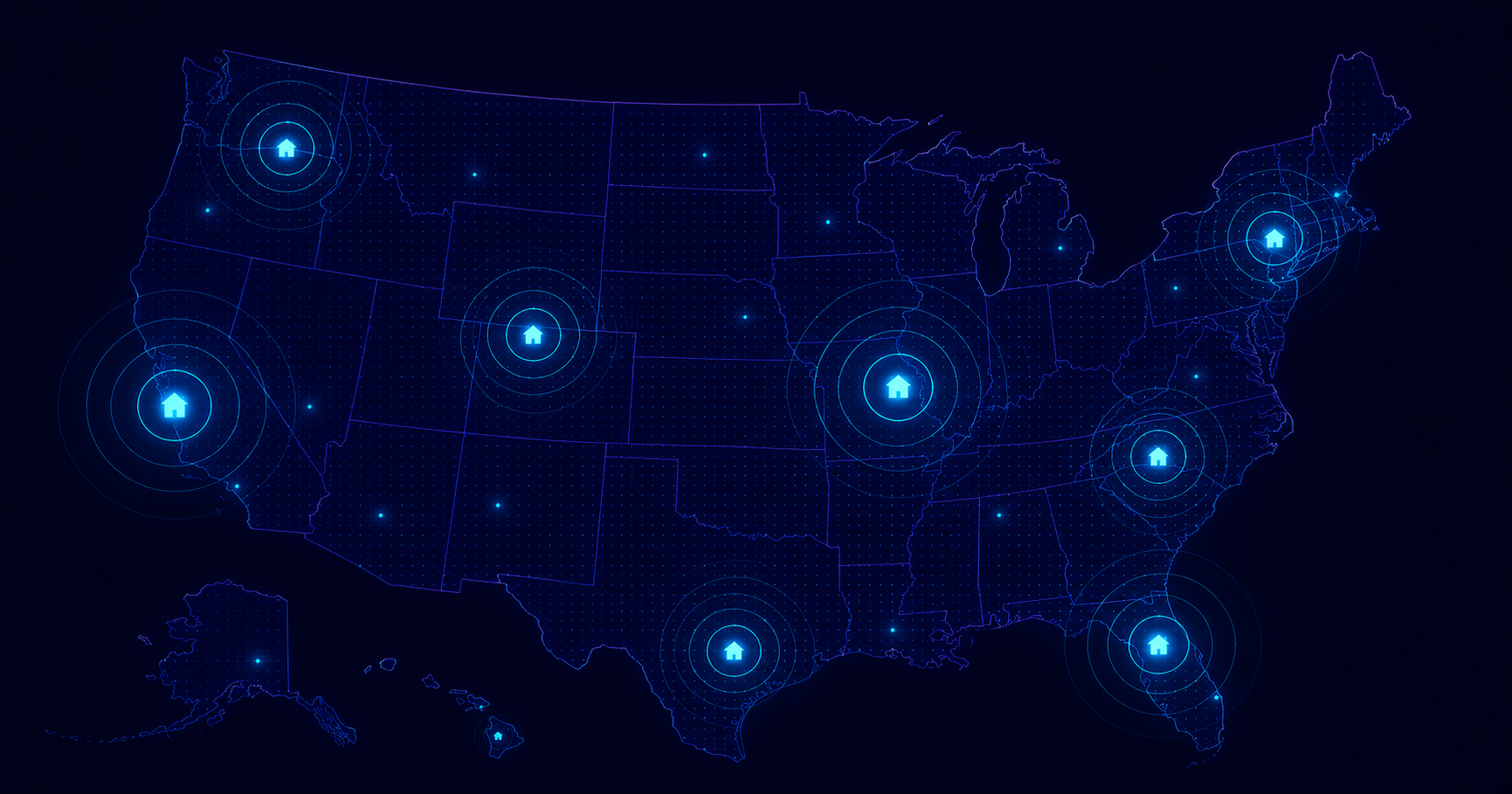
Geographic targeting in CTV advertising enables a precision that linear television advertising could never achieve. Traditional local TV advertising buys time on a broadcast or cable channel that reaches an entire market — the Chicago DMA, the Dallas-Fort Worth DMA — whether the advertiser's customers are spread across the whole market or concentrated in specific suburbs and zip codes. CTV geotargeting serves ads to households in specific geographic boundaries: a dealership targeting zip codes within 15 miles of their store, a gubernatorial campaign targeting counties where the race is competitive, a regional grocery chain targeting the neighborhoods where their stores operate. The precision is digital; the screen is television; the audience quality and completion rate are the highest in video advertising. This guide covers CTV geotargeting mechanics, accuracy, use cases, and configuration on the LtvAdx advertiser platform.
How CTV geotargeting works: IP-to-household location
CTV geotargeting relies primarily on IP address-to-location matching. Every household internet connection has an IP address assigned by the internet service provider (ISP). IP geolocation databases maintained by specialized providers map IP addresses to geographic locations by analyzing the ISP's network topology and cross-referencing with registration data, wireless tower locations, and other signals. When a CTV device makes an ad request, the IP address in the request is matched against these databases to determine the household's location at DMA, city, zip code, or in some cases block-level precision.
IP geolocation accuracy varies significantly by connection type. Fixed residential broadband connections (cable, fiber, DSL) produce the highest accuracy — 95%+ DMA-level accuracy and 85%+ zip code accuracy — because the IP is assigned to a specific service address by the ISP. Mobile broadband connections (cellular home internet, such as T-Mobile Home Internet or Verizon 5G Home) carry less precise geolocation because cellular IP assignment is tied to the carrier's network point of presence, which may cover a broader geographic area than the household's actual location. Shared IP environments — apartment buildings with a single building-level ISP connection, university campuses, hotel Wi-Fi — produce location data for the shared connection point rather than the individual unit.
For the majority of US CTV households — approximately 85% of which use fixed residential broadband — IP geolocation provides sufficient accuracy for DMA, county, and zip code targeting. The LtvAdx HouseholdID system incorporates IP-to-location mapping as a standard component of the household profile, enabling geographic targeting at the DMA, state, county, zip code, and congressional district levels for campaigns running on LtvAdx inventory.
DMA targeting: the standard unit of TV geographic planning
Designated Market Areas (DMAs) are the 210 geographic television advertising markets defined by Nielsen that have structured the business of local TV advertising for decades. DMA boundaries define which local broadcast stations a household can receive over-the-air and which cable and satellite channel packages are applicable to that market. DMA-based buying is the universal vocabulary of local TV advertising — media buyers, publishers, and ad servers all reference DMAs as the standard geographic unit.
CTV geotargeting at the DMA level is the most mature and broadly available geographic targeting capability in streaming advertising. Every major CTV SSP, DSP, and publisher supports DMA-level targeting, and accuracy at DMA level is consistently high because the geographic boundary is large enough that IP location uncertainty rarely crosses DMA lines. For national advertisers running market-weighted campaigns — allocating budget proportionally to market opportunity across multiple DMAs — DMA-level CTV targeting provides a direct equivalent to the local TV buy structure that is familiar to traditional broadcast buyers.
Configure DMA targeting in the LtvAdx advertiser platform by selecting from the standard 210 Nielsen DMA codes. For campaigns running across multiple DMAs with different budget allocations by market, configure separate line items per DMA with budgets reflecting market priority, rather than a single line item with multiple DMA targets sharing a global budget — the latter produces uncontrolled delivery distribution that typically over-delivers in large markets at the expense of smaller-market coverage.
Zip code targeting: precision for local advertisers
Zip code targeting in CTV enables the local retail, service, and political advertiser use cases that DMA targeting is too broad to serve. A plumbing company wants customers within a 20-minute service radius, not the entire Chicago DMA. A local auto dealer wants households within 25 miles of their dealership, not all of northeastern Illinois. A city council candidate wants voters in their district, not the entire metropolitan market. Zip code targeting serves all of these by restricting ad delivery to the specific postal codes that constitute the advertiser's relevant market.
Zip code targeting accuracy in CTV is strong for residential fixed broadband — approximately 85% of targeted zip code impressions land in the intended zip code or an immediately adjacent one. The ~15% margin reflects the IP geolocation uncertainty described above and is consistent with the accuracy provided by zip code geolocation in digital display advertising. For local advertisers used to buying cable zone inserts, this accuracy is a significant improvement — cable zones often cover multiple zip codes and lack the household-level identity data that CTV provides for audience targeting within the geographic boundary.
When configuring zip code targeting campaigns, calculate the household universe in the target zip codes before setting budget expectations. A campaign targeting 15 zip codes in suburban Minneapolis may have a total addressable CTV household universe of 80,000–120,000 households — at 3 impressions per household per flight, the maximum efficient campaign volume is 240,000–360,000 impressions before frequency capping limits incremental reach. Budget beyond this scale in a tight geographic target produces frequency excess rather than incremental reach. The frequency capping guide covers how to configure household caps that prevent over-frequency in geographically constrained campaigns.
Radius targeting: distance-based local advertising
Radius targeting — reaching households within a defined distance from a specific location — is a natural fit for retail, automotive, home services, and restaurant advertisers whose customer catchment area is defined by drive time or distance rather than by administrative boundaries like zip codes or counties. A national fast-casual restaurant chain may want to target within 5 miles of each of their 200 store locations simultaneously; a tire shop chain may want 10-mile radius targeting around 50 locations in a regional market.
CTV radius targeting is implemented by converting the radius boundary to a set of zip codes that fall partially or fully within the radius and applying those as a zip code target list. This is an approximation rather than a precise geofence — zip codes are irregular polygons that do not conform to circular boundaries — but it is the standard approach in programmatic CTV because the IP geolocation precision that would support true polygon-level targeting is only available for a minority of impressions where more precise location data exists in the bid request.
For national advertisers running radius campaigns at scale across many locations, the LtvAdx partner API supports bulk zip code list upload for location-based campaign configuration. Rather than manually identifying zip codes for each location, input a list of store addresses and radius distance, and the API generates the appropriate zip code targeting lists for each location.
Congressional district and political geographic targeting
Political advertising requires geographic targeting at the administrative boundary level — congressional districts, state senate districts, state house districts, county commission districts — that do not align with DMA or zip code boundaries. A congressional district may cross zip code lines, county lines, and even DMA lines in the case of districts that span metropolitan-rural boundaries. Accurate political geographic targeting requires the ability to target at the district level using boundary data rather than zip code approximations.
District-level CTV targeting is available through geographic boundary data overlaid on IP-to-location data, with the accuracy caveats that apply to zip-level targeting and the additional complexity of district boundaries that do not align with ISP geographic segmentation. For the political advertising use case, the combination of voter file targeting (matching registered voters in the district to their CTV household devices through email hashing) and geographic targeting (IP-to-district boundary matching) provides better accuracy than geographic boundary targeting alone. The CTV political advertising guide covers how these two targeting approaches combine for campaign execution.
Geo-fenced OOH retargeting in CTV
An advanced CTV geotargeting use case is the retargeting of households whose devices were observed in a specific physical location — a competitor's store, a convention venue, a sporting event — through their mobile device location data. Households identified through mobile device geo-fencing are matched to their home IP address (via mobile-to-home connection inference) and retargeted with CTV advertising when they return home and use their streaming devices. This technique, sometimes called "OOH retargeting to CTV," bridges physical world behavior with streaming ad delivery.
The accuracy of OOH-to-CTV retargeting depends heavily on the quality of the mobile-to-home device graph used for the connection. This is a probabilistic match — not deterministic — and match rates vary significantly by provider and geography. For advertisers in competitive retail categories (automotive, financial services, sporting goods) where competitor location visits are a strong purchase intent signal, the reach efficiency of geo-fenced CTV retargeting justifies the accuracy trade-off.
Measuring local CTV campaign effectiveness
Local CTV campaigns require measurement approaches calibrated to the geographic precision of the targeting. Household reach within the geographic target is the primary efficiency metric: what percentage of CTV households within the defined area were reached? This requires the HouseholdID reach data combined with a census estimate of total CTV households in the target geography to calculate reach percentage.
Outcome attribution for local CTV campaigns typically uses store visit lift — measuring whether households exposed to CTV advertising visit the advertiser's physical location at higher rates than unexposed control households in the same geographic area. Store visit attribution uses mobile location data to identify store visits from household member mobile devices, matched back to the HouseholdID key from the CTV delivery log. This attribution methodology is particularly relevant for the local retail, restaurant, and automotive dealer use cases described above.
For local advertisers using CTV for the first time, the CTV for performance advertisers guide covers the measurement setup and attribution configuration steps that enable outcome measurement beyond delivery reporting. The LtvAdx reporting system surfaces geographic delivery breakdowns by DMA and zip code for campaigns with geotargeting configured, enabling post-campaign verification that delivery landed in the intended geography. To discuss local or regional CTV campaign setup, contact the advertiser team or request a platform demonstration.