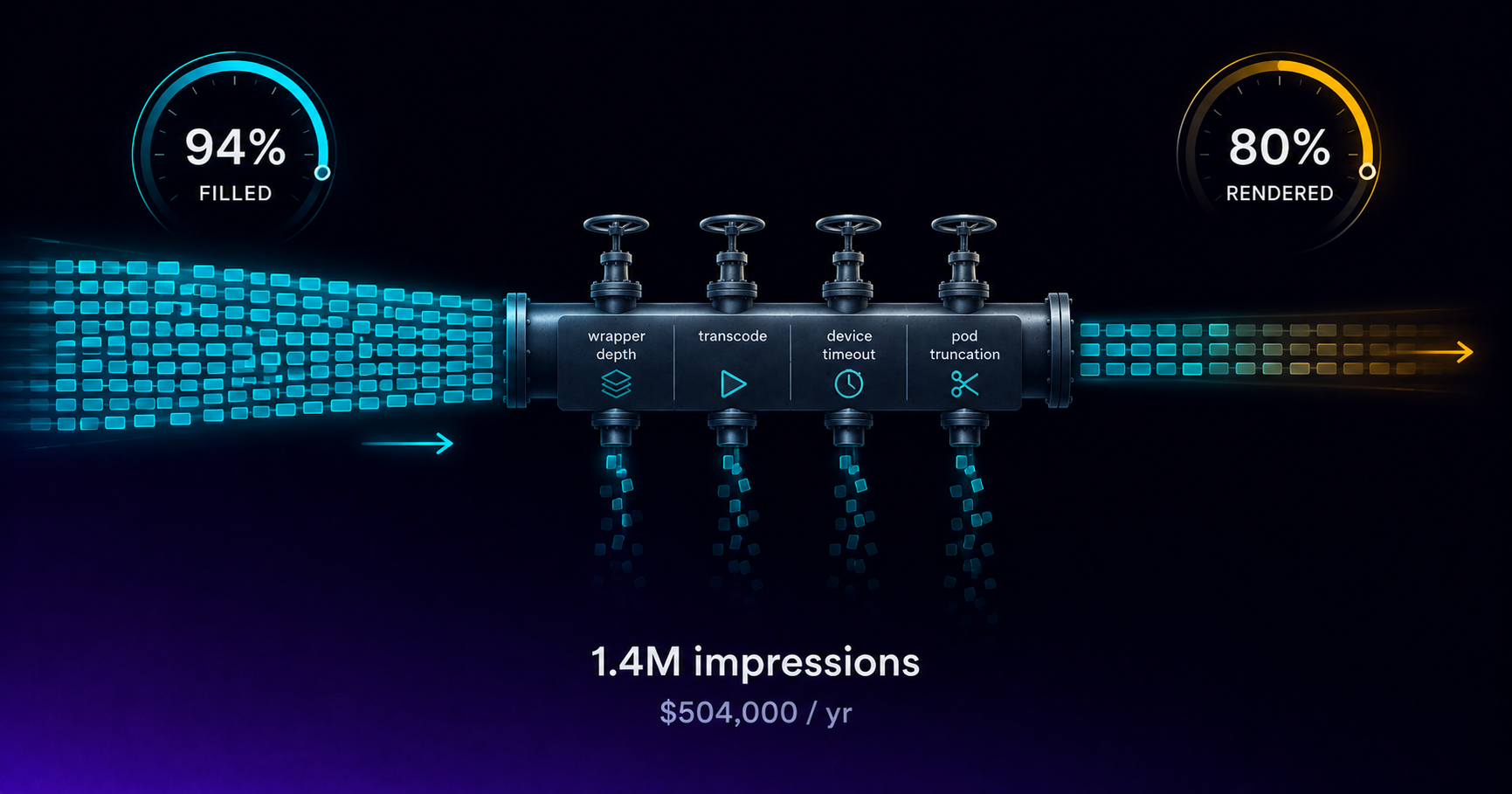
VAST — Video Ad Serving Template — is the IAB standard for communicating video ad metadata between ad servers and players, and version 4.2 is the one CTV publishers should be implementing against in 2026. It isn't a cosmetic update over 4.0: 4.2 formalizes the fields verification vendors and demand-side platforms actually require, and inventory served on an older VAST version increasingly fails brand safety verification on the DSPs that matter most. This guide covers what changed, what a compliant response needs to include, and the operational details that separate a spec-compliant tag from one that actually performs in production.
Why VAST 4.2 matters for CTV specifically
VAST 4.0 introduced the Verification resource model and ViewabilityVendor nodes that let third-party measurement vendors — IAS, DoubleVerify, MOAT — confirm an ad actually rendered in a viewable state. 4.2 refines that model and adds clearer support for server-side ad insertion, improved tracking event definitions, and better handling of multiple creatives within a single response. For CTV specifically, where client-side execution is constrained compared to a browser — no JavaScript verification tags, limited creative rendering — these server-declared fields carry more weight than they do in web video, because there's no client-side fallback to compensate for a gap in the VAST response.
Publishers running VAST 3.0 or earlier tags aren't necessarily broken today, but they're increasingly locked out of demand. DSPs that require ViewabilityVendor and Verification nodes for brand safety compliance will either reject the bid response outright or bid it down relative to VAST 4.x inventory carrying the same content. That demand gap tends to be invisible to a publisher until they specifically audit fill rate by VAST version — the auction doesn't announce why a bid didn't show up.
Key elements a compliant response needs
A VAST 4.2 response for CTV needs the media file — or, when the impression will be delivered via SSAI, a mezzanine reference the stitcher resolves rather than a direct client-side media URL — plus impression and quartile tracking URLs (start, firstQuartile, midpoint, thirdQuartile, complete), error beacons covering the standard VAST error code ranges, and, where a verification vendor is contracted, the AdVerifications node with the vendor's JavaScript resource or, for CTV, its native verification signal. Duration must be declared in HH:MM:SS format, not raw seconds — a common validation failure that causes strict CTV players to reject an otherwise-valid response.
Publishers should validate responses against the IAB spec using a real parser — the free VAST Tag Inspector and VAST Tag Validator tools both handle 4.2 — and then confirm behavior on actual devices, not just a desktop test player. Roku, tvOS, and Fire TV enforce spec compliance more strictly than web-based test tools, and a tag that passes validation but was never tested on-device is the most common source of production surprises after launch.
Operational best practices
Set ad request timeouts appropriate to CTV — typically 3–5 seconds, tighter than what many web video integrations use by default, because CTV players have less tolerance for a stalled break before viewers perceive it as broken playback. Log VAST errors by code rather than treating every failure as an undifferentiated miss: error codes in the 300 range point to wrapper chain problems (timeout, depth exceeded), 400-range codes point to media file delivery issues, and knowing which is failing determines whether the fix is on the demand side or the creative side.
Keep direct-sold and programmatic wrappers separated in your trafficking logic rather than routing both through the same generic wrapper chain — direct-sold campaigns typically have tighter creative QA requirements and don't need the same wrapper depth tolerance as programmatic demand that may pass through an exchange or two before resolving. When stitching server-side, confirm tracking pixels fire at the actual stitched timeline position in the manifest, not the position they'd occupy in an unstitched client-side play — a mismatch here is a common cause of completion rates that don't match what the buyer's own reporting shows, which becomes a reconciliation dispute nobody enjoys.
Migrating existing inventory to VAST 4.2
A full migration doesn't need to happen in one release. Publishers typically move their highest-value inventory — premium content, live sports, prime-time FAST pods — to VAST 4.2 first, since that's where the demand gap from verification requirements is most costly, then backfill the rest of the catalog over subsequent sprints. The VAST integration docs cover the specific response fields LtvAdx expects and validates against, which is a useful checklist even for publishers not yet on the platform.