YouTube and CTV represent the two largest video advertising environments outside linear television, and the decision about how to allocate budget between them is one that every significant video advertiser faces. The comparison is more nuanced than CPM or reach figures suggest: YouTube and CTV serve fundamentally different audience states, produce different creative exposure experiences, enable different measurement methodologies, and reach different demographic segments. This guide provides an honest, data-grounded comparison across every dimension that affects media planning — not a promotional argument for either platform, but a practical framework for making the allocation decision based on campaign objectives. Where CTV is the stronger fit, we explain why through the lens of the LtvAdx advertiser platform. Where YouTube is the stronger fit, we explain that too.
Audience state: lean-back television vs task-oriented browsing
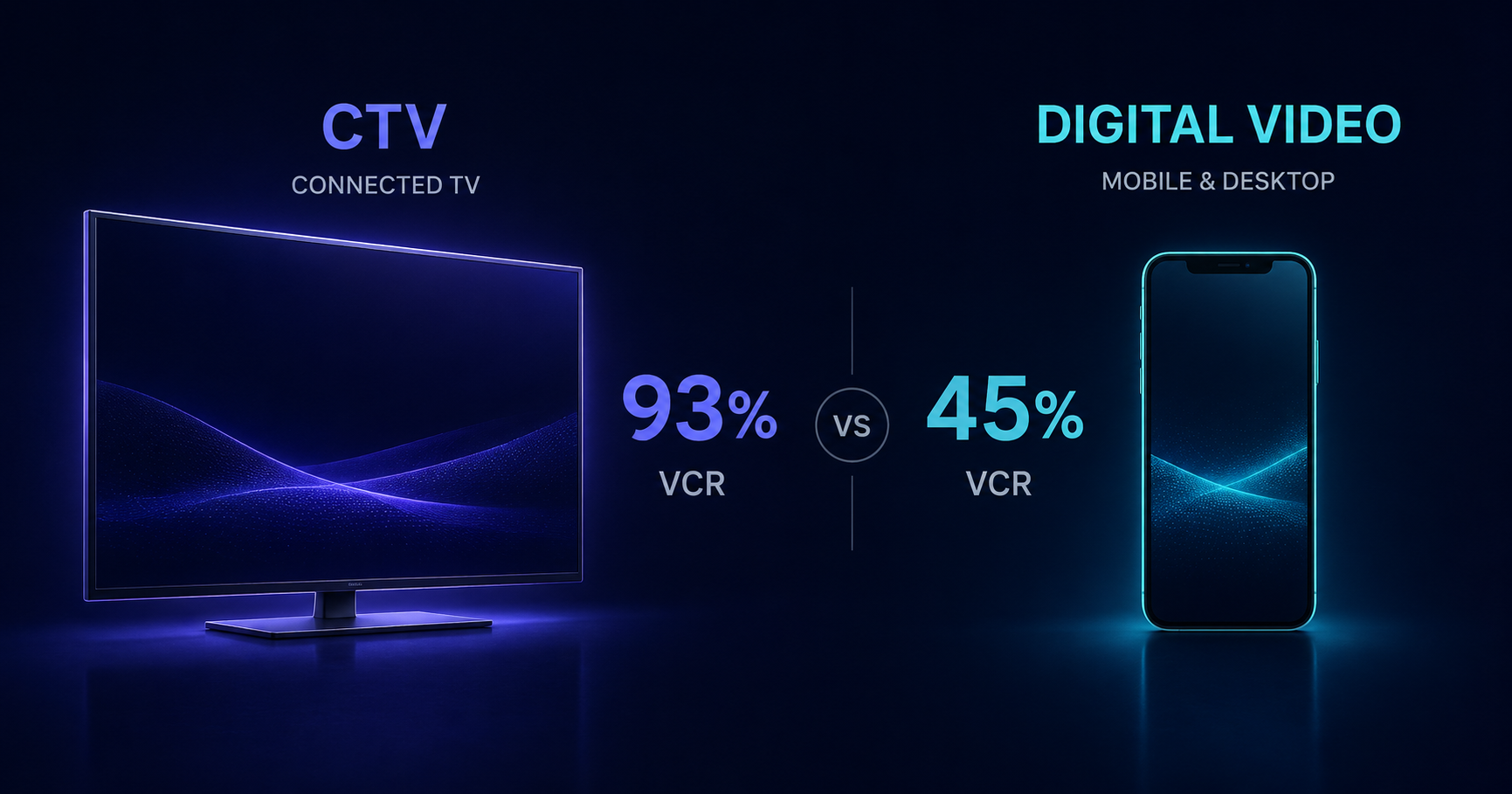
The most important difference between YouTube and CTV advertising is not technical — it is the mental state of the viewer when the ad appears. YouTube viewers are in an active, task-oriented browsing mode. They have navigated to YouTube with intent to find and watch specific content. The pre-roll or mid-roll ad interrupts that intentional navigation; the viewer's primary impulse is to complete the skip countdown and return to their content choice. This creates the dynamics that define YouTube advertising performance: high skip rates (typically 55–75% of viewers skip at the five-second mark), low completion rates on skippable formats (25–45%), and audience attention that is often partial rather than fully engaged.
CTV viewers are in a lean-back, passive mode. They have selected something to watch and settled into a television-viewing posture — often on a couch, often with other household members, with the television screen as the primary focus of their attention. The commercial break is an expected part of the viewing experience (particularly on FAST channels and AVOD platforms that are explicitly free because they carry advertising). The absence of skip functionality means the ad receives the viewer's attention for its full duration in a context where exiting requires the deliberate action of changing channels or opening another app. CTV completion rates reflect this: 90–95% consistently across publisher types and content genres.
The audience state difference has direct implications for creative strategy. YouTube creative must capture attention and deliver the core brand message in the first five seconds before skip becomes available. CTV creative can unfold over 30 seconds with a narrative arc, emotional development, and a complete product demonstration without the risk of pre-skip abandonment. Repurposing YouTube creative for CTV — or vice versa — produces suboptimal results for both. Review the CTV creative best practices guide for the specification differences that require format-specific production.
Audience composition: who YouTube and CTV actually reach
YouTube reaches the broadest possible video audience: 2+ billion logged-in users globally, spanning every age, income, and demographic category. YouTube's strength is depth of reach into younger audiences (13–34) and international markets. Its challenge is that the massive scale includes enormous inventory variation in quality, audience engagement, and content adjacency — a brand campaign on YouTube is running alongside everything from professional documentaries to user-generated kitchen accidents.
CTV in the US reaches approximately 115 million households with a distribution that skews toward a specific demographic profile: streaming households are more likely to be college-educated, have higher household incomes, and be in the 25–54 age range than the general population. Cord-cutters — households that have canceled cable TV — are disproportionately concentrated in this demographic, which is why CTV is essential for brands whose target audience has migrated away from linear TV. CTV does not reach the 13–24 demographic at the same efficiency as YouTube (which has near-universal penetration in that group), but it is the superior vehicle for affluent adults 25–54.
The reach overlap between YouTube and CTV is meaningful: many households use both YouTube on their smart TVs (which counts as CTV when viewed on a television screen) and streaming apps on the same devices. For campaigns targeting adults 35+, the incremental reach from adding CTV to a YouTube plan is significant because this demographic has lower YouTube engagement relative to streaming apps. For campaigns targeting 18–24, YouTube typically delivers better cost-efficiency and reach penetration.
Targeting: identity and audience precision
YouTube targeting is built on Google's logged-in identity infrastructure — one of the most comprehensive individual-level audience data sets in advertising. YouTube can target by Google account demographics (age, gender, parental status inferred from search and account activity), interest categories derived from search and YouTube viewing history, life events (inferred from search behavior), and custom intent audiences built from keyword lists. For campaigns targeting individual-level behavioral signals at scale, Google's identity depth is difficult to match.
CTV targeting operates at the household level rather than the individual level — not a limitation but a different targeting model that aligns better with television advertising's household purchase behavior framework. Household income, geographic precision, voter registration (for political), first-party CRM match, and ACR viewing history are CTV-native targeting dimensions that YouTube cannot provide. The CTV audience segments guide covers the full targeting taxonomy.
The LtvAdx HouseholdID system enables CTV targeting that is specifically valuable for household purchase decisions — automotive, home services, financial products, insurance — where the buying unit is the household rather than an individual. A campaign targeting households with cars over five years old (a high-intent auto replacement signal) runs more accurately on household-level CTV identity data than on individual-level Google account inference.
Brand safety: structure vs. scale
YouTube brand safety has been a persistent challenge because the platform hosts billions of pieces of user-generated content that cannot all be manually reviewed. Despite Google's significant investment in automated brand safety tools, YouTube Preferred (premium curated content) packages, and content exclusion controls, the platform has experienced multiple brand adjacency controversies driven by the sheer volume of content that algorithmic review processes at the edges. The risks are manageable for most advertisers with correct exclusion configuration, but they require active management and remain a real exposure.
CTV brand safety is structurally more robust because the content universe is vastly smaller and app distribution is gated by platform review. A streaming app must pass Roku, Amazon, or Apple review before it is distributed; this baseline quality filter eliminates the long tail of problematic content that exists in open web video. The remaining CTV brand safety risks — content metadata accuracy, competitive pod adjacency, supply chain misrepresentation — are real but manageable through the controls covered in the CTV brand safety guide.
Measurement and attribution
YouTube measurement benefits from Google's comprehensive analytics infrastructure: view counts, watch time, click-through rates, and Google Ads conversion tracking for campaigns where the conversion event happens in Google's ecosystem (search, Play Store, YouTube itself). Attribution for conversions that happen off-Google — website purchases, in-store visits, phone calls — relies on Google's own conversion tracking pixels and attribution models, which are closed-box from the advertiser's perspective.
CTV measurement requires more deliberate setup but produces more transparent attribution data. The CTV attribution guide covers the household IP matching methodology that connects CTV exposure to downstream web behavior, the brand lift study methodology that measures persuasion effect, and the incrementality testing approach that provides the highest-confidence ROI calculation. CTV measurement data is accessible as raw impression logs through the LtvAdx reporting API — unlike YouTube analytics, which are available only through Google's reporting interfaces and export capabilities. For advertisers who want to own their attribution data and run custom analysis in their own data infrastructure, CTV impression log portability is a significant advantage.
CPM and efficiency comparison
YouTube CPMs vary enormously by format, targeting, and competitive period. TrueView in-stream (skippable) CPMs run $5–$15 for broad audiences. Non-skippable in-stream runs $10–$20. YouTube Select (premium channels and content) runs $20–$35. YouTube TV advertising — which is actually CTV advertising on the YouTube TV vMVPD app — runs at CTV-comparable CPMs of $20–$40. CTV open auction programmatic CPMs on LtvAdx run $10–$35 depending on audience enrichment and content tier.
As covered in the CTV advertising costs guide, the valid comparison metric is cost per completed view (CPCV), not CPM. At equivalent CPCV, CTV and YouTube non-skippable are comparable in efficiency; CTV delivers a more premium creative environment. For campaigns with performance objectives, cost per outcome is the correct metric — and CTV typically outperforms skippable YouTube on this measure for considered-purchase categories where the 30-second ad delivery drives measurably higher post-exposure search and site visit rates.
Portfolio allocation: using both effectively
The most effective video media plans treat YouTube and CTV as complementary rather than competitive. YouTube excels for: reaching 13–34 audiences, driving search intent and product discovery, performance campaigns where click-through attribution is available, and frequency-efficient brand recall for short-duration creative formats. CTV excels for: reaching cord-cutter adults 25–54, household-level targeting for considered purchases, brand storytelling in a premium television environment, and performance measurement where household outcome attribution is more accurate than individual click-based attribution.
A typical balanced allocation for a national consumer brand with broad demographic targets: 40–50% YouTube (reach efficiency for younger audiences and performance campaigns), 35–45% CTV (premium brand environment for adults 25+, household targeting for consideration campaigns), and 10–15% linear TV or addressable linear (tentpole events, older demographic reach extension). The exact allocation shifts by category, objective, and audience composition of the specific campaign. To discuss how CTV fits your current video allocation, the LtvAdx agency team provides media mix analysis alongside platform access. To evaluate CTV inventory specifically, request a platform demonstration.