Media buyers frequently face a budget allocation question that looks deceptively simple: should this video spend go to CTV or digital video (YouTube, social pre-roll, display video networks)? The answer depends on objectives, audience composition, creative assets, and measurement requirements in ways that simple CPM comparisons miss. This guide maps the real differences between CTV and digital video advertising across the dimensions that matter for media planning, using the CTV advertising landscape as the reference framework.
Audience and reach differences
Digital video on YouTube and social platforms reaches a broader demographic spectrum than CTV but with lower average viewing intent for long-form content. The YouTube audience spans mobile and desktop viewers who encounter pre-roll in a context of task completion — they are navigating to watch a specific video, not leaning back for an extended viewing session. CTV reaches streaming households in an intentional, long-form viewing environment where ad tolerance is generally higher and attention quality is stronger.
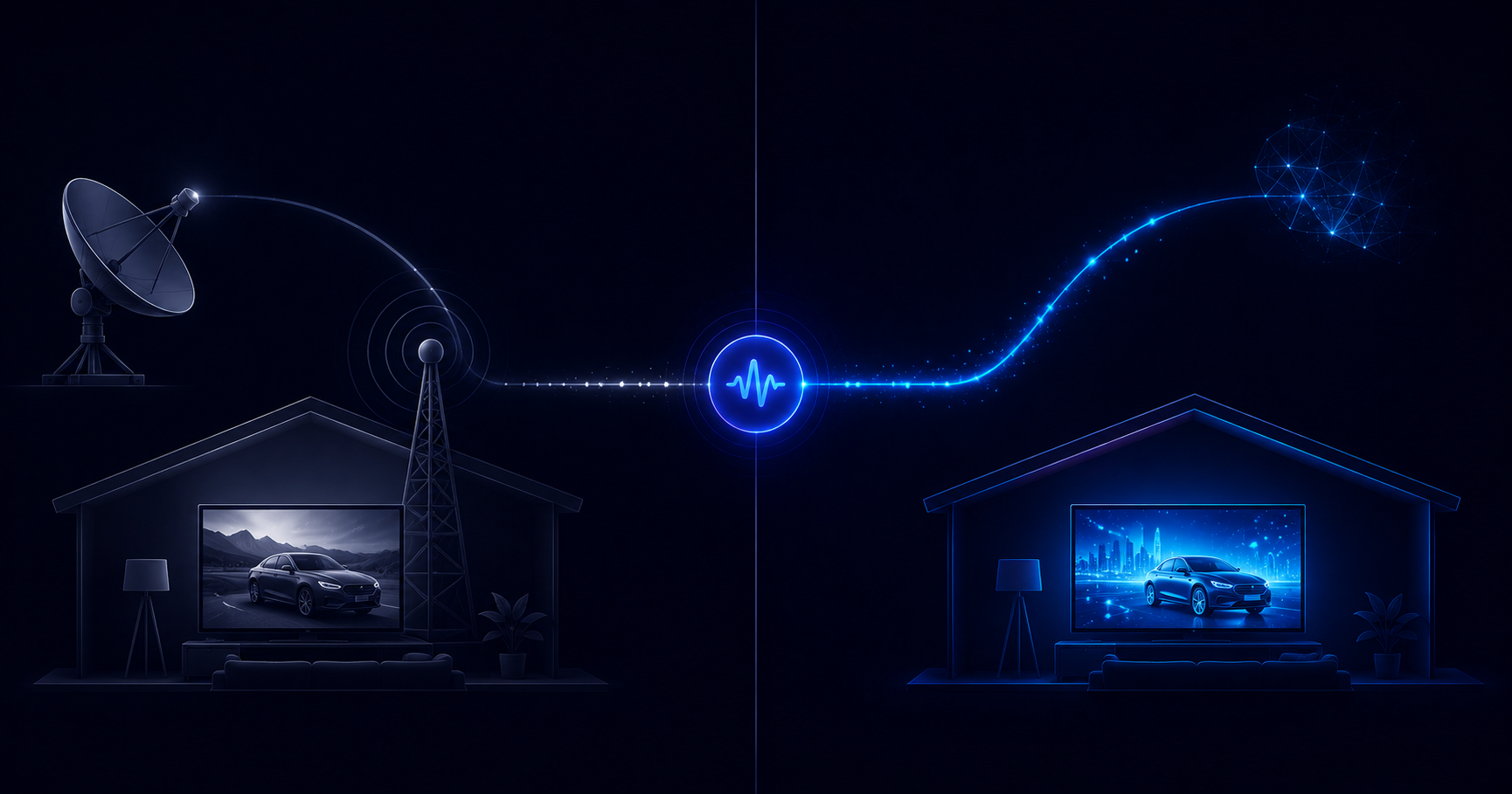
The audience gap that matters most for many advertisers is the cord-cutter and cord-never population. Households that have canceled or never subscribed to traditional cable TV — estimated at 40%+ of US households — are largely unreachable through linear TV advertising. They are accessible through CTV. For brands with mass reach objectives, a combined linear TV and CTV strategy covers both the cable subscriber and cord-cutter segments without duplication when household-level reach is de-duplicated through an identity layer.
Viewability and completion rate comparison
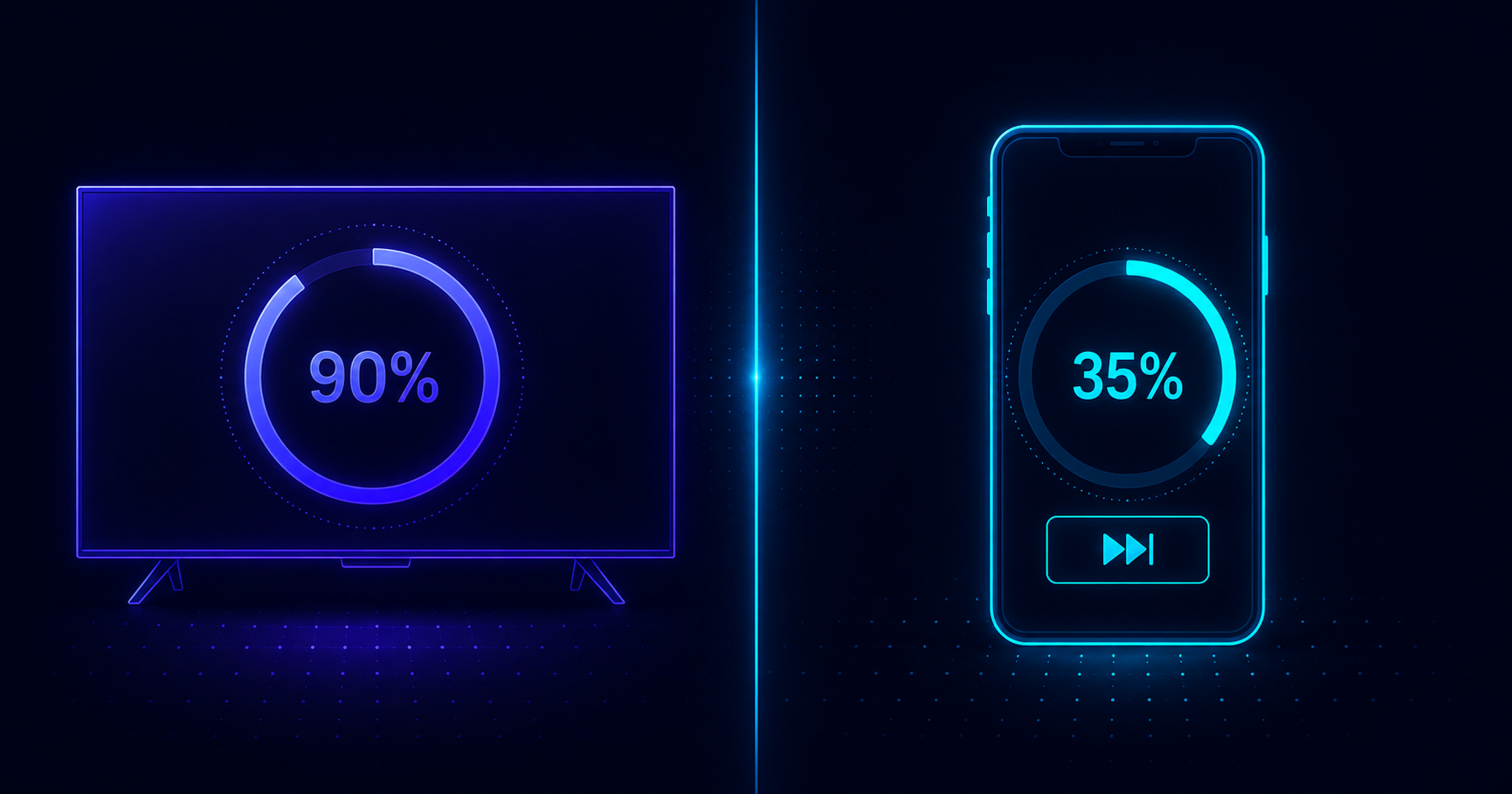
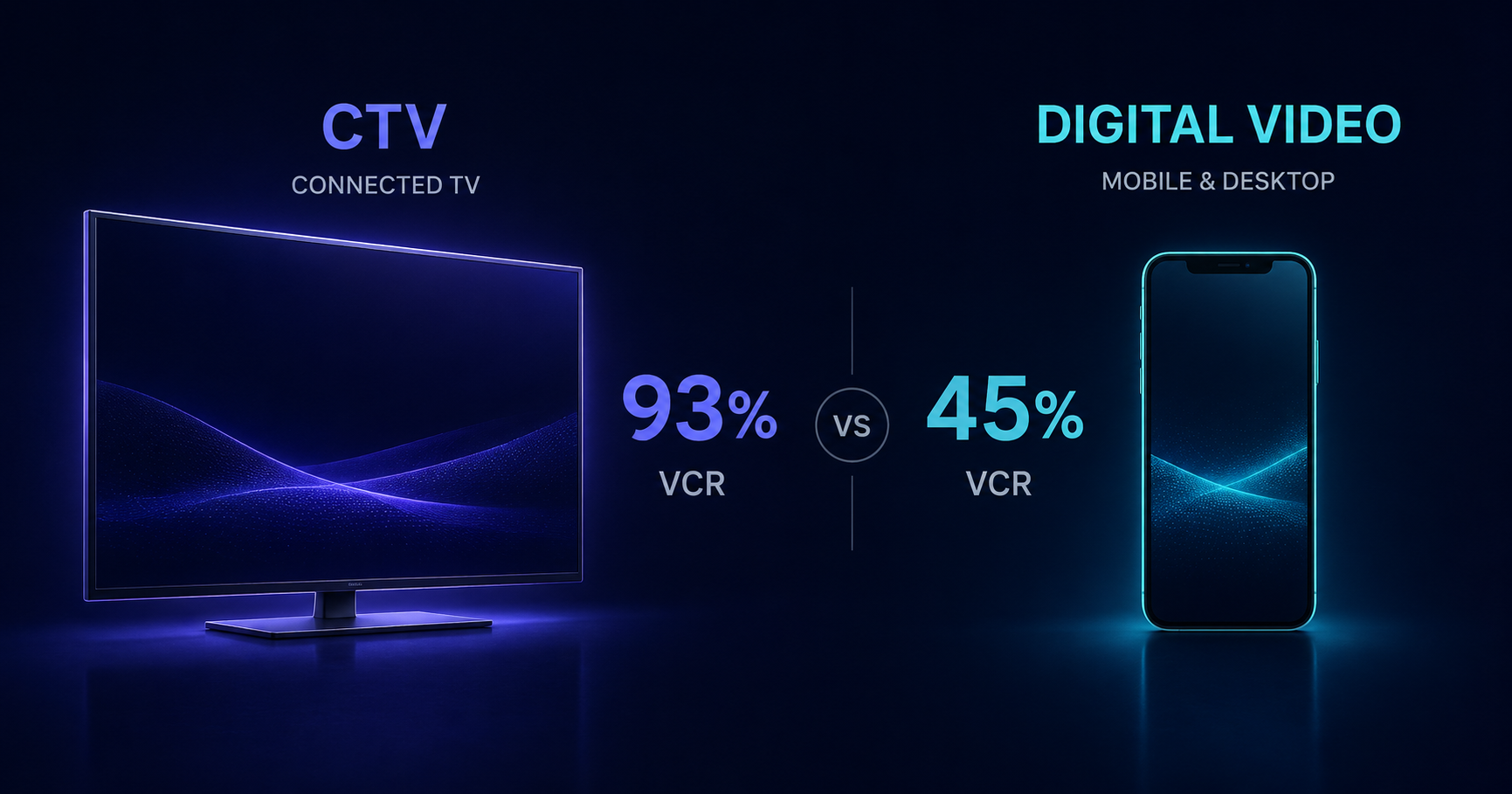
CTV consistently outperforms digital video on completion rate. The structural reason is the absence of skip functionality: CTV ads are non-skippable in the vast majority of streaming environments, so a viewer who has not exited the app or changed channels completes the ad. Industry benchmarks place CTV completion rates at 90–95% versus 40–65% for skippable digital pre-roll. The comparison to non-skippable digital video (bumper ads, YouTube non-skip) is closer but still favors CTV because of the full-screen, no-distraction context.
Viewability in CTV is near-perfect for ads that reach a device with the app in active foreground use: the full screen displays the ad at a fixed aspect ratio with no partial viewport, no below-the-fold placement, and no competitive creative visible simultaneously. Digital video viewability — measured against the MRC 50% pixel / 2-second standard — is far lower, particularly on display video and in-article placements. For VCR and completion rate measurement, CTV and digital video require separate benchmarks.
Targeting capabilities: CTV vs digital
Digital video platforms have more mature audience targeting infrastructure, built over two decades of browser cookie and logged-in user data. Google and Meta can reach declared interest segments, purchase intent cohorts, and CRM match audiences at scale with deterministic identity. CTV targeting has historically been weaker — reliant on IP-based household matching and content genre context rather than individual-level behavioral signals.
That gap is closing. The HouseholdID approach in CTV exchanges like LtvAdx enables deterministic household targeting using operator subscriber data, first-party publisher logins, and ACR content signals. The targeting unit is the household rather than the individual — which is actually a better match for television creative that is designed for household viewing. For most brand targeting use cases, household-level CTV targeting is now comparable in precision to individual-level digital targeting.
CPM comparison and value assessment
CTV CPMs are typically higher than digital video CPMs on an absolute basis — programmatic CTV averages $20–40 CPM versus $5–15 for digital pre-roll depending on audience and format. This difference reflects the superior viewability, completion rate, and contextual environment rather than inventory scarcity alone. The relevant comparison is cost per completed view (CPCV): at a 93% completion rate, a $30 CTV CPM produces a CPCV of $0.032. At a 45% completion rate, a $10 digital pre-roll CPM produces a CPCV of $0.022. The gap is smaller than the CPM difference suggests, and disappears entirely when attention quality and brand recall are factored in.
For direct response objectives where click-through or post-view conversion drives the value calculation, digital video typically outperforms CTV on cost-per-action because digital viewers are on devices with immediate purchase capability. CTV remote controls create friction in conversion paths. The appropriate CTV attribution model for response campaigns is post-household-exposure window (7–14 days) rather than same-session click-through, as covered in the CTV attribution guide.
Creative requirements and asset compatibility
Creative for CTV is significantly more demanding than digital video in technical specification: HD/4K resolution, broadcast-grade audio, VAST compliance with tracking events, and legibility at viewing distance. Most brands have a large library of digital video assets — 9:16 vertical, 1:1 square, lightweight MP4 for web — that are technically unsuitable for CTV delivery without reformatting. The cost of creating CTV-specific creative from scratch is a real barrier, particularly for SMB advertisers.
The practical implication for media planners is that CTV budget requires creative budget. A campaign allocating 20% of video spend to CTV needs CTV-quality creative, which typically means a 16:9 horizontal cut at broadcast bitrate — not a mobile reformatted version. Review the CTV creative best practices guide for the complete technical and strategic requirements before briefing creative production.
Measurement and attribution infrastructure
Digital video measurement is more mature: cookie-based cross-site attribution, view-through windows, and post-click conversion tracking are standard DSP features. CTV measurement is more specialized and requires deliberate setup — VAST beacon configuration, household identity bridging, and incrementality test design — to produce attributable outcomes rather than delivery metrics.
For campaigns requiring measurement parity between CTV and digital video channels, the cleanest approach is unified household identity: mapping digital display and video exposures to the same household identifier used for CTV frequency management and attribution. LtvAdx supports this through the HouseholdID graph and cross-channel reporting API. This lets media buyers report total household exposure and outcome attribution across CTV and digital in a single view rather than reconciling platform-siloed reports.
For media buyers evaluating CTV as an addition to an existing digital video plan, the LtvAdx advertiser platform provides a starting point for deal access and measurement setup. The programmatic TV buying checklist covers the incremental workflow steps CTV requires beyond digital video campaign setup. Book a demo to walk through a CTV media plan alongside the LtvAdx team.