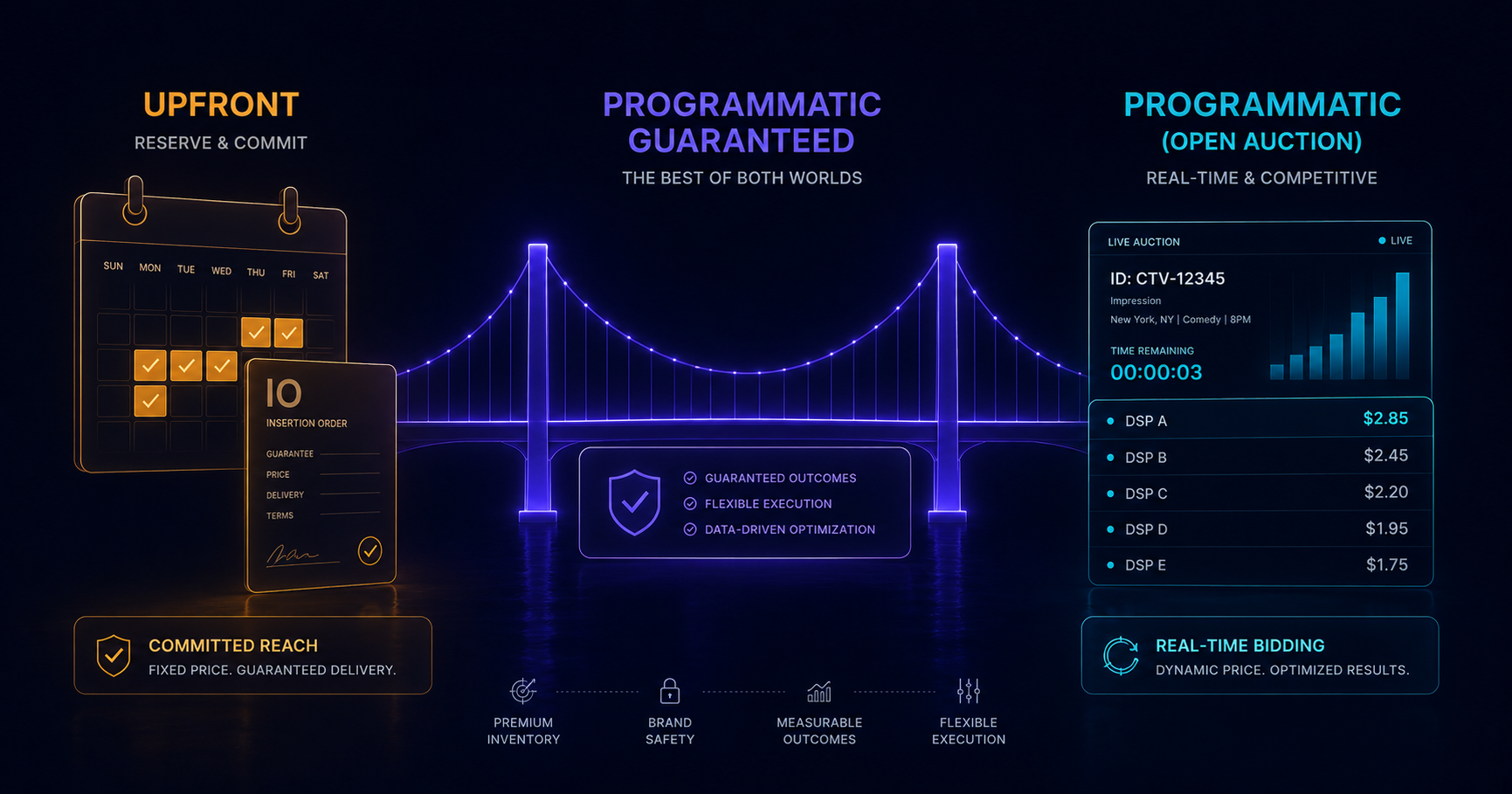
The annual television upfront negotiation — where networks sell the majority of their advertising inventory to agencies months before it airs — is colliding with programmatic buying workflows that operate on milliseconds rather than months. For advanced TV advertisers and agencies, the strategic question is not whether to use upfront or programmatic but how to combine them to achieve reach certainty, pricing efficiency, and measurement accountability simultaneously. The answer looks different for CTV than for linear, and it is evolving quickly as streaming platforms scale and programmatic guaranteed deals bridge the two models.
How the TV upfront works and why it persists
The upfront cycle runs from May (when networks present their programming slates) through July (when most commitments are finalized). Advertisers commit to large volume purchases — typically 75–85% of a network's sellable inventory — at negotiated CPMs with audience delivery guarantees. Networks benefit from demand visibility that allows programming investment. Advertisers benefit from guaranteed access to premium inventory at rates negotiated before the scatter market, which historically carries 20–30% CPM premiums.
The upfront persists in CTV because the same structural incentives apply. Premium streaming platforms — those with live sports rights, original programming, and large household reach — can sell inventory in advance at rates that reward commitment over spot buying. For advertisers who plan media budgets annually, upfront commitments on CTV platforms provide the reach guarantee and price certainty that programmatic open auction cannot deliver.
Where programmatic is superior to upfront
Programmatic buying excels at efficiency, flexibility, and audience precision that upfront commitments cannot match. An open auction or OpenRTB private marketplace deal allows buyers to target specific household segments — income, geography, viewing behavior — and pay only for impressions that match those criteria. Upfront deals are sold on demographic ratings (adults 25–54) that are approximations rather than the deterministic household targeting that HouseholdID-based programmatic provides.
Programmatic also allows mid-flight optimization. If a campaign is underperforming on completion rate in a specific genre or overperforming on outcome attribution in a specific DMA, the buying parameters can be adjusted without renegotiating a contract. Upfront commitments have limited flexibility once signed — make-good provisions exist for audience delivery shortfalls but not for strategic pivots.
Programmatic guaranteed as the bridge
Programmatic guaranteed (PG) deals capture the benefits of both models. The fixed price and reserved inventory provide upfront-style certainty; the automated delivery through deal IDs provides programmatic efficiency and reporting granularity. Most major streaming platforms now offer PG deal structures that allow upfront-style commitments to execute through their programmatic pipes rather than through manual insertion order trafficking.
The practical difference from a traditional upfront is the measurement infrastructure: a PG deal through LtvAdx delivers impression-level logs, household reach data, and VCR metrics that a traditional upfront IO cannot produce. Advertisers who have shifted upfront commitments to PG execution report significantly better accountability for the same inventory because the delivery evidence is digital rather than modeled. For agencies managing client upfront commitments on streaming platforms, the LtvAdx agency portal consolidates PG deal management and reporting across clients.
Budget allocation: a framework for 2026
A practical framework for advanced TV budget allocation in 2026 divides spend across three pools. The guaranteed pool (40–60% of CTV budget) covers upfront commitments and PG deals on premium inventory where reach certainty and first-look position justify the commitment. This inventory includes live sports, premium drama, and high-reach FAST channels with strong household demographics.
The preferred access pool (20–30%) covers private marketplace deals with priority access to mid-tier streaming inventory and addressable linear operators. These deals provide better pricing than open auction with more flexibility than PG. The spot and efficiency pool (15–30%) covers open auction programmatic buying optimized for audience segments and cost efficiency, used for retargeting exposed households, filling reach gaps in underperforming geographies, and testing new inventory sources before committing to higher tiers.
Negotiating CTV upfront deals in a programmatic era
CTV upfront negotiations are increasingly driven by data rather than relationships and reach estimates. Streaming platforms can show historical viewership data by content genre, household demographic composition by program, and programmatic clearing rates that set a price floor for guaranteed commitment premiums. Advertisers negotiating CTV upfronts should request:
Historical VCR by program and genre to identify high-completion-rate inventory worth paying a premium for. Household demographic composition verified against third-party data rather than self-reported. Measurement methodology documentation — how impressions are counted, what event fires the impression beacon, and how household reach is calculated. Make-good provisions that trigger on impressions delivered rather than panels-measured audience estimates. And programmatic execution options — whether the commitment can execute through a PG deal ID rather than traditional IO trafficking.
Linear vs CTV upfront allocation
Advertisers maintaining both linear and CTV upfront commitments should model household reach de-duplication before finalizing allocations. A household that has cable TV and a streaming subscription may be reachable in both places; a household that is a cord-cutter is only in the CTV pool. Over-committing to linear while under-investing in CTV leaves cord-cutter households unreached regardless of linear upfront scale.
The household reach overlap analysis requires the same identity infrastructure used for campaign frequency management: a HouseholdID graph that can report the intersection of linear addressable households and CTV streaming households in your target segments. LtvAdx provides this analysis for operators and programmers running both linear addressable and CTV inventory on the platform.
What programmatic cannot replace
Programmatic buying, even at scale with sophisticated targeting, cannot replace the premium adjacency, sponsorship positioning, and tentpole exclusivity that upfront deals secure. A brand that wants guaranteed association with a specific sporting event, a season premiere, or a cultural moment must commit upfront. Programmatic cannot reserve those moments — they sell out through direct relationships before they enter the programmatic supply.
The strategic implication is that upfront and programmatic are not substitutes — they are complements. Upfront secures premium positioning and reach scale; programmatic delivers efficiency, addressability, and measurement depth. The optimal mix shifts by campaign objective, brand category, and inventory availability, but eliminating either buying mode entirely creates gaps that the other cannot fill.
For brands and agencies developing their advanced TV buying strategy, start with the programmatic TV buying checklist for the operational framework and review the CTV advertising guide for the ecosystem context. To discuss deal structure for your specific upfront or programmatic requirements on LtvAdx inventory, contact the sales team or request a demo.