Live sports is the inventory category that kept linear television advertising alive through a decade of streaming disruption. It is also the category that commands the highest CPMs in CTV programmatic, requires the most technically demanding delivery infrastructure, and presents the most operationally complex brand safety and competitive separation challenges. As sports rights migrate to streaming platforms — NFL on Amazon Prime, NBA on Peacock and Amazon, MLB on Apple TV+, and the ongoing expansion of regional sports networks into OTT — the techniques and infrastructure for monetizing live sports through CTV have become a core competency for any publisher or ad network with rights to this programming. This guide covers the end-to-end considerations for live sports CTV advertising: delivery mechanics, ad pod strategy, yield management, brand safety, and measurement.
Why live sports changes the CTV ad serving calculus
Live sports inventory differs from VOD and FAST linear in several ways that have direct operational implications. The timeline is fixed and non-recoverable: a commercial break during a timeout in the fourth quarter of a close game starts at a specific second and ends when play resumes — there is no editorial flexibility to extend or shorten the break. Ad pod decisions must be made and manifests must be stitched before the break begins, not during it. Latency tolerances that are acceptable in VOD are disqualifying in live sports.
The audience is engaged and co-viewing. Sports viewers are attentive to the screen during breaks because they are waiting for play to resume. Completion rates for live sports CTV advertising are among the highest in the streaming ecosystem — consistently 92–97% — and the household size per device is larger than average because sports is a social viewing activity. This means effective CPM on a household basis is even higher than it appears on a per-device impression basis, and the creative quality standards matter more because the audience is actually watching.
Simultaneous audience peaks create infrastructure load profiles unlike any other content type. A 10-minute first-quarter commercial break in a nationally broadcast game generates a spike in ad requests, SSP auction volume, and SSAI stitching operations that must be handled without latency degradation. The LtvAdx SSAI engine is designed for live event scale, with pre-provisioned capacity that handles peak sports load without queuing delays that would miss break windows.
SCTE-35 and live break detection
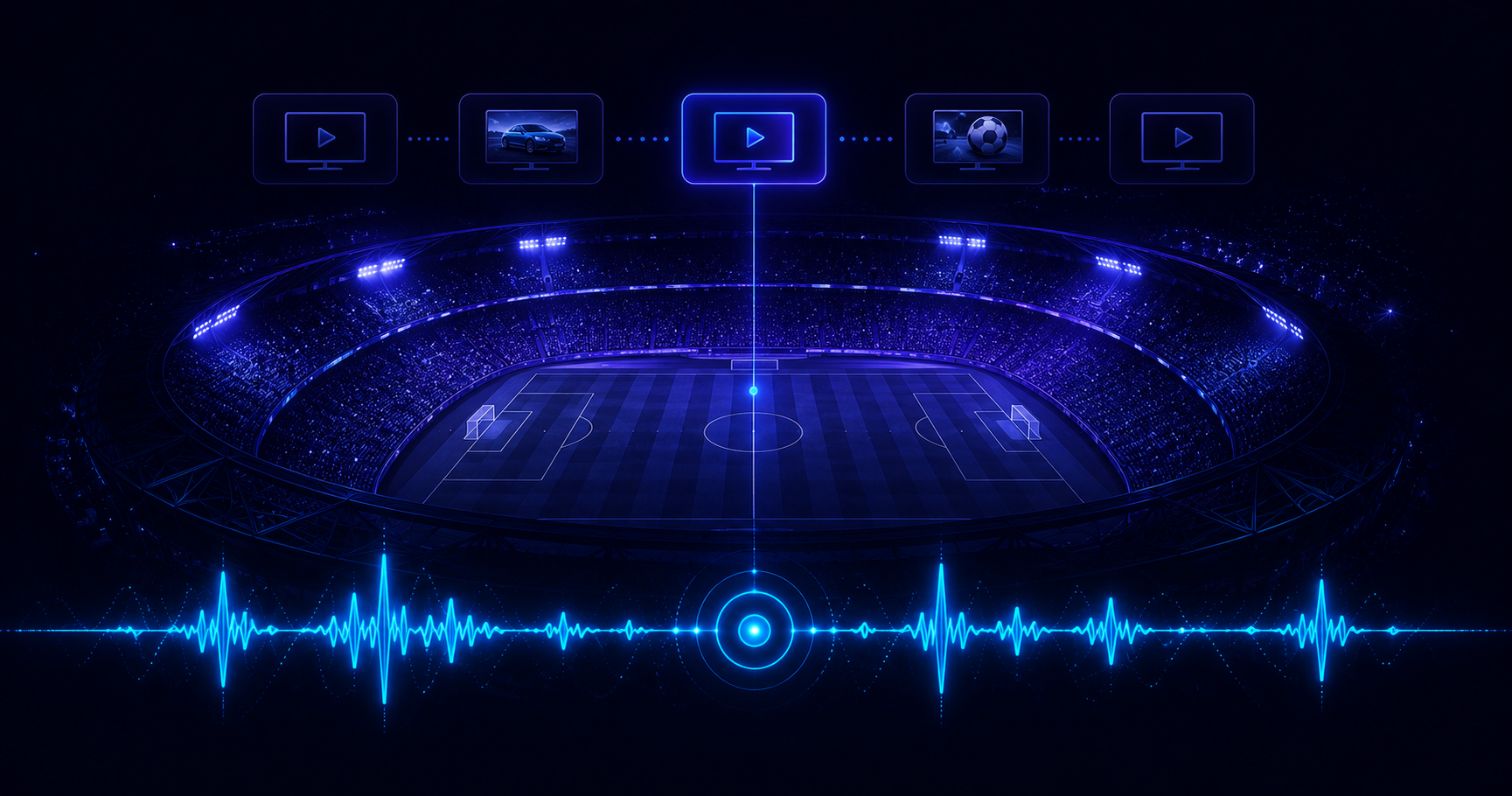
Live sports ad breaks are signaled through SCTE-35 cue tone markers embedded in the transport stream. SCTE-35 is the broadcast standard for signaling commercial break opportunities: a SCTE-35 spliceInsert or timeSignal command tells the distribution system that a break of a specific duration is beginning, enabling the ad insertion system to prepare and deliver the appropriate content. In an SSAI live sports deployment, the LtvAdx stitcher monitors the HLS or DASH live manifest for SCTE-35 markers, interprets the break type and duration, and initiates the ad decision process immediately upon marker detection.
The precision of SCTE-35 signaling varies by content source. Premium network feeds typically provide accurate break duration signals — the encoder operator knows when timeouts and commercial breaks are occurring and fires the markers with correct duration metadata. Lower-tier productions may fire markers with incorrect or missing duration metadata, requiring the SSAI system to use default break duration configuration. Configure a sensible default break duration per content type — two minutes for most live sports, four minutes for primetime halftime breaks — so that incorrectly signaled breaks still fill adequately rather than defaulting to a one-slot pod.
Return-from-break handling is equally important. When SCTE-35 signals the end of the commercial break, the SSAI stitcher must seamlessly transition back to content. If the break ends while an ad creative is still playing — because the break was shorter than the last ad slot — the stitcher must either truncate the creative, insert slate, or carry over to a slate-only period until the next content segment is available. Configure truncation behavior explicitly in the SSAI settings rather than accepting defaults that may produce jarring cut-offs during high-stakes moments.
Pod strategy for live sports inventory
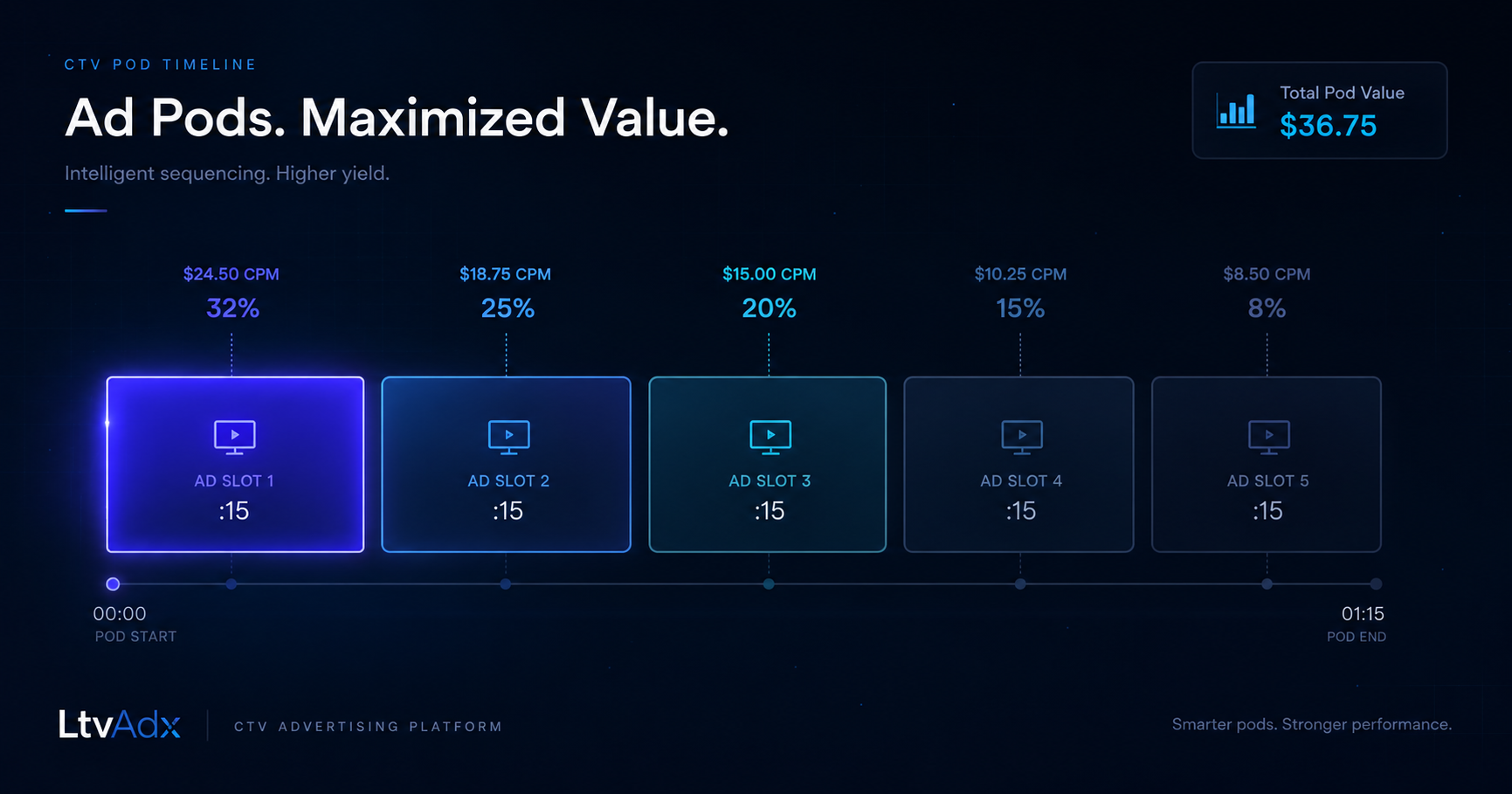
Live sports pods differ structurally from entertainment or FAST linear pods. Breaks are shorter, more frequent, and audience tolerance for long ad loads is lower because every second of commercial time is a second away from the game. Research across major sports streaming properties consistently shows that four-slot, two-minute pods perform better on both completion rate and advertiser recall than six-slot, three-minute pods, even when the additional slot count represents meaningful revenue per break.
First-pod, first-slot placement commands the largest premium in live sports inventory — often 60–100% above mid-pod positions — because the first commercial in the first break after a major play or scoring event receives the highest audience attention. Package first-position premium pricing into your direct sales rate card and expose position metadata in programmatic bid requests through the OpenRTB video position field so demand-side buyers can bid competitively for first-slot inventory.
Sponsorship packaging is a significant incremental revenue opportunity in live sports. Quarter-sponsorships, halftime-sponsorships, and "brought to you by" integrations carry CPM multiples of 3–5x above standard rotational spots and provide the advertiser with brand association benefits that programmatic impressions cannot replicate. Direct sales teams should package live sports sponsorships before programmatic inventory is made available, protecting the highest-value placements from programmatic clearing at rates below their sponsorship value.
Demand sourcing for live sports CPM maximization
Live sports inventory attracts categories of advertiser that do not compete heavily for general entertainment inventory: auto brands with new model launch campaigns, financial services brands with broad reach objectives, beer and spirits (where not prohibited), and athletic wear. These categories have historically allocated significant upfront commitments to live sports and are willing to pay premium programmatic CPMs for live sports adjacency.
Build your demand mix for live sports with tier structure: premium direct-sold and PG deals for the top 20% of audience-rich games and match-ups; PMP deals for preferred buyers across the full live sports schedule; open auction backfill at floor prices set significantly above your standard inventory floors. The open auction floor for premium live sports inventory should reflect the CPM you would achieve through direct sales for that specific event, not your general entertainment floor. A playoff game has a different supply scarcity profile than a regular-season weeknight game; floors should reflect that scarcity dynamically rather than applying the same floor across the entire season.
The LtvAdx publisher portal supports event-level floor pricing that can be configured per scheduled game or event in advance of the broadcast window. Set premium floors for playoffs, finals, and marquee matchups at the start of the season using your broadcast schedule as the configuration input. The reporting dashboard tracks clearing CPM versus floor by event so your floor calibration improves each season based on actual demand evidence.
Brand safety in live sports: the adjacency and category challenge
Live sports creates brand safety challenges that scheduled entertainment does not. A controversial moment — a fight, an injury, a politically charged player action — can transform a premium content context into a problematic adjacency instantly, and the ad that runs in the following break is unavoidably associated with what just happened on screen. Advertisers with low risk tolerance for contextual adjacency should include live sports-specific brand safety considerations in their campaign configuration.
Category exclusions are the primary pre-campaign brand safety control. Gambling and sports betting advertisers are excluded from inventory that carries audience demographics skewing toward minors. Alcohol advertisers follow legal restrictions by DMA. Competing sports league brands (a sponsor of one league advertising against a rival league's inventory) require competitive exclusion at the league or sport level. Configure these in the LtvAdx advertiser platform before campaign launch, not after an adjacency incident has occurred.
Publisher-side competitive separation rules are equally important in live sports because the audience concentration amplifies the visibility of competitive conflicts. Two competing auto brands in the same break during the Super Bowl halftime creates a brand integrity problem that neither advertiser can afford. The pod-level competitive separation capabilities of the LtvAdx ad server apply at the event level, not just the channel level, ensuring that premium live events carry the separation standards that justify their premium pricing.
Live sports measurement and real-time optimization
Live sports campaigns require near-real-time monitoring because the delivery window is fixed. A campaign pacing to underdeliver during a live event cannot be made good with inventory from next week's game if the advertiser bought specific event adjacency. Monitor delivery rate against pacing targets hourly during live events and adjust competing campaign priorities in real time if specific campaigns are at risk of underdelivery.
The LtvAdx reporting API provides real-time impression stream data with sub-minute latency, enabling operations teams to monitor live event delivery and respond to under-pacing before the event ends. Set up automated pacing alerts for campaigns with guaranteed delivery commitments on live sports inventory so the operations team is notified before underdelivery becomes a billing dispute.
Post-event measurement for live sports campaigns should include brand lift and outcome attribution analysis aligned with the event timeline. Households exposed to brand advertising during a major sporting event show measurably elevated brand search and site visit rates in the 48–72 hours post-event — the "sports afterglow" effect where audience engagement with the brand extends beyond the broadcast window. Configure attribution lookback windows of 7–14 days for live sports campaigns rather than the standard 3-day window used for low-involvement content, to capture this extended post-exposure behavior.
For publishers and operators managing live sports rights, the combination of SCTE-35 integration, pod strategy, premium floor configuration, and real-time pacing monitoring described above represents the operational playbook for live sports CTV monetization. To discuss your specific live sports inventory setup or to evaluate LtvAdx for a live sports deployment, contact the solutions team or request a demonstration.