Whose Number Settles Your TV Guarantee?
A guarantee is a contract about a figure a third party produces later. With four certified currencies now in play, naming which one is the clause that matters.

A television guarantee is not a promise about your campaign. It is a contract about a number that a third party will produce, weeks after the campaign has ended, using a methodology neither you nor the seller controls.
Which makes the identity of that third party the most consequential clause in the deal, and the one most often left unstated. If your insertion order guarantees a rating point without naming the measurement provider, you have written down a number and not a guarantee.
The industry spent the last few years arguing about which provider should hold that role. The US Joint Industry Committee has now certified Comscore, iSpot and VideoAmp alongside Nielsen as currencies of record. VideoAmp has projected around $6 billion in currency and measurement transactions for 2026, roughly double its 2024 volume.
Almost all of the coverage has been about who is winning. Very little has been about what a buyer or seller should actually do now that the answer is plural, which is the more useful question and the subject of this piece.
What a currency actually is
The word gets used loosely. It does two specific jobs, and separating them explains most of what follows.
A currency is a denominator. Every reach figure, every rating point, every audience percentage is a fraction, and the currency supplies the bottom half. It says how many households or people exist in the audience you are buying. Change the denominator and the same delivered impressions produce a different reported reach, without a single ad having been served differently.
A currency is an arbiter. When a campaign is guaranteed and the delivery is disputed, someone has to be the authority whose count settles it. That is the role that makes a currency a currency rather than merely a measurement product. Anyone can measure. A currency is what both parties agreed in advance to be bound by.
The second job is why this matters commercially. A measurement vendor tells you what happened. A currency determines what you owe.
Why it only bites on guarantees
Worth stating plainly, because it explains why a great deal of CTV inventory is untouched by any of this.
If you buy impressions and receive impressions, there is nothing to arbitrate. The server logged a delivery, the delivery was billed, and the transaction is complete. Most programmatic CTV works this way, which is why the currency debate can feel abstract to buyers whose spend runs through an exchange.
A guarantee is different. It commits the seller to an audience outcome rather than a delivery outcome. Deliver a million impressions and fall short of the guaranteed rating, and the seller owes a makegood. Which means the seller's liability is determined by a number produced by an outside organisation.
That is an unusual commercial arrangement, and it is worth noticing how unusual. Two companies agree that a third company, party to neither side, will later produce a figure that decides how much one owes the other. It works only because both sides trusted the same arbiter.
Plural currencies remove the assumption that they will.
What happens when the numbers disagree
They will. Different providers use different panels, different big-data inputs, different attribution of co-viewing, and different universe estimates. Producing identical figures would be surprising.
The disagreement matters in three specific places.
The guarantee itself. A campaign that met its guarantee under one currency may have missed it under another. If the contract names one, that is settled. If it names none, both parties can produce a defensible number supporting their own position, and the dispute becomes a negotiation about whose vendor is better rather than about what happened.
The makegood calculation. Even where both sides agree a shortfall occurred, its size depends on the measurement. A 10% shortfall under one methodology can be 4% under another, and the makegood inventory owed scales directly with it.
Cross-campaign comparison. The quietest and most damaging. A team comparing a Q1 campaign measured one way against a Q2 campaign measured another is comparing methodologies, not performance. Any conclusion drawn about creative, targeting or channel mix from that comparison is unreliable, and nothing in the reporting flags it.
The third one is worth dwelling on, because it produces bad decisions that nobody ever traces back to their cause. A currency change mid-year looks like a performance change, and organisations respond to performance changes by moving budget.
The CTV complication
Everything above is the linear television problem, which has decades of practice behind it. CTV inherits the concepts and breaks several of the assumptions.
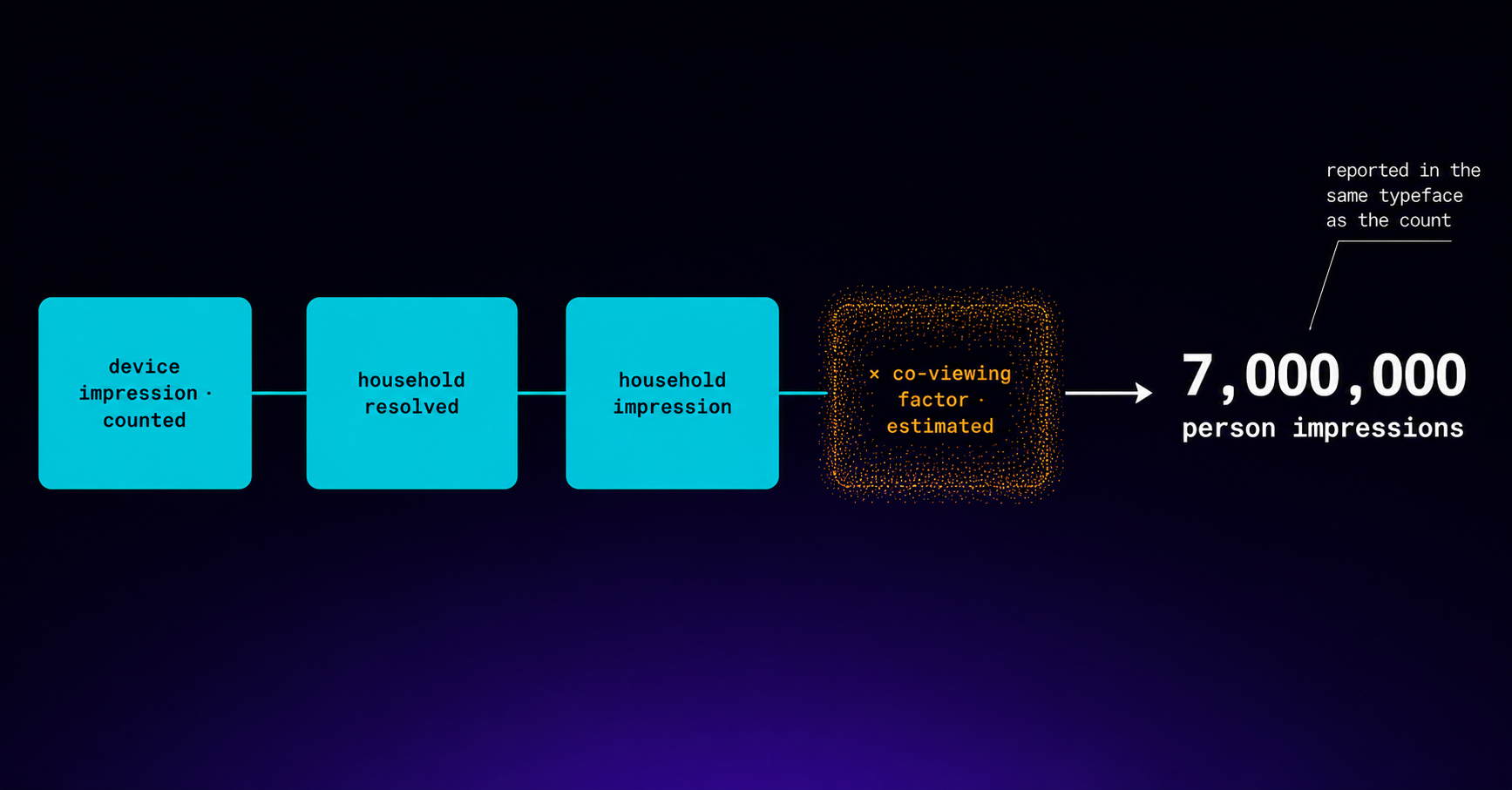
The unit is the household, not the person. Linear currency reports people. CTV serving knows devices and households. Converting between them requires a co-viewing multiplier, which is itself an estimate with a well-known incentive problem, covered in the co-viewing piece. Two currencies applying different multipliers to identical delivery produce different person-level reach, and the difference can exceed the shortfall the guarantee was written around.
Server-side insertion limits independent verification. The ad is stitched into the stream before it reaches the device, so third-party measurement has no client-side context to report from. Everything downstream rests on beacons the server fires on the client's behalf, which is a weaker attestation than a tag executing where the vendor controls the environment. The mechanics are in server-side ad insertion explained.
Most CTV inventory is not currency-transacted at all. Programmatic buys settle on server-logged delivery, not on an external audience count. That is simpler and it also means the buyer has no external arbiter if they later dispute what they received. Simplicity here is a trade rather than a free gain.
The universe estimate is harder. A CTV universe has to account for streaming penetration, ad-supported versus ad-free tiers, and the households actually reachable through the publishers in a specific buy. That last adjustment is buy-specific, which means no external provider can produce it for you. We worked through why in reach curves and effective reach.
What to do about it, practically
Five things, in rough order of how much they prevent.
Name the currency in the contract. Not the vendor category, the specific provider and, ideally, the specific product and version. This costs nothing at signature and settles every subsequent dispute. Its absence is the single most common cause of an unresolvable makegood argument. The same applies to any brand study running alongside the buy, since lift measurement carries its own methodology questions, discussed in CTV attribution and measurement.
Agree the tolerance band. Measurement is an estimate with sampling error, and two honest counts of the same campaign will differ. State how large a difference is immaterial. Without a band, every rounding disagreement is a dispute in principle.
Say what happens if the named provider cannot report. Coverage gaps happen, particularly on smaller publishers and newer services. A contract that names a currency without a fallback has a hole in exactly the situation where it is most needed.
Hold one currency constant for comparison. Even if you transact in several, pick one and run everything through it for internal reporting. It may not be the one you buy on. Its job is to be the constant against which you compare periods, so that a methodology change never masquerades as a performance change.
Keep your own delivery record. Server-logged impressions are not a currency and cannot settle an audience guarantee. They are, however, the only record you fully control, and they are what lets you tell whether a currency discrepancy is a measurement difference or a delivery problem. The distinction between counted and actually rendered is set out in fill rate versus rendered impressions.
For publishers specifically
The exposure runs the other way and is frequently underestimated.
If you sell a guarantee, you have accepted liability determined by a third party's methodology. A change in that methodology, made without consulting you, can turn a delivered campaign into a makegood obligation.
Three defences. Understand how the named provider measures your specific inventory before agreeing to be measured by it, because coverage of streaming and FAST inventory varies considerably between providers. Model your guarantee against your own delivery data first, so you know how much headroom you are selling. And price the guarantee, because a guaranteed buy carries risk that an unguaranteed one does not, and that risk belongs in the rate. The deal structures this affects are in programmatic guaranteed for CTV and deal ID mechanics.
Why the plural state is likely to persist
There is a temptation to treat this as a transition with an endpoint, and to wait for it.
The structural reasons point the other way. Nielsen retains the national linear market largely through legacy contracts and decades of trend data, and neither of those transfers. Publishers have commercial reasons to prefer whichever provider counts their inventory most favourably, which is not a temporary incentive. Buyers have the mirror-image reason. And a JIC that has certified several providers has institutionalised plurality rather than resolving it.
Meanwhile the fastest-growing part of the market, programmatic CTV, mostly transacts on server-logged delivery and does not use a currency at all. The inventory types this covers, and how they differ commercially, are set out in the CTV ad networks guide. That share is rising, which means the proportion of video spend settled by an external arbiter is falling even as the arbiters multiply.
The practical implication is that this is a permanent operating condition rather than a phase. Planning around it, by naming providers and holding one constant for comparison, is more useful than waiting for a resolution that the incentives do not support.
Why the providers disagree in the first place
It helps to know where the differences come from, because it makes the size of them predictable rather than mysterious.
Panel versus big data. The traditional approach recruits a representative sample of households, meters them, and projects to the population. The newer approach ingests very large volumes of set-top box, smart TV or device data and corrects it for known biases. Panels are small but representative by construction. Big data is enormous but skewed by whichever devices happen to report, and the correction is where the methodology lives.
Different bias corrections. Smart television data over-represents the manufacturers that sell most in a market. Set-top box data over-represents households on a particular distributor. Every provider corrects for this, and no two correct identically. Most of the visible disagreement between currencies traces to this step rather than to raw counting.
Co-viewing attribution. A household-level exposure has to be converted to people. Panel approaches observe who is in the room. Device approaches model it. Those produce different multipliers, applied to the same delivery.
Different universe estimates. The denominator problem again. Two providers with different views of how many households qualify for an audience will report different percentages from identical impressions.
None of this makes any of them wrong. It makes them different instruments measuring the same thing, and the useful consequence is that the size of the gap between two providers is roughly stable rather than random. If you know your inventory reads 8% lower under one provider than another, that is information you can build into a guarantee rather than discover during a makegood argument.
Renegotiating a guarantee when the currency changes
This comes up more than the coverage suggests, because publishers switch providers and buyers inherit the switch mid-flight.
The situation: you agreed a guarantee measured one way, the seller has moved to a different provider, and the campaign is still running.
The contract governs. If it names the original provider, the guarantee is still measured that way regardless of what the seller now uses internally. This is the entire reason to name it, and the point at which a vague contract becomes expensive.
Ask for both figures during the transition. Most sellers running a provider change can produce parallel reporting for a period, and many will if asked before the switch rather than after. It costs them little and it tells you the size of the gap on your specific inventory, which is the number you will need at renewal. Asking after the switch is a considerably harder conversation, because by then the parallel data no longer exists.
Re-baseline the guarantee rather than the campaign. If a new provider reports your inventory systematically lower, the honest fix is to adjust the guaranteed figure to reflect the new instrument, not to demand a makegood for a change in measurement. A seller who delivered the same audience and now reports a lower number has not underdelivered. Treating it as a shortfall is how commercial relationships get damaged by an accounting change.
Reset trend comparisons deliberately. Mark the switch date in your own reporting so that nobody six months later compares across it without knowing. This is the cheapest possible safeguard and the one most often skipped. A single annotated line in a reporting dashboard prevents an entire class of misattributed conclusions, and the people who will need it are usually not the people running the campaign today.
What this means for CTV specifically over the next few years
Three trends are moving at once, and they do not point the same way.
More money is moving into CTV. Its share of programmatic spend has grown substantially, and the growth has come predominantly through channels that settle on delivery rather than on an audience guarantee.
More providers are certified. Which increases aggregate measurement quality and decreases the likelihood of any single arbiter.
Guaranteed buying is not going away. Upfront commitments and programmatic guaranteed deals both remain substantial, and both depend on an agreed arbiter. The comparison between committing early and buying in the market is covered in upfront versus programmatic.
The net effect is a market where a growing majority of transactions need no currency at all, and a shrinking but commercially important minority need one badly and cannot rely on everyone agreeing which. That is a more awkward equilibrium than either a single currency or none, and it is the one that appears most likely.
The practical posture that follows is unglamorous. Name the provider on anything guaranteed. Hold one constant for internal comparison. Keep your own delivery record so you can tell a measurement difference from a delivery problem. And stop waiting for the market to settle the question, because the incentives of everyone involved point away from settling it. The teams that handle this well are not the ones with the best measurement partner. They are the ones whose contracts say which partner it is.
The underlying question
Strip away the vendor names and one question remains: when the buyer and the seller disagree about what was delivered, who decides?
For decades, television answered that with a single organisation everyone had agreed to accept. That arrangement had real problems, and it had one significant virtue, which was that disputes ended.
The plural answer is more accurate in aggregate, because several methodologies examining the same market surface more than one ever did. It is also operationally harder, because accuracy and arbitration are different jobs and only the second one requires agreement.
A buyer who names their currency has a guarantee. A buyer who does not has an expectation, and expectations are settled by whoever argues better. That is a poor position for a buyer and, less obviously, a poor one for a seller, since a publisher who delivered honestly still loses the argument if the counterparty produces a number they cannot refute. Naming the arbiter protects both sides, which is why it is worth pressing for even when you are the one being asked to accept it.
If you want to see how delivery, deal type and fee structure are recorded against each impression so that a discrepancy can be traced rather than argued, the reporting tools cover it, and the product tour covers how the auction and waterfall resolve. To discuss a specific guarantee structure, get in touch.
Frequently asked questions
What is a TV measurement currency?
A measurement provider that both buyer and seller have agreed, in advance, will supply the numbers that settle a guaranteed transaction. It does two jobs: it provides the denominator that every reach and rating figure is calculated against, and it acts as the arbiter when delivery is disputed. Any vendor can measure. A currency is the one both parties contracted to be bound by, which is what makes it commercially different from a measurement product.
Which companies are certified as TV currencies?
The US Joint Industry Committee has certified Comscore, iSpot and VideoAmp as currencies of record alongside Nielsen, which retains the majority of national linear transactions through legacy contracts and long trend datasets. VideoAmp has projected around $6 billion in currency and measurement transactions for 2026, roughly double its 2024 volume, though both it and Comscore have been cautious about how much national share they expect to take in any given cycle.
What happens if two currencies report different numbers for the same campaign?
Whichever one the contract names is the one that counts. If the contract names none, both parties can produce a defensible figure supporting their own position, and the makegood discussion becomes an argument about vendor methodology rather than about delivery. This is why naming the specific provider, product and version at signature is worth more than any other clause in a guaranteed buy.
Does the currency debate affect programmatic CTV buys?
Less directly, because most programmatic CTV settles on server-logged delivery rather than on an external audience count. If you bought impressions and received impressions, there is nothing to arbitrate. The trade-off is that you also have no external arbiter if you later dispute what you received, and that your delivery record is the seller's. Simplicity here is an exchange rather than a free gain.
Why is measurement currency harder in CTV than in linear TV?
Four reasons. The native unit is the household rather than the person, so a co-viewing multiplier sits between delivery and the reported figure. Server-side ad insertion removes the client-side context that third-party measurement normally depends on. Universe estimates require buy-specific supply adjustments no external provider can make for you. And a large and growing share of CTV inventory transacts with no currency involved at all.
Should I use the same currency for buying and for reporting?
Not necessarily, and there is a good argument for separating them. Transact in whatever the seller requires, but hold one provider constant for internal period-over-period comparison. Otherwise a methodology change between quarters presents as a performance change, and organisations respond to performance changes by reallocating budget. That is the most expensive version of this problem because nobody ever traces the decision back to its cause.
What is the risk to a publisher who sells a guarantee?
Accepting liability determined by a third party's methodology, which can change without consulting you and turn a delivered campaign into a makegood obligation. Three defences: understand how the named provider measures your specific inventory before agreeing to it, since streaming and FAST coverage varies considerably between providers; model the guarantee against your own delivery data first so you know how much headroom you are selling; and price the guarantee, because guaranteed inventory carries risk that unguaranteed inventory does not.
Stay ahead of CTV and addressable TV
Get articles on streaming monetization, identity, and programmatic TV.
Subscribe + request demo →Head of CTV Product, LtvAdx
Related articles

CTV Geo-Targeting by IP: Whose Address Is It?
CTV country targeting rests on one IP lookup. It fails when the address is the SSAI server's, when IND meets IN, or when unknown counts as a match.

CTV Lift Tests: How Many Households You Need
A 10% lift on a 1% baseline needs 326,000 households split evenly, 906,000 with a 10% holdout, and about 2.5 million at 60% reach.

CTV Reach Curves: Why 70% Becomes 35%
The standard planning formula assumes perfect frequency control. Without it, a plan for 70% reach at frequency three delivers effective reach nearer 35%.

CTV Ad Loudness: The Rule That Silences Spots
California's SB 576 extended loudness law to streaming on 1 July 2026. The failure mode is not a quieter ad. It is an ad that never runs at all.

Where Your CTV Ad Dollar Actually Goes
The ANA traced it: 36 cents of every programmatic dollar reached working media in 2023, about 45% by 2026. CTV is the fastest-growing and least efficient slice.
Co-Viewing: The One CTV Number Nobody Audits
Every party in a CTV transaction benefits when the co-viewing multiplier is larger. Nobody has a reason to audit it, and the errors offset.
Start trading TV
Ready to monetise CTV inventory?
See how LtvAdx fits your streaming and addressable TV setup — start free or book a walkthrough.
<10ms
VAST decision latency
p99 under 15ms — product specification
7-tier
HouseholdID graph tiers
UID2 · PPID · ADID · DeviceID · ACR · IP/24 · fingerprint
Illustrative platform metrics · System status