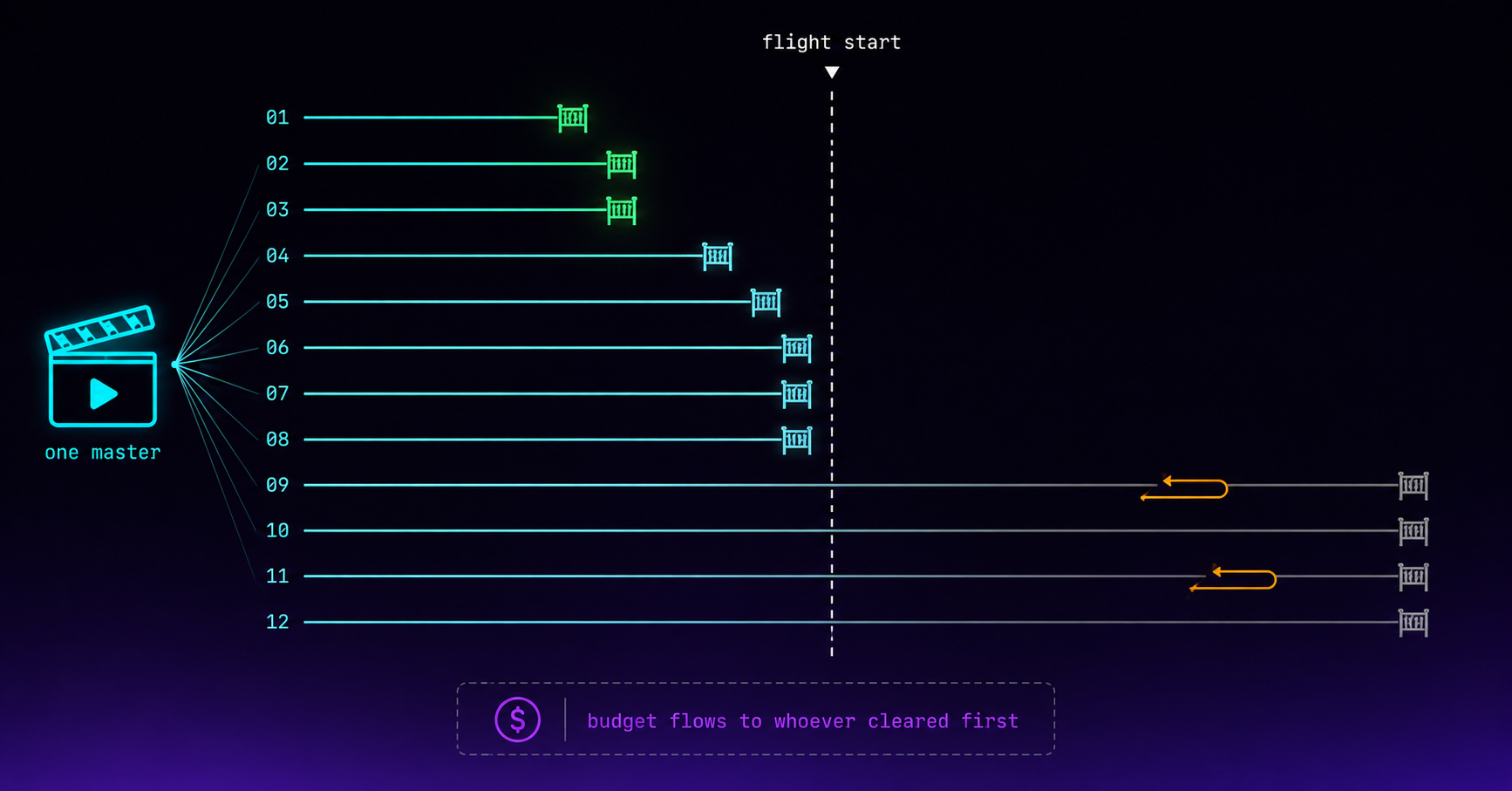
A planner builds a CTV campaign across twelve publishers, selected for audience composition, content adjacency, and price. That plan is a set of deliberate decisions made against real data.
Then the creative enters trafficking, and the plan gets rewritten by something nobody chose.
By the time the flight starts, seven publishers are live and five are still in review. Budget flows to available inventory, so it flows to whichever publishers cleared fastest. Not the ones with the best audience fit. The ones with the most permissive specifications and the shortest queues.
Industry reporting puts a typical CTV launch at three to six weeks from brief to first impression, and a full creative iteration cycle at six to eight weeks, driven substantially by platform quality control turnaround. This guide traces where that time actually goes, what it costs beyond the delay, and what can be compressed.
Follow one spot through the pipeline
The failure is not in any individual step. Every step has a defensible reason. It is in the accumulation, which is why nobody owns the problem.
Day zero: the master arrives
A finished thirty-second spot. Broadcast quality, correct duration, professionally produced.
Most people assume the work is done here. It starts here.
Days one to two: specification triage
Twelve publishers, twelve specification documents. They overlap substantially and they do not match.
Bitrate ladders differ. Container and codec preferences differ. Some require specific keyframe intervals for clean stitching. Duration tolerance varies, so a spot running 30.4 seconds passes with one publisher and fails another. Caption requirements differ, with some accepting burned-in captions and others requiring a sidecar file.
Then loudness. In the United States, the CALM Act requires commercials to be normalised against the surrounding programming, measured to the ATSC A/85 recommended practice. That is a legal requirement rather than a preference, and publishers enforce it because the liability sits with them. Different publishers apply different tolerance around the target.
None of this is unreasonable individually. Collectively, one master becomes several deliverables. The technical requirements themselves are covered in CTV creative best practices.
Days three to five: transcode and submit
Encoding variants are produced and submitted. Twelve submissions enter twelve queues, each with its own process and its own clock.
Day six: first responses
Three publishers approve. Two reject.
One rejection is loudness, measured slightly outside their tolerance. Re-encode, resubmit, rejoin the queue at the back rather than at the position it held.
The second rejection is a caption format the advertiser did not produce. Captions have to be authored, which is a different vendor with a different timeline.
Day nine: the manual queues
Four publishers use human review for brand safety and category compliance. Their stated turnaround is three to five business days and they are inside it.
Nothing has gone wrong. There is nothing to escalate. They are simply slower than the automated ones, and the campaign has no mechanism to account for that difference because it was never disclosed during planning.
Day eleven: the flight starts
Seven of twelve publishers are live. Five remain in review or resubmission.
The campaign begins delivering against the seven. By the time the remaining five clear, a meaningful share of the flight has been spent, and the delivery mix bears little relationship to the plan that was approved.
What this actually costs, beyond the delay
Delay is the visible cost and it is the smallest one.
The media plan becomes advisory. Every audience decision made during planning is overridden by an operational variable that appeared nowhere on the plan. Nobody decided to weight budget toward the publishers with the loosest specifications. It happened, and it will happen the same way next quarter.
Creative testing becomes impractical. Testing two variants means running the whole process twice. Given a six to eight week iteration cycle, a test cannot inform a four-week flight. So most CTV campaigns run a single creative unchanged, and the industry concludes that CTV creative testing is difficult — when what is difficult is the trafficking around it.
The frequency problem gets worse. Running one creative for a full flight, in a channel where household frequency is high, is exactly the condition that produces fatigue. The trafficking overhead is quietly enforcing a creative strategy that runs against what the frequency data says you should do.
Smaller advertisers are excluded disproportionately. A large advertiser has an agency team absorbing this and producing variants in advance. A smaller one has a single spot and nobody to manage twelve queues. The overhead is roughly fixed per campaign, which makes it a rounding error on a large budget and prohibitive on a small one.
Responsive creative is impossible. Any campaign that needs to react to something — a result, a news event, a competitor's move — cannot, because response time is dominated by approval rather than by production.
The second flight is worse, not better
The intuition is that this is a one-time cost. Clear the specs once and subsequent campaigns run on that clearance.
That holds only if the creative never changes, which defeats the point of running television advertising over time.
A new spot restarts the cycle. So does a re-edit. So does a duration variant, because a fifteen-second cut of an approved thirty is a new asset requiring its own clearance. So does a seasonal version, a regional version, or a version with a different end card.
Which produces a distortion in how campaigns get built. The cost of creative variation is not the production cost, which advertisers understand and budget for. It is the trafficking cost, which is invisible during planning and arrives during execution.
The rational response to an invisible cost is to avoid triggering it, so campaigns default to fewer variants running longer. Duration strategy interacts with this directly, and the trade-offs are covered in creative best practices.
What agencies actually do about it
The workarounds are informative, because they tell you where the pain concentrates.
They front-load. Large agencies produce every variant they might need before the campaign starts, submit them simultaneously, and accept that some will never run. That converts a latency problem into a production cost problem, which is rational at scale and pure waste below it.
They maintain internal specification matrices. Publisher-by-publisher requirement tables, updated manually, because no canonical source exists. This is an institutional asset built entirely out of other people's inconsistency, and it is one of the less obvious reasons large agencies hold an advantage in CTV that has nothing to do with buying power.
They build relationships with individual ad ops teams to expedite queues. Which works, and is exactly the kind of informal mechanism that indicates a process problem rather than a capacity one.
None of these are available to a smaller buyer, which is why the exclusion effect described above is structural rather than incidental.
The arithmetic of what the delay costs
Approval latency is usually discussed as an operational annoyance. It is worth putting a number on it, because the number is larger than the annoyance suggests.
Take a four-week flight with a $400,000 budget across twelve publishers, planned to deliver evenly. Illustrative figures, chosen to show the mechanism.
Seven publishers clear by day eleven. Five clear by day eighteen.
In the seven days between, the campaign delivers against seven publishers rather than twelve. At even pacing, that period represents roughly a quarter of the flight, so approximately $100,000 is spent during a window when 42% of the planned supply is unavailable.
That $100,000 does not go unspent. It concentrates on the seven publishers that cleared, which means those seven receive substantially more delivery than planned, at higher frequency against a smaller pool of households.
Two things follow. Unique reach for the flight comes in below plan, because a quarter of the budget was confined to 58% of the intended supply. And frequency against the households reachable through those seven publishers runs above cap-adjacent levels for a week, which is exactly the over-exposure condition covered in the frequency capping guide.
Neither effect appears in the campaign report as a trafficking problem. Reach came in under plan, which reads as an audience availability issue. Frequency ran high on some publishers, which reads as a pacing issue. The actual cause was a caption format and a loudness measurement.
This is the reason the problem persists: its symptoms surface in metrics owned by a different team than the one that could fix it.
Why every step exists
It would be dishonest to present this as pure friction, so the reasons are worth stating properly.
Technical specifications exist because mismatched creative breaks stitching. A creative that does not conform to the stream's bitrate ladder or codec profile fails at the SSAI layer, and a failed stitch is worse than a slow approval — it produces slate in front of a viewer and an impression that was billed and never rendered. That failure mode is covered in fill rate versus rendered impressions.
Loudness normalisation is a legal obligation with real liability attached, and the liability sits with the publisher rather than the advertiser.
Manual brand safety review exists because publishers carry reputational risk for what appears inside their content, and a category concern that matters to them may not be visible in any metadata field. The publisher-side considerations are covered in the brand safety guide.
So the problem is not that any publisher is behaving unreasonably. It is that twelve reasonable processes, each optimised locally, compose into something no one would have designed deliberately.
What can actually be compressed
Four things, in rough order of how much time they recover.
Separate technical approval from editorial approval. These are different reviews, with different reviewers, different risk profiles, and wildly different achievable turnaround. Merging them into one queue means a spot waits behind human brand safety review for a bitrate check a machine completes in seconds. Splitting them lets the automatable half clear immediately, and it is the single largest available saving.
Validate against specifications before submission, not after rejection. Most rejections are technical rather than editorial, and most technical rejections are detectable locally. Running a conformance check against each publisher's requirements before submitting removes an entire rejection-and-resubmission cycle, which is typically the largest single block of lost time. You can validate a VAST response directly with the VAST validator and inspect wrapper structure with the VAST inspector.
Produce variants in advance for the specifications you know differ. If loudness tolerance and caption format account for most of your rejections historically, produce those variants at the same time as the master. The marginal encoding cost is trivial against a week of queue time.
Ask for stated turnaround during planning. Simply knowing that four publishers on your list run five-day manual review changes the plan, because you can either start them earlier or weight the launch expectation accordingly. Right now approval latency is invisible when the plan is built and decisive when it executes, which is the worst possible combination.
The publisher's side of the same problem
Publishers generally experience approval as a cost centre and a source of advertiser complaints. It is also a revenue variable, and framing it that way changes the investment case.
A slow queue costs you delivery, not just goodwill. If your review takes five days and a competitor's takes one, a campaign launching in both places delivers against them for four days before it reaches you. On a four-week flight that is a meaningful share of the budget you were allocated, and you never see it because the impressions simply never arrived.
Rejection rates are a diagnosable metric. Most publishers do not track what share of submitted creative is rejected, or why. If a single specification accounts for a large share of your rejections, that is either a spec worth relaxing or a requirement worth documenting more prominently. Either fix is cheap; not knowing which applies is the expensive part.
Publishing turnaround is a competitive move. Stating a number, and hitting it, differentiates you during planning in a market where nobody discloses this. Planners route around uncertainty, and an undisclosed queue is uncertainty.
Automating the technical half is mostly a solved problem. Bitrate, codec, duration, and loudness conformance are all machine-checkable. A publisher who validates those automatically and reserves human review for genuine editorial questions can cut stated turnaround substantially without accepting any additional brand safety risk. What that risk actually consists of is covered in the brand safety guide, and publisher-side controls in publisher tools.
What would fix it structurally
The compressions above are what an individual buyer can do. The structural fixes require more than one party.
Specification convergence. VAST 4.2 separates the ad from its creative delivery in a way that supports more consistent handling, and adoption remains uneven. The gap now is less about the standard than about publishers applying it consistently. The standard itself is covered in the VAST 4.2 guide.
Pre-certification. A creative certified once against a common technical baseline, with that certification honoured across publishers who accept the baseline. Other regulated formats handle the same problem this way. It requires publishers to trust a shared certifier, which is a commercial question rather than a technical one.
Published queue times. If turnaround were disclosed as a number alongside specifications, planners could account for it. This costs publishers nothing and would materially improve how campaigns are built.
The industry treats creative operations as a downstream administrative function, staffed and discussed accordingly. It is the actual constraint on campaign flexibility in CTV. Targeting sophistication has raced ahead while the ability to get a creative in front of that targeting has barely moved.
A pre-submission checklist that removes most rejections
Most rejections are technical rather than editorial, and most technical rejections are detectable before submission. Running this list costs an hour and removes the resubmission cycle that dominates lost time.
Measure loudness against the target, not by ear. Confirm integrated loudness sits inside the tightest tolerance across your publisher set rather than the loosest. If one publisher requires a narrower window, encode to that and every other publisher passes automatically.
Check duration against the strictest tolerance. A spot intended as thirty seconds that measures 30.4 will fail somewhere. Trim to the nominal duration rather than relying on tolerance.
Verify the codec profile and bitrate ladder against each publisher's stated requirement, not against a generic broadcast spec. This is the most common source of stitching failures and the easiest to check locally.
Confirm caption format per publisher. Burned-in and sidecar are not interchangeable, and producing the wrong one means engaging a captioning vendor mid-flight.
Test the VAST response end to end. Wrapper depth, tracking event presence, and creative URL resolution are all verifiable before anyone reviews anything. Excessive wrapper depth is a rendering risk as much as an approval one.
Produce the known variants upfront. If your rejection history shows loudness and caption format account for most failures, encode those variants alongside the master. Marginal cost is trivial; a week of queue time is not.
Submit to the slowest queues first. Obvious once stated and rarely done. If four publishers run five-day manual review, they should receive the creative on day one, not after the automated ones have cleared.
That last point is the highest-return habit change available, because it costs nothing and directly compresses the critical path. Campaign sequencing considerations are covered in the campaign planning guide.
Frequently asked questions
How long does CTV creative approval actually take?
Industry reporting puts a typical CTV launch at three to six weeks from brief to first impression, including RFP, contract, trafficking handoff, and approval cycles. Approval alone varies widely by publisher: automated technical checks can clear in hours, while manual brand safety review commonly runs three to five business days. A campaign across twelve publishers is governed by the slowest of them, not the average.
Why did my creative pass with one publisher and fail with another?
Because specifications genuinely differ. Bitrate ladders, codec profiles, keyframe intervals, duration tolerance, caption format, and loudness tolerance all vary between publishers. A spot running 30.4 seconds or measuring slightly outside one publisher's loudness window will pass elsewhere and fail there. Validating against each publisher's specification before submitting avoids most of this.
Does a fifteen-second cut of an approved thirty need separate approval?
Yes, in essentially all cases. It is a new asset with its own encoding, its own loudness measurement, and its own file. Approval attaches to the asset rather than to the campaign or the advertiser, which is why creative variation carries a trafficking cost that most planning ignores.
Can I launch a CTV campaign faster than three weeks?
Yes, and it depends heavily on the buying route. Self-serve platforms with automated technical validation and a narrower publisher set can go from setup to live considerably faster, sometimes the same day. The three-to-six-week figure reflects a multi-publisher managed buy with contract negotiation and manual review in the path. Fewer publishers and automated validation compress it substantially.
Why does approval latency change which publishers deliver my budget?
Because budget flows to available inventory. If seven publishers are live at flight start and five are still in review, the campaign delivers against those seven until the others clear. Pacing does not wait. The result is a delivery mix weighted toward publishers with permissive specifications and short queues, which is unrelated to audience quality and was never a planning decision.
Should I reduce my publisher count to launch faster?
Sometimes, and it is a real trade rather than an obvious win. Fewer publishers means fewer specifications, fewer queues, and a critical path governed by fewer slow reviewers, which genuinely compresses launch. It also concentrates delivery on a narrower supply set, which reduces unique reach and raises frequency against a smaller household pool.
The better version of the same instinct is to stage rather than cut. Launch with the publishers that clear quickly, and add the slower ones as they approve, with pacing configured so the early publishers do not absorb the entire budget before the rest arrive. That preserves the planned supply mix while removing the delay, and it requires only that someone sets flight-level pacing deliberately rather than leaving it to spend evenly across whatever is live.
Who should own creative operations, the agency or the platform?
In practice it falls between them, which is most of the problem. The agency owns the creative and the relationship. The platform owns the technical validation and the connection to publishers. Neither owns the end-to-end timeline, so nobody is accountable for the eleven days.
The practical fix is to make one party responsible for a stated date and give them visibility into every queue. That is an organisational decision rather than a technical one, and it is the reason the problem survives improvements to the underlying tooling.
Is this getting better or worse?
Mixed. Wider VAST 4.2 adoption and better automated validation are genuinely reducing technical rejection rates. Working against that, the number of CTV supply sources continues to grow, so the count of distinct specifications a campaign must satisfy is rising. Net, the per-publisher friction is falling while the number of publishers is climbing.
Validate before you submit, not after you are rejected
LtvAdx separates automated technical validation from editorial review, so conformance checks clear in seconds rather than waiting behind a manual queue.