The vocabulary of streaming advertising has a specificity problem. OTT, CTV, AVOD, SVOD, FAST, MVPD, vMVPD — these terms circulate in agency briefs, publisher rate cards, and DSP configuration menus simultaneously, and they are not synonyms. Conflating them produces real planning errors: campaigns trafficked to the wrong delivery path, reporting that combines incompatible impression types, and deals structured for inventory that does not match what the buyer actually wants to reach. This guide defines each term with precision, explains how they relate to one another structurally, and maps them to the ad serving and monetization workflows that practitioners need to understand. Whether you are configuring supply on the LtvAdx publisher platform or allocating budget across streaming channels as an advertiser, the taxonomy here provides the shared language for accurate decisions.
OTT: the delivery layer, not the business model
Over-the-top (OTT) describes a delivery method: video content transported over the public internet rather than through a managed cable, satellite, or broadcast signal. The "over the top" phrasing refers to going over the top of traditional distribution infrastructure — bypassing cable operators, satellite uplinks, and broadcast towers. OTT is fundamentally a delivery architecture, not a content type, a monetization model, or a device category. Netflix, YouTube, a live sports stream on an app, and a free ad-supported FAST channel are all OTT because they all use internet delivery.
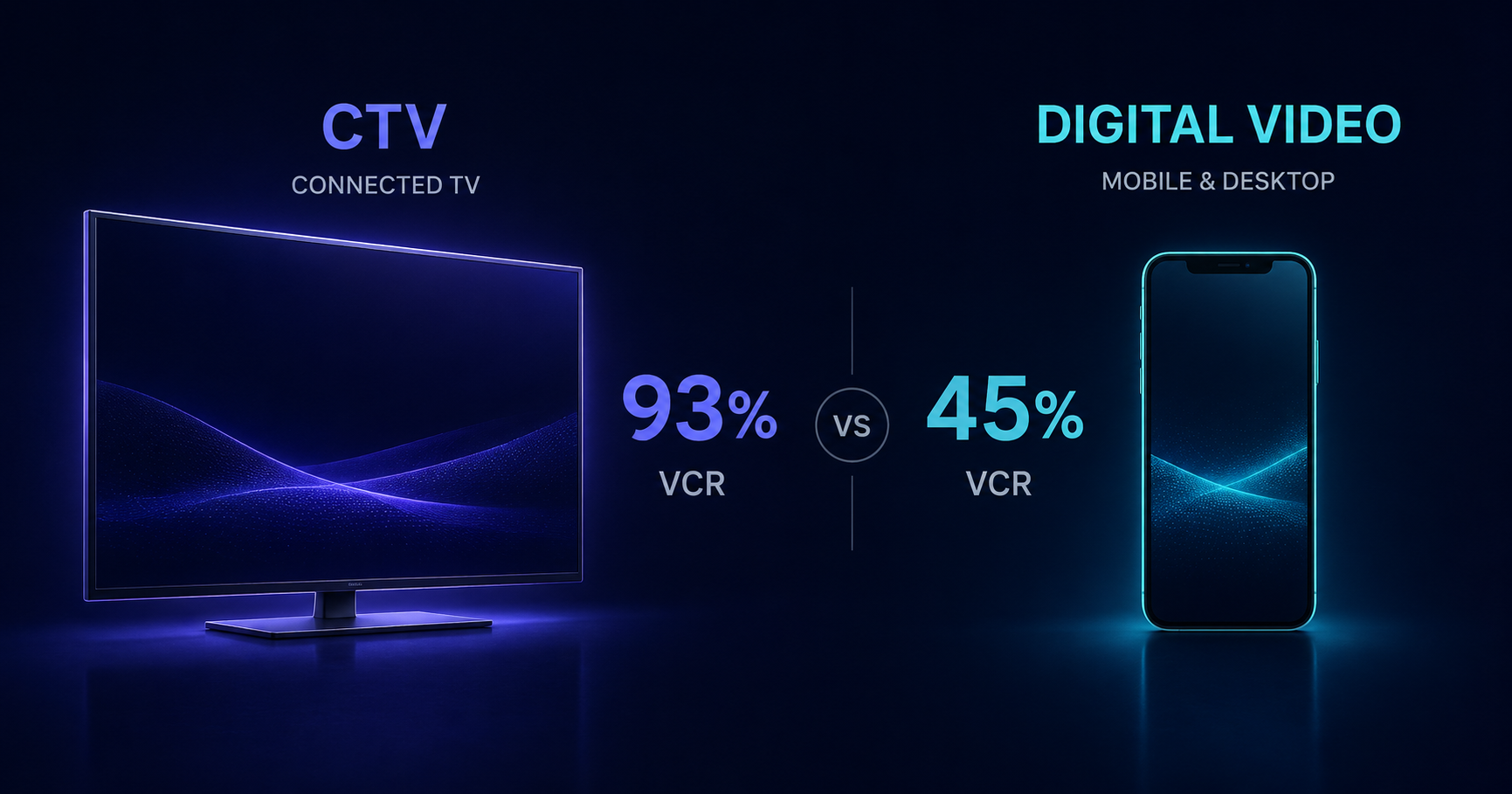
The practical significance of OTT as a category is that it encompasses all internet-delivered video: on phones, tablets, laptops, desktop browsers, and television screens. This breadth is exactly why OTT is an imprecise targeting label in media planning. When a campaign is described as running "on OTT," that description includes mobile pre-roll, desktop video advertising, in-app video on tablets, and living room streaming — four very different viewership environments with different completion rates, CPMs, and brand experience characteristics. Precise campaign planning requires decomposing OTT into its component sub-categories.
Ad serving in the OTT universe spans every device type and delivery context. The LtvAdx ad server operates across the OTT spectrum but is optimized for the television-screen segments where VAST, SSAI, and household-level targeting carry the most value. Understanding which segment of OTT you are actually buying or monetizing is the prerequisite for configuring the right delivery mechanism.
CTV: the screen matters
Connected TV (CTV) is the subset of OTT delivery that reaches a television screen. Specifically: any internet-connected television device — smart TV operating systems (Samsung Tizen, LG webOS, Vizio SmartCast, Roku OS), streaming media players (Roku sticks, Amazon Fire TV sticks, Apple TV, NVIDIA Shield), gaming consoles (PlayStation, Xbox), and Blu-ray players with streaming apps. The defining characteristic of CTV is not the content or the business model — it is the television screen in the living room.
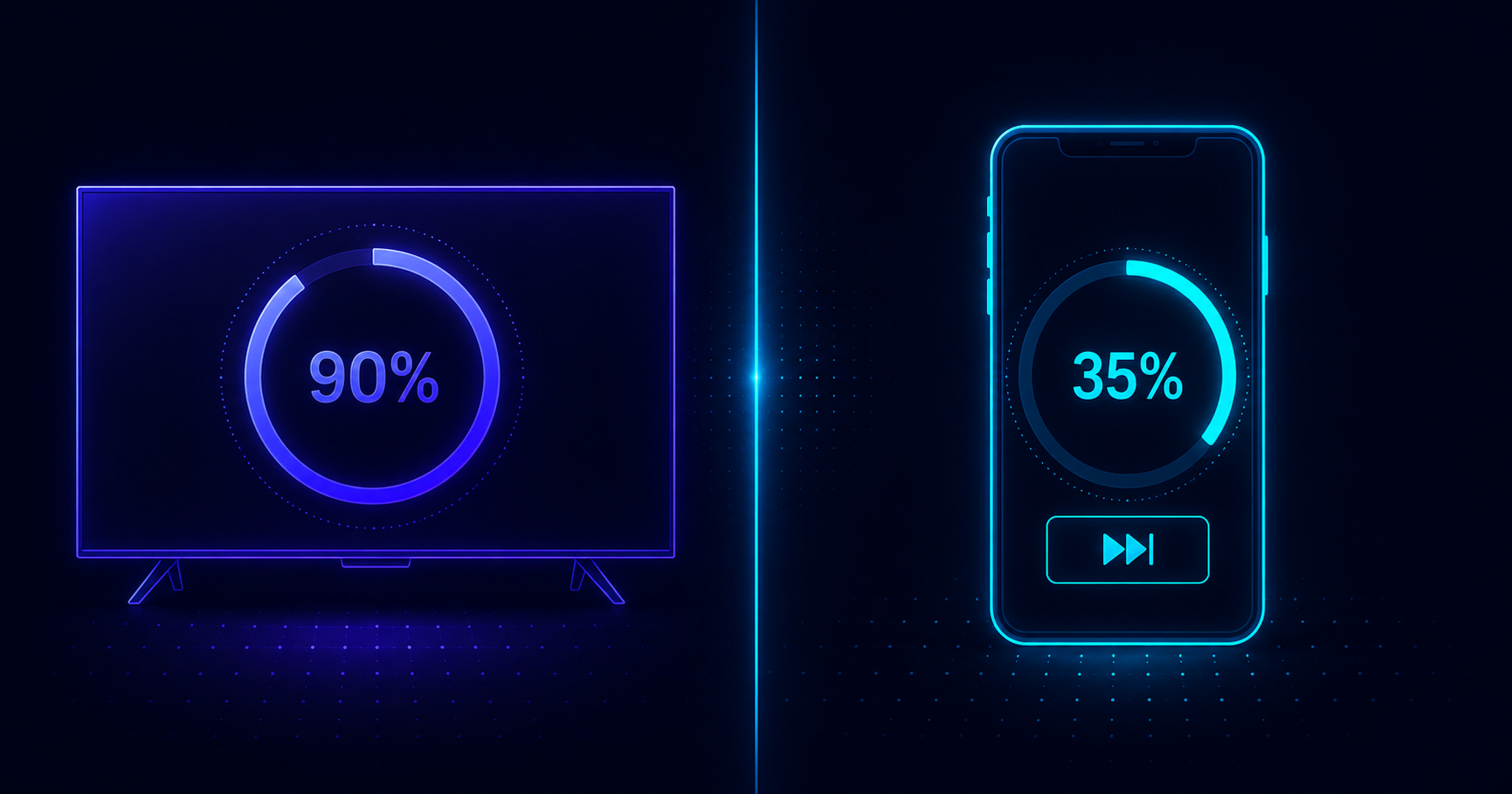
This screen distinction matters enormously for advertisers. CTV ads are full-screen, non-skippable video on the largest display in the household, typically in a lean-back viewing environment shared by multiple household members. These characteristics produce the video completion rates above 90% that make CTV attractive for brand campaigns. They also require distinct creative specifications — broadcast-grade resolution, professional audio levels, text legible at viewing distance — that a mobile-optimized digital video asset does not meet without reformatting.
From a supply perspective, CTV inventory is served through SSAI or client-side VAST, with SSAI dominant in premium environments because it prevents ad blockers and delivers seamless playback. The LtvAdx SSAI engine stitches ads into HLS and DASH manifests for CTV apps running on Roku, Fire TV, Apple TV, and smart TV platforms. CTV is the television-screen subset of OTT, and it is the highest-CPM, highest-completion segment of the streaming advertising market.
AVOD: the monetization model
Ad-Supported Video on Demand (AVOD) is a business model, not a device category or delivery method. An AVOD service offers on-demand video content free to the viewer, monetized through advertising rather than subscription fees. Tubi, Pluto TV (on-demand catalog), Peacock (ad-supported tier), Paramount+ Essential, and the ad-supported tier of Amazon Prime Video are all AVOD services. The viewer pays nothing; the advertiser pays CPMs; the platform keeps the revenue minus content licensing costs.
AVOD is frequently confused with FAST because both are free and ad-supported. The structural difference is the viewing experience: AVOD is on-demand (the viewer picks a specific title, episode, or clip), while FAST is linear (the channel schedules programming and the viewer tunes in). AVOD monetization is per-impression at the episode level; FAST monetization is per-impression at the break level in a scheduled programming flow. The ad serving mechanics overlap — both primarily use VAST and SSAI — but the break structure, pod length configuration, and demand packaging differ in ways that matter for publishers and advertisers.
AVOD represents a significant share of CTV viewing time and advertising revenue. The proliferation of AVOD tiers on major streaming platforms — driven by subscriber acquisition cost pressure and advertising revenue diversification — has made AVOD CPMs competitive with premium FAST and addressable linear inventory. Publishers operating AVOD catalogs on the LtvAdx platform use the same ad server and identity infrastructure as FAST operators, with configuration differences at the break and pod level.
SVOD and the hybrid model
Subscription Video on Demand (SVOD) is the pure subscription model: the viewer pays a monthly fee for ad-free or ad-light access. Netflix (standard plan), Disney+ (premium), HBO Max (ad-free tier) — these are SVOD in the classical sense. No advertising is sold against SVOD inventory in the pure model, which puts it outside the programmatic advertising universe.
The reality in 2026 is that SVOD has largely given way to hybrid models. Netflix launched an ad-supported tier; Disney+ offers both; Amazon operates subscription and AVOD simultaneously. These hybrid services are SVOD at the subscription layer and AVOD at the advertising layer. For media buyers, the practical distinction is that ad inventory on hybrid platforms can carry premium audience signals — subscribers who have authenticated with payment information represent a known, motivated audience segment — at AVOD-tier CPMs that are often below what comparable FAST inventory commands. The programmatic guaranteed deal structures that work for FAST are equally applicable to hybrid SVOD/AVOD platforms.
FAST: the linear resurgence
Free Ad-Supported Streaming Television (FAST) is linear television delivered over the internet. A FAST channel has a scheduled programming lineup — like a traditional cable channel — that viewers tune into and watch in real time. They cannot pause, rewind to the beginning, or skip ahead. Pluto TV channels, Tubi live TV channels, Peacock channels, Amazon Freevee channels, and the thousands of FAST channels available on Roku and Samsung TV Plus are all examples. The programming may be original content, acquired library content organized thematically, or live news and sports.
FAST has grown dramatically because it solves a specific content consumption pattern: viewers who want a TV-like experience — lean back, let it play, do not think too hard about what to watch — can access FAST channels without a subscription. For advertisers, FAST provides television-like reach and context at CPMs that are often below premium SVOD/AVOD inventory while delivering strong completion rates. The LtvAdx FAST channel platform is purpose-built for this model, with SCTE-35 live break detection, pod-level competitive separation, and direct-IO deal packaging alongside programmatic demand.
FAST monetization strategy is covered in depth in the FAST channel monetization playbook, and the yield optimization mechanics — waterfall architecture, floor pricing by daypart, identity enrichment — are explored in FAST channel yield optimization. For the purposes of terminology, the key distinction is: FAST is linear OTT, AVOD is on-demand OTT, and CTV is the screen on which both are primarily viewed.
MVPD and vMVPD: the operator layer
A Multichannel Video Programming Distributor (MVPD) is a traditional cable, satellite, or fiber TV operator: Comcast Xfinity, Charter Spectrum, DirecTV, Cox, Dish Network. MVPDs distribute bundled linear channel packages to subscribers and have historically controlled the addressable advertising opportunity on those channels — the ability to deliver different ads to different households watching the same linear programming. Addressable TV advertising through MVPDs was the first form of household-targeted television advertising, predating streaming by more than a decade.
A virtual MVPD (vMVPD) is the same linear channel bundle delivered over the internet rather than through a physical cable plant: YouTube TV, Hulu Live TV, FuboTV, Sling TV. vMVPDs carry the same network programming as traditional cable but with OTT delivery, which gives them digital-grade impression tracking and programmatic ad capabilities that traditional cable infrastructure cannot match. The addressable linear TV guide covers how MVPD and vMVPD inventory works in the programmatic context and how LtvAdx operator solutions connect these distribution channels to the programmatic demand that FAST and CTV publishers already access.
The significance of MVPD and vMVPD for advertisers is reach: these platforms carry live sports, news, and primetime network programming that remains largely inaccessible through pure streaming. For campaigns requiring live event adjacency or network brand association, MVPD addressable and vMVPD programmatic are essential complements to FAST and AVOD in the media mix.
dDTC streaming and the direct publisher
Direct-to-consumer (DTC) streaming services are platforms that distribute content directly from a single content owner: ESPN+, Paramount+, Peacock, Apple TV+, HBO Max, Disney+. These are distinguished from aggregator platforms (Pluto TV, Tubi) that license content from multiple sources. DTC platforms typically carry premium, brand-safe environments — network-quality programming with smaller, more valuable ad loads — and command the highest CPMs in the streaming advertising market.
The advertising opportunity on DTC streaming platforms is primarily captured through direct deals, upfront commitments, and private marketplace arrangements. Open auction programmatic is a smaller share of DTC ad revenue than on FAST or AVOD aggregators. For agencies and brands targeting DTC streaming, the relevant buying mechanism is the programmatic guaranteed deal or direct IO — not open auction. The upfront vs programmatic framework applies directly to DTC streaming budget allocation.
The relationship between terms: a practical mapping
The correct relationship between these terms is hierarchical, not synonymous. OTT is the broadest category: all internet-delivered video regardless of device or model. CTV is a subset of OTT defined by the television screen device. AVOD and FAST are monetization models that describe how content is funded — both can be delivered as CTV (on a television) or as OTT on non-television devices. SVOD is a non-advertising monetization model that exists primarily in contrast to AVOD. FAST is a further sub-model of AVOD distinguished by linear scheduling. MVPD and vMVPD are distribution channels that carry linear programming, with MVPD on traditional cable infrastructure and vMVPD on OTT delivery.
A single impression served to a household watching Pluto TV's Western channel on a Roku device is simultaneously: OTT (internet delivery), CTV (television screen), AVOD (free, ad-supported), and FAST (linear scheduled programming). Understanding which label applies in which context prevents confusion: the buyer cares that it is CTV and FAST for targeting and CPM reasons; the publisher cares that it is AVOD and FAST for monetization model reasons; the technology layer cares that it is OTT for delivery configuration reasons.
Why the terminology matters for ad operations
The terminology confusion in streaming advertising is not merely semantic — it produces measurable operational errors. Campaigns configured to target "OTT" without specifying CTV include mobile video impressions that carry different CPMs, creative requirements, and completion rate benchmarks. Reporting that aggregates AVOD VOD impressions with FAST linear impressions blends completion rates across fundamentally different viewing contexts and makes optimization impossible. Attribution and measurement setups that treat all OTT impressions as CTV overcount television-screen viewership and produce inflated household reach figures.
The LtvAdx reporting system segments delivery by device type (CTV, mobile, tablet, desktop), by content type (VOD, linear/FAST, live), and by monetization model so that operational decisions are made with the correct reference frame. Configuring inventory classification accurately at publisher onboarding — using the content and device taxonomy in the publisher portal — is what ensures downstream reporting reflects reality rather than lumping everything into a single "streaming" bucket.
ACR and automatic content recognition
Automatic Content Recognition (ACR) is a technology layer embedded in smart TV operating systems that recognizes what is being displayed on the screen by fingerprinting audio or video frames against a reference database. ACR data is used for two primary advertising purposes: audience targeting (identifying households that have watched specific programming or competitor advertising) and linear TV attribution (identifying households exposed to linear TV advertising for cross-channel retargeting or measurement purposes).
ACR is relevant to the OTT/CTV terminology framework because it extends the addressability of television advertising beyond the OTT delivery infrastructure itself. A household watching live sports on a cable subscription — traditional linear TV, not OTT — can still be identified as sports-interested through ACR data on their smart TV and targeted with CTV ads on that same device or on other connected devices through the HouseholdID graph. ACR bridges the measurement gap between linear and streaming by providing the household-level content exposure data that pure programmatic delivery logs cannot.
The overlap between ACR-based targeting and household identity resolution is one of the most powerful targeting capabilities in advanced TV advertising. Understanding ACR as a data layer — distinct from the delivery infrastructure acronyms — completes the vocabulary picture for advanced TV practitioners.
Applying the terminology to campaign planning
The practical application of this terminology framework is a planning matrix. For any video advertising campaign, the relevant axis labels are: device (CTV, mobile, desktop, tablet), content type (FAST linear, AVOD VOD, live event, SVOD ad tier), and transaction model (open auction, PMP, programmatic guaranteed, direct IO, upfront). Mapping each planned buy to its correct position on this matrix — rather than labeling everything "streaming" or "OTT" — produces accurate CPM forecasts, correct creative specifications, appropriate measurement methodologies, and valid cross-channel reach de-duplication.
The linear TV vs CTV comparison and the CTV vs digital video guide both apply this framework to specific budget allocation decisions. For a complete overview of the CTV advertising ecosystem and where LtvAdx fits within it, the CTV advertising overview provides the commercial context. Publishers and advertisers new to the platform should start with the getting started documentation or request a platform walkthrough.